


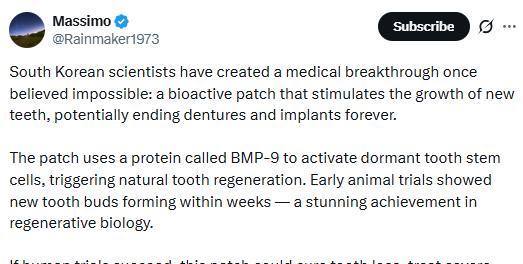

Article on this is below, but it’s not what you think…
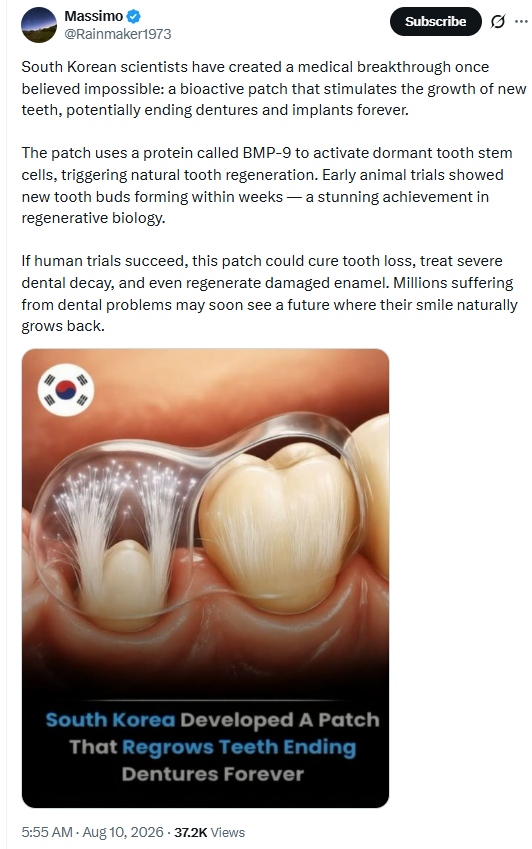
A recent post circulating on X claimed South Korean scientists had developed a BMP-9 bioactive patch that activates dormant tooth stem cells, produces new tooth buds in animal trials within weeks, and could eventually end dentures and implants. Fact-checks and the scientific record show no such published breakthrough, no clinical trials matching that description, and no peer-reviewed evidence of a patch that grows complete new teeth. Korean researchers are doing useful work on BMP9 for peri-implant bone regeneration, periodontal tissue repair, and mapping the positional signals that decide whether cells form a tooth versus supporting bone and gum. That research matters. It is not the miracle patch being shared.
The most advanced effort is Japanese.
Unlocking a Third Set of Teeth
Humans normally form two sets of teeth. Evidence indicates residual or dormant tooth buds exist for a potential third dentition. A protein called USAG-1 (also known as SOSTDC1) acts as a brake, suppressing the BMP signaling pathway that would allow those buds to develop.
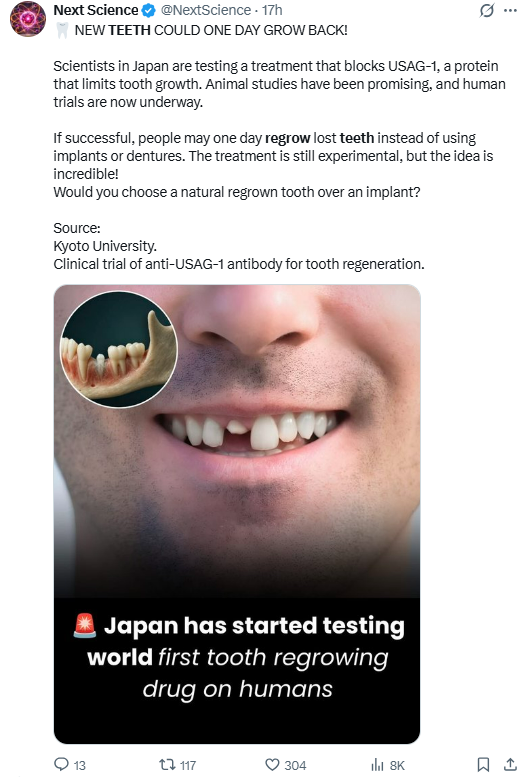
Researchers led by Katsu Takahashi (Kitano Hospital in Osaka, with ties to Kyoto University) developed a neutralizing monoclonal antibody that blocks USAG-1. In animal models—mice, ferrets, and beagles with congenital tooth agenesis—the antibody triggered formation of new teeth that developed enamel, dentin, and living pulp. A single administration was sufficient in key experiments.
Toregem BioPharma, the Kyoto University spinout founded in 2020 to commercialize this work, has moved the antibody (TRG-035 / TRG035) into human testing. Phase I, a safety and dose-escalation study, began in September/October 2024 at Kyoto University Hospital. It enrolled 30 men aged roughly 30–64 who were each missing at least one molar. The primary goal was safety, not regrowth. Reports indicate the trial completed without serious adverse events. The drug has received orphan-drug designation in Japan for severe congenital tooth agenesis.
In May 2026 Toregem raised approximately $5.3 million (¥850 million) in a pre-Series C round, bringing total funding (including grants) above $29 million. The capital supports Phase II trials focused on patients with severe congenital hypodontia/oligodontia—people born missing six or more permanent teeth. Children in the 2–7 age range are the priority group for efficacy testing because their jaws and residual dental lamina are still in a developmental window. The stated target for availability is around 2030, first for the congenital indication. Broader use for teeth lost to decay, trauma, or aging would require additional evidence and later trials.
Parallel Tracks
Other groups are pursuing complementary approaches:
- Bioengineered whole teeth and organoids. Teams at Tufts (Pamela Yelick) have grown tooth-like structures with human and pig cells on scaffolds in minipigs. King’s College London (Ana Angelova Volponi) has produced hybrid human-mouse tooth structures with developing roots from adult gum cells combined with tooth-forming cells. University of Washington researchers have advanced ameloblast (enamel-forming) maturation pathways.
- Enamel and dentin repair. A 2026 University of Nottingham gel mimics the proteins that guide natural enamel formation, drawing minerals from saliva to rebuild damaged enamel. Separate work targets dentin regeneration and self-filling of early lesions.
- Supporting biology. Korean researchers at Yonsei University mapped lingual versus buccal dental mesenchymal cells and the WNT/BMP signals that decide tooth versus bone/gum fate—foundational knowledge for any future stem-cell or tissue-engineering strategy.
None of these is ready for routine clinical use. Fully functional, erupted, load-bearing teeth that integrate with bone and soft tissue, last decades, and work in adult human jaws remain a high bar.
Realistic Timeline and Limits
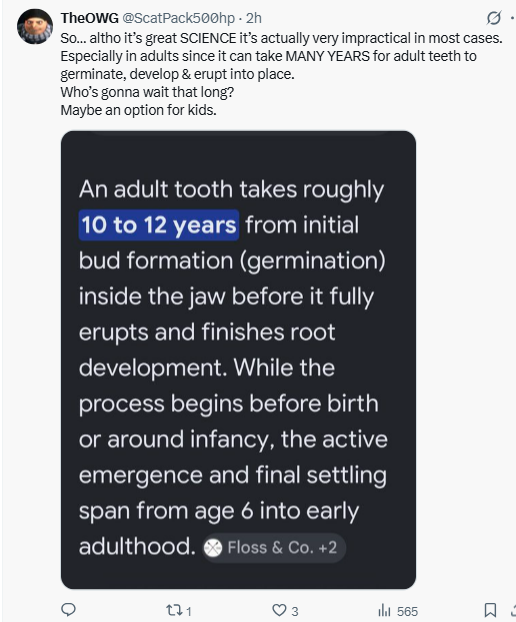
Phase I safety clearance is necessary but not sufficient. Phase II must demonstrate actual tooth induction, proper morphology, eruption or clinical utility, and durability in the target population. Even if successful, initial approval will almost certainly be limited to severe congenital cases. Adult acquired tooth loss involves different biology—scar tissue, missing residual buds in some sites, age-related changes in the jaw, and the practical problem of waiting years for a new tooth to form and erupt. Cost, delivery method (currently intravenous), long-term safety of modulating a developmental pathway, and regulatory hurdles in the U.S. and elsewhere are open questions.
Dentures and implants will remain the standard for the foreseeable future. Implants work well for many people but are expensive, can fail, lack the sensory feedback of a natural tooth, and do not fully restore the biological system. A true biological replacement would be transformative for nutrition, speech, jaw health, and the systemic links between oral and overall health. That is why the Japanese program and the supporting basic science deserve attention without the viral exaggeration.
The science is moving. The hype about an imminent Korean patch that ends tooth loss is not. Watch the Phase II data from Toregem and the parallel organoid and enamel work. Those results, not social media claims, will tell us how close we actually are.
— Whatfinger News Team: Sgt L and Lisa
References
- Scientists are regrowing human teeth – BBC Future
- Scientists activate dormant tooth buds to regrow human teeth | Raleigh News & Observer
- New drug may unlock the body’s ability to grow new teeth – Earth.com
- Humans May Be Able to Grow New Teeth Within Just 4 Years – Popular Mechanics
- Tooth regrowth is no longer science fiction | How close are we in 2026? – Dental News
- Japan Completes First Human Trial of Tooth-Regrowth Drug Blocking USAG-1 Protein
- Toregem BioPharma raises funding for Phase II of TRG035
- No, this South Korean patch does not regrow teeth – France 24 / fact-check
- Scientists in Korea find cells that know when, where, and how to grow teeth | British Dental Journal
- Goodbye, cavities? New gel could regrow tooth enamel | ScienceDaily / University of Nottingham
- Stem cell study uncovers molecular pathway for enamel regeneration | News-Medical
- Bone Morphogenetic Protein (BMP) 9 Outperforms BMP2 in Osteogenesis and Osseointegration
Top Features and Vids across all Whatfinger sites right now
- Leftist Judges, Governors, and Mayors Keep Releasing Career Criminals to Rape, Burn, and Murder Americans — Time for Real Accountability
- 10 Must-See Tips on Longevity and Wellness – Megyn Kelly Vid
- James Comey’s “Good Job My Friend” Notes and the Long Trail of Treason Against Trump—and America
- Hilarious Botched Robbery Ends With Thief Losing Her Top
- 1,500 couples tie the knot during a mass wedding in Nigeria
- Joe Rogan: The Latest Developments in Age Reversal Research – Fast clip plus full show (MUST SEE FOLKS)
Get on over to Whatfinger.com – Whatfinger News does millions of pageviews a month for a reason…. Truth, Justice, the American way, plus news on the Left as well – all links from all sites gives you the true news. – CLICK HERE 🛑
Drudge Report Alternative