


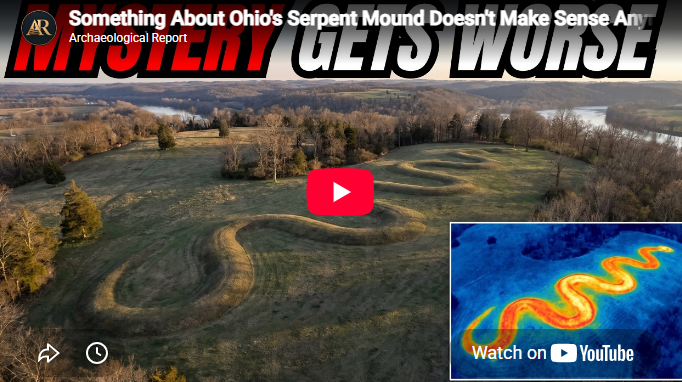

The world’s largest snake earthwork sits on a 300-million-year-old impact crater. A new YouTube video is driving the argument again. The dirt has two clocks. The builders left no graves.
A YouTube channel called Archaeological Report dropped a clip titled Something About Ohio’s Serpent Mound Doesn’t Make Sense Anymore. (see below) The same file is circulating on Rumble and X. The pitch is simple: the biggest serpent effigy on Earth is sitting on shattered bedrock, the 1880s rebuild erased the original outline, and two radiocarbon campaigns pulled the construction date 1,300 years apart. Enough to get anyone into ancient history interested. Especially Whatfinger readers that devour history.
The mystery is real. The packaging is doing what mystery packaging always does. Here is what the ground will support, what the video claims, and what the rest of the internet is stacking on top of both. Article continued below this video
The thing on the bluff
Serpent Mound runs along a narrow ridge above Ohio Brush Creek in Adams County, about 73 miles east of Cincinnati. Address: 3850 State Route 73, Peebles. Ohio History Connection runs the park. It is a National Historic Landmark.
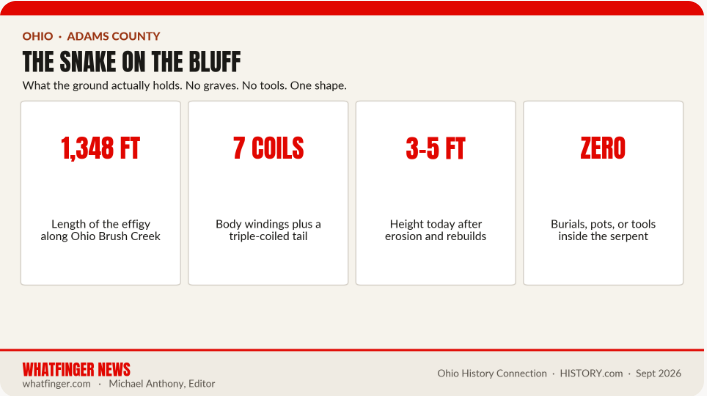
The commonly cited length is 1,348 feet. Height today is about three to five feet. Width runs 20 to 25 feet. The body winds through seven coils. The tail is a tight triple spiral. At the east end the jaws open around a hollow oval. Surveyors have called that oval an egg, an eye, a sun disk, even a frog. Squier and Davis, who published the first Smithsonian survey in 1848, wrote that the oval held “large stones, much burned.”
Two thousand years ago, someone carried a sheet of Appalachian mica more than 400 miles into Ohio, cut it into a human hand nearly a foot tall, then buried it inside a mound. pic.twitter.com/aBp860OjIk
— MoundLore (@MoundLore) September 25, 2026
There are no burials in the serpent. No pots. No tools. No hearths. Two centuries of digging, coring, and trench work have not produced a single object that pins the effigy to one culture by itself. Nearby, yes: two Adena burial mounds and one Fort Ancient burial mound sit in the same park. The snake itself is empty.
From the ground it looks like a low grass ridge. The full animal only reads from the air or from the 1908 steel observation tower. That tower was closed in 2022 as unsafe. Restoration started in late 2025. Ohio History Connection has promised a 2026 reopening announcement.
Graphic — what the ground holds
The star wound is real
The video leans hard on the geology, and the geology is not folklore.
The ridge sits inside the Serpent Mound crater, also called the Serpent Mound Disturbance. Geologists spent a century arguing whether the smashed, folded Paleozoic rock was a meteor strike or a gas blowout from below. In 1998 a team published shock-metamorphism evidence from a 903-meter core in the central uplift: planar deformation features in quartz, altered impact-melt clasts, and a weak siderophile bump including iridium. That is the standard fingerprint of a hypervelocity impact.
Serpent Mound in Ohio aligns with the landscape, featuring an elliptical shape—like a comet’s orbit. It also sits near water, a common trait of sacred sites. Coincidence or intentional design? pic.twitter.com/KSJ6uh8A3p
— Randall Carlson (@randallwcarlson) March 12, 2025
The structure is a complex crater. Published rim estimates run from about 8 kilometers to as much as 14. Age estimates put the strike younger than 320 million years, commonly cited around 250 to 300 million years. The National Park Service listed the cryptoexplosive structure as a National Natural Landmark in 1980.
Did the builders know they were standing on a cosmic scar? Probably not in the modern sense. Three hundred million years of rain had already softened the bowl. They would have seen jumbled rock, sinkholes, and a strange ridge. Whether that is why they put a quarter-mile snake there is an open question. Geologists and archaeologists both say there is no proven causal link. The overlap is still the part that sticks.
Putnam saved it and changed it
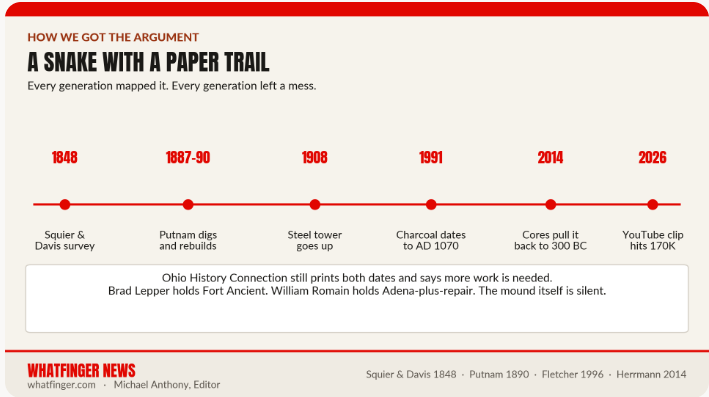
Harvard’s Frederic Ward Putnam got to the site in the mid-1880s and found farmers plowing the coils down. He raised money, bought the farm in Harvard’s name, dug for three seasons, then piled dirt back onto the serpent by hand. In 1900 the land passed to what is now the Ohio History Connection.
Putnam’s rescue is why the mound is still there. It is also why nobody can swear the outline you walk today is the outline Squier and Davis mapped in 1846.
The 1848 plates show small dark appendages behind the jaws — later writers call them horns. Early notes mention neck projections and a wishbone-shaped rise that are gone. Ground-penetrating radar in recent years has hinted at a body loop that looks erased. Charles Willoughby, writing in 1919, said Putnam restored projections at the base of the head that later flattened again. Putnam did not leave a modern excavation grid. He heaped local soil onto a plow-damaged earthwork and called it restored.
The video treats that rebuild as the original sin of the site. Fair enough as history. It does not prove the snake was something else.
Graphic — the paper trail
Two clocks
This is the fight the academics have not settled.
For most of the 20th century, archaeologists handed Serpent Mound to the Adena culture, roughly 800 B.C. to A.D. 100, because Adena burial mounds sit a short walk away. Circumstantial. Putnam himself thought an earlier people built the effigy and a later people used the ridge.
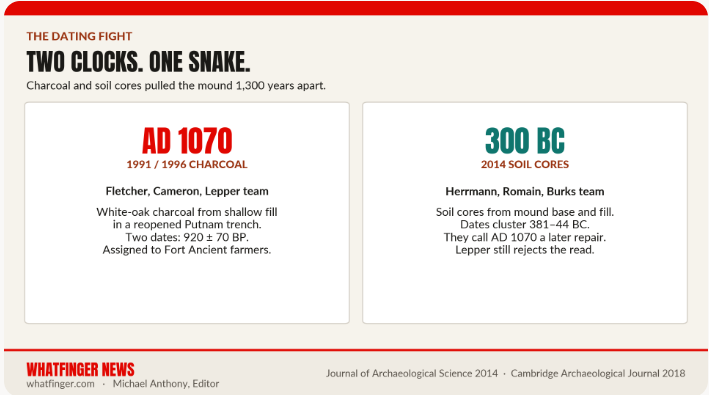
In 1991 a team that included Robert Fletcher, Terry Cameron, DeeAnne Wymer, and Ohio History Connection curator Brad Lepper reopened one of Putnam’s old trenches. They pulled white-oak charcoal from shallow fill, 35 to 45 centimeters down. Two AMS dates came back identical: 920 ± 70 BP, calibrated around A.D. 1070. That is Fort Ancient country — maize farmers who did build other Ohio effigies, including Alligator Mound, and who put serpents on their art.
Ohio has so much more to offer than people think.
The Serpent Mound is fascinating. pic.twitter.com/SLd8mxu63E— J∅kër Kîng 👑 (@j0ker937) April 30, 2025
Then 2014. Edward Herrmann, William Romain, Jarrod Burks and colleagues published a Journal of Archaeological Science paper on soil cores. Dates from the base and the fill clustered around 300 B.C., with a modeled window of 381 to 44 B.C. Their read: Adena built it about 2,300 years ago. Fort Ancient people repaired the eroded coils 1,400 years later. The 1991 charcoal, they said, was a renovation layer, not the first construction.
Lepper did not roll over. In Cambridge Archaeological Journal and later Ohio Archaeology papers he argued the 2014 samples were soil humates from bulk sediment, not clean charcoal in a cut profile, and that humate dates on mounds can run centuries or millennia too old. He still says Fort Ancient is the better cultural fit: Adena is not known for large animal effigies. Fort Ancient is.
Ohio History Connection’s own site page prints both campaigns and then says the quiet part: “More work is needed to clarify the age of Serpent Mound.”
That sentence is the official position. Everything else is a camp.
Graphic — the two dates
What the video claims
Archaeological Report’s script tracks the published record closer than most YouTube mystery hours. It also stacks the uncertainties until they sound like a single indictment.
The channel says the bedrock is a “star wound,” that the snake is more than 1,300 feet, coiled seven times, and that two centuries of excavation produced no datable objects from inside the effigy. Accurate.
It says Putnam rebuilt the mound by hand without recording his cuts, and that features on the 1848 maps no longer exist. Accurate as far as the paper trail goes.
It says the 1991 dates put the work near the 1054 supernova and the 1066 appearance of Halley’s Comet, and that some researchers floated a celestial motive. That is a real hypothesis in the Fort Ancient camp. It is not proven. Plenty of earthworks get lined up to solstices after the fact.
It says Adena people were not effigy builders, so an Adena date makes the snake a loner. That is Lepper’s argument. Romain’s camp answers that serpent images exist in Adena and Hopewell art and that one masterpiece can sit outside the usual toolkit.
It says charcoal only brackets an age because soil mixes over time. Both sides use that sword.
It says the Shawnee, forced out of Ohio in the 1830s, co-led interpretation work in 2021 and speak as keepers, not as the original construction crew. That matches the joint 2021 Ohio History Connection essay by Shawnee Chief Ben Barnes and Brad Lepper. Barnes has said the serpent still lives in Shawnee clan tradition. He has not claimed his people stacked the dirt in 300 B.C. or A.D. 1100.
The video’s title does the rest. “Doesn’t make sense anymore”
What X is doing with it
On X the same week, the clip is being passed as proof of a cover-up, a stargate, and a forgotten race, sometimes in the same thread.
A history account reminded followers that 19th-century settlers invented a “lost race of Mound Builders” so they would not have to credit living tribes. Cyrus Thomas and the Smithsonian spent the 1890s killing that story. It keeps coming back in new clothes.
Indian Country Today put the short version on the record years ago and it still holds: no space aliens, no prehistoric giants. Ancestral Native people built it.
Account @MoundLore, which actually maps this landscape, posted the clean overlap: a 1,300-foot serpent laid on the rim of a 300-million-year-old impact structure, head aimed at summer solstice sunset, Fort Ancient date preferred. High-engagement, low-fantasy.
Then the other lane. A poster this weekend said Lyrans gifted the mound to the first humans as a tuning fork and that Ohio will never admit it. Another thread tied the crater to fallen angels using meteors as doorways and claimed an obelisk once stood in the egg. Crop circles, ley lines to Washington, dragon lore from the Great Lakes — all of it is in the current feed. None of that is in the cores.
Graphic — settled vs still fought
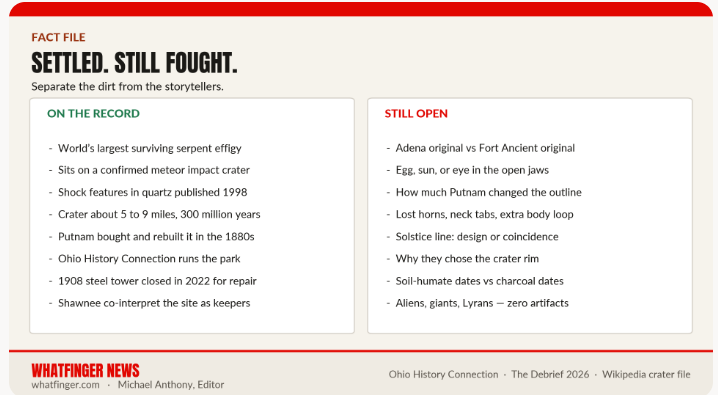
Alignments, and the limit of the dirt
The head of the serpent faces the summer solstice sunset. Some writers extend coil-to-sunrise lines for the winter solstice and the equinoxes. William Romain has published on the astronomy. Critics say a long, bent earthwork on a crooked ridge will point at something if you pick the right coil.
Same rule for Halley’s Comet and the Crab supernova. If you accept the A.D. 1070 charcoal as construction, the sky was busy. If you accept the 300 B.C. cores as construction, those later lights are a renovation story at best.
What the mound will not do is testify. Putnam mixed the fill. Trees grew through it. CCC crews and later parks staff patched it. Radiocarbon on mixed soil is a bracket, not a birth certificate.
What is actually known
Ancestral Native people of the Ohio Valley built the largest surviving serpent effigy on the planet. They put it on a ridge inside a confirmed meteor crater. They left no grave and no toolkit in the snake. Harvard’s Putnam saved the site from the plow and altered the surface while he did it. One dating program says Fort Ancient, around A.D. 1070. Another says Adena, around 300 B.C., with a Fort Ancient repair. The state historical society prints both and waits. The Shawnee treat the place as living tradition. The observation tower is in pieces until the welders finish.
The rest — horns, extra loops, star people, comet maps — is argument piled on a silent animal.
Ben would say the old builders already told you the only part that matters. They spent a season, or ten, packing clay into a snake you can only see from the sky. Then they walked off and let the grass take the rest. Such is the mystery.
– — The Whatfinger News Team: Sgt L and Sgt K with Ben, Grok on edits and graphics
Top Features and Vids across all Whatfinger sites
- Mysteries🛑
- NEW: Whatfinger Deals – Best Prices – Amazon, Walmart, Home Depot, Target on select items.
- COVID Lesbians LOSING IT Over No Masking Shows THE LFT IS INSANE | Tim Pool
- Dr. John Campbell… “We could be CURING your wife, your husband, your parents & your children.” of cancer….
- They had NO CHOICE but to sign the deal
- Lindsay Clancy INSANE TWIST On The View! These People Are NUTS!
- It’s Happening: Mass Layoffs At CNN, Lib Anchors RAGE Quit LIVE On-Air As Trump Donors to BUY Network
Weekly Features
Our Projects…
- FingerPlay is up: search a game, get the official trailer and player clips, score it with Fingers, and run the lists — Out Now through From the Past, plus RPGs, shooters, and each console.
- Whatfinger Hate Hoax File – You wanted the better research, here you go🛑
- The list — Survival Command: Grid-Down Survival & Weapons – save this link – it might save your life one day!
- The Great Whatfinger Link Directory
- Why Move to Texas or Other Red States from a Suffocating, Declining Blue State
- We Built the Movie And TV Page Rotten Tomatoes Is Afraid Of – And FREE! – Whatfinger News’ Flick
- Whatfinger’s Conservative News Sites Plus Guide
