



Boeing’s F-15EX Eagle II can haul up to 29,500 pounds of munitions or up to 12 air-to-air missiles. That is the number that jumped out of the National Security Journal piece. The jet is not stealthy in any way. Lockheed Martin’s F-35 is. The Air Force is buying both, and the case for keeping the Eagle line open is stronger than the sticker-price debate suggests.
The Eagle II is an evolution of the two-seat F-15 Strike Eagle, adapted from the Qatari F-15QA. It brings digital fly-by-wire, a modern glass cockpit, the APG-82 AESA radar, and the EPAWSS electronic warfare suite. Open Mission Systems architecture is meant to speed future upgrades. Conformal fuel tanks hold roughly 750 gallons each, sit close to the fuselage to cut drag, and carry their own weapon stations so the wings stay free. They extend range for long Pacific legs and standoff loads such as JASSM, though the tanks cannot be jettisoned and add weight.
🇺🇸 A new eagle in the game! Meet the F-15EX.
– Better engines, improved flight performance
– Up to x12 AIM-120D
– Up to x22 precision-guided bombs
– Anti-radiation and anti-ship missiles
– AESA radar
https://t.co/r3HJ8OKb0d https://t.co/pQdz5YJjEM— War Thunder (@WarThunder) November 6, 2026
First flight came in 2021. By late 2026 roughly 22 aircraft had been delivered, with about 120 under contract. The fiscal 2027 budget request lifted the program of record from 129 to 267 jets—the largest recent fighter-buy reversal. The service is retiring older F-15C/Ds and beginning to recapitalize worn F-15Es. Production in St. Louis hit delays from a long machinists’ strike, but the line is moving again and targeting higher monthly output.
Whatfinger News’ Military and War Aggregate – more military news daily from more sources than ANY other site on the net
Critics correctly note that the flyaway cost has climbed into the mid-to-high $90 million range depending on the lot, putting the non-stealth jet near recent F-35A prices once engines are included. Early talk of a cheap complement has faded. Early availability on the first small batch cleared the rapid-fielding threshold around 72 percent but remains short of the long-term 80 percent target. Those are real numbers.
Top 10 Fastest Fighter Jets in Active Operation (2026) ✈️
1. 🇷🇺 MiG-31 Foxhound — Mach 2.83
2. 🇺🇸 F-15EX Eagle II — Mach 2.5
3. 🇷🇺 Su-57 Felon — Mach 2.45
4. 🇷🇺 Su-27 Flanker — Mach 2.35
5. 🇷🇺 MiG-29 Fulcrum — Mach 2.3
6. 🇺🇸 F-22 Raptor — Mach 2.25
7. 🇷🇺 Su-35S Flanker-E — Mach 2.25
8. 🇨🇳 J-20 Mighty Dragon — Mach 2.0+
9. 🇪🇺 Eurofighter Typhoon — Mach 2.0
10. 🇸🇪 JAS 39 Gripen E — Mach 2.0Source: Manufacturer Specs (Boeing, Lockheed Martin, Sukhoi, Saab, Eurofighter) & GlobalSecurity
— Infodex (@infodexx) March 5, 2026
They do not end the argument. The Air Force needs fighter capacity now. The F-15C/D fleet is aging out under structural limits. The F-35 line cannot replace every retiring airframe while its own software and sustainment mature. A 20,000-hour airframe design life on the Eagle II versus an 8,000-hour design life on the F-35A means one Eagle can deliver roughly two and a half times the flying hours before major life-extension work. Cost per flight hour on the new jet runs well below the legacy F-15s it replaces. Squadrons already flying Eagles transition with existing infrastructure, simulators, and maintenance culture.
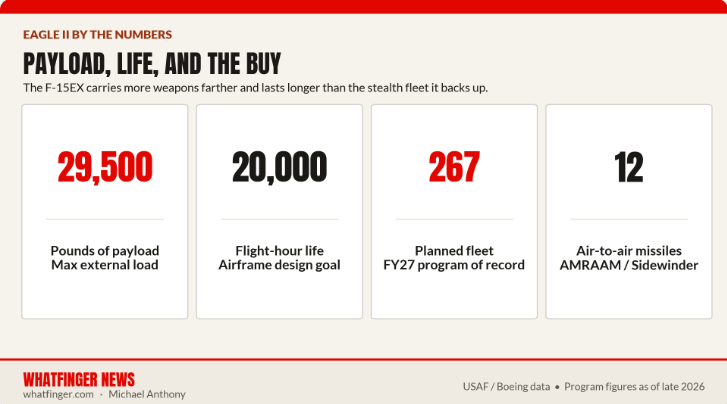
In the Pacific the reach and magazine depth matter. An F-15EX with conformal tanks and tanker support can stay on station longer, carry heavy standoff weapons, and still hold a dozen missiles for air-superiority work. It is the flying magazine that fills in behind the stealth screen. F-35s and F-22s open the door and fuse sensors. The Eagle hauls the volume once defenses are degraded, or when the mission is homeland defense, base protection, or long-range escort that does not require low observability on the first night.
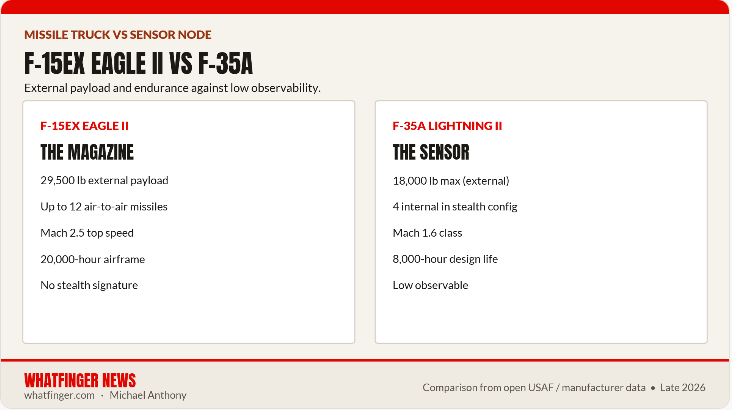
F-15EX versus F-35A on payload, missiles, speed, airframe life, and signature. The Eagle trades stealth for volume and endurance.
China is building numbers. A prolonged fight rewards the side that can generate sorties, reload, and keep shooting. The Eagle II keeps the St. Louis line and its suppliers alive at a time when the industrial base needs more than one fighter source. Foreign sales reinforce that base. The same budgets that fund the F-15EX expansion continue to pour money into the F-35, the B-21, and next-generation programs. This is not a retreat from stealth. It is a recognition that stealth alone does not solve capacity or magazine depth.
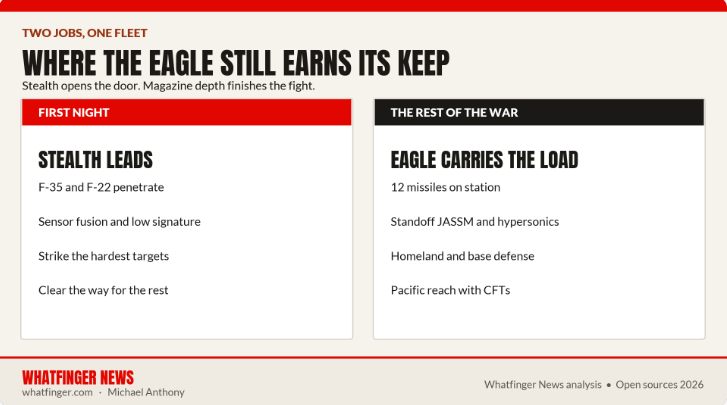
Stealth leads the first night. The Eagle carries the load for the rest of the fight—homeland defense, standoff, and Pacific reach.
Continue producing them. Buy the full planned fleet. Pair every stealth squadron with the high-capacity, long-life, high-speed complement that already exists and can be fielded faster than the next clean-sheet design. The F-15EX is not the answer to every problem. It is the answer to the volume and endurance problems the stealth fleet alone cannot solve. For more on the Pacific fight and the fighter fleet, see Whatfinger News military coverage at militarywar.whatfinger.com.
