


Sen. Rand Paul called it straight. Texas Gov.-elect Gina Hinojosa’s day-one plan to freeze electricity rates is “out of the Venezuelan socialist playbook.” He posted the warning on November 10: “Nothing like your first act being out of the Venezuelan socialist playbook… This will not end well.” He followed with the record. Venezuela set prices by decree on rice, chicken, soap, and toilet paper. Caps sat below costs. Producers quit. Shortages, smuggling, and bankruptcies followed. Electricity subsidies produced the same result: losses and underinvestment in the sector. “Texas are you prepared Venezuelan socialism?”
I vow to continue defending against the far-left’s radical agenda, the war of choice with Iran, and policies that will explode costs and expand big government.
I hope to see other Republicans join me.
@WillCainShow https://t.co/kEbEBh4Tk2— Senator Rand Paul (@SenRandPaul) November 10, 2026
Hinojosa, the Austin Democrat who unseated Greg Abbott on November 3, told the Texas Tribune she will act within an hour of taking the oath on January 19. She will declare a “high-cost emergency” and issue an executive order to freeze electricity rates and suspend the gas and diesel tax. On the campaign trail she promised to freeze residential rates and make corporations “pay their fair share.” Fox News reported the legal doubts immediately. The Texas Disaster Act lets a governor declare disasters and suspend statutes, but energy analyst Nick Loris of C3 Solutions told Fox there is high skepticism in courts and among policymakers that high prices qualify as a disaster. Affected suppliers would likely sue. Texas built a competitive market under 1999 Senate Bill 7. Most Texans buy power from competing retail providers. The law states that production and sale of electricity is not a monopoly. Prices are set by customer choice and competition, not by decree. Loris compared it to shopping for cereal: short contracts, long contracts, different fuels. A freeze forces suppliers to eat costs they cannot recover. Investment and maintenance stop. Reliability follows.
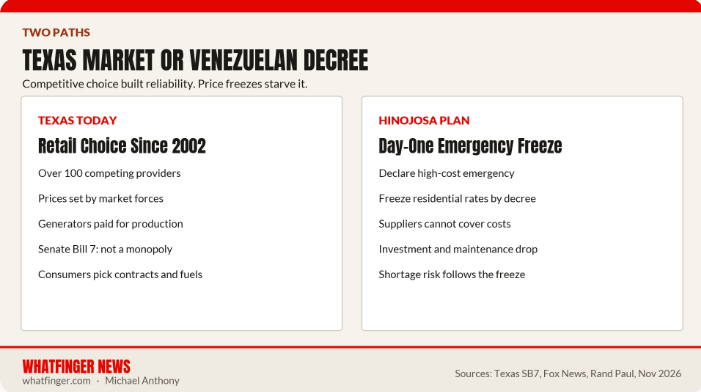
Texas built retail choice. Hinojosa wants a decree.
New Jersey already ran the experiment. Gov. Mikie Sherrill took office in January 2026 after promising a day-one emergency freeze on rate hikes. The order used existing funds to offset June increases and let the Board of Public Utilities pause or modify some utility actions. It did not freeze the full bill. Supply rates still reset. Delivery charges, taxes, and usage moved. Residents got one-time credits—$25 for most households, more for lower-income ones. Some bills still rose or stayed high. Reason reported that the freeze touched only part of the bill and left some ratepayers with higher bills than before. An E3 analysis for the state found most of a typical bill is set in federal and regional markets the governor cannot control. Sherrill later signed bills on data centers and utility incentives and claimed over $1 billion in annual savings. The underlying costs remained.
Nothing like your first act being out of the Venezuelan socialist playbook . . . This will not end well.
https://t.co/XrEnm2Vlcz
— Rand Paul (@RandPaul) November 10, 2026
The pattern is national. Abigail Spanberger in Virginia pushed a six-year freeze on base rates as a condition for a big utility merger. California lived the full version in 2000–2001. Retail price caps sat far below the wholesale prices utilities paid. PG&E went bankrupt. Rolling blackouts hit while the state forced generators to sell at controlled prices. Energy Secretary Chris Wright has noted electricity prices run almost 50 percent higher in states run by Democrats. Renewable portfolio standards, wildfire costs, and rate design all play roles, but the policy direction is consistent: more mandates, more subsidies, more political overrides of price signals.
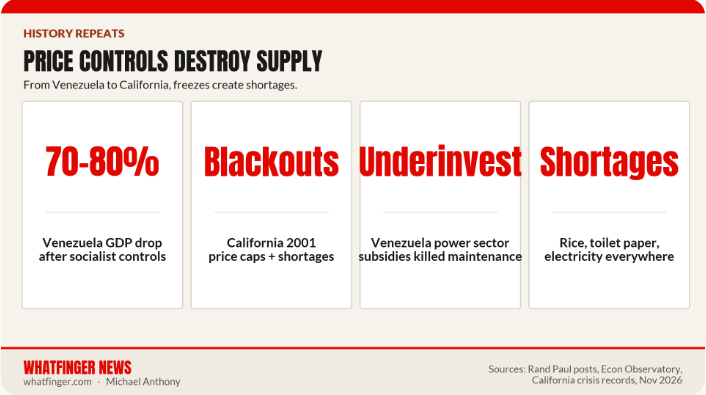
The record is not theoretical.
Price controls do not make power cheaper. They hide the cost until the lights go out. Generators and retailers need revenue to cover fuel, maintenance, transmission, and new capacity. Cap the price below cost and they cut spending. Plants stay offline longer. New plants do not get built. Demand keeps rising from data centers, heat pumps, and electric vehicles. The gap appears as brownouts or blackouts. Venezuela’s power sector showed the end state: chronic underinvestment and unreliable service. California showed the American version in real time. Texas’s competitive market has kept the lights on under stress that broke other grids. Hinojosa’s emergency order collides with that structure. State Rep. Brian Harrison has already urged Abbott to call a special session and limit emergency powers before she takes office. Republicans in the legislature can still box the move in.
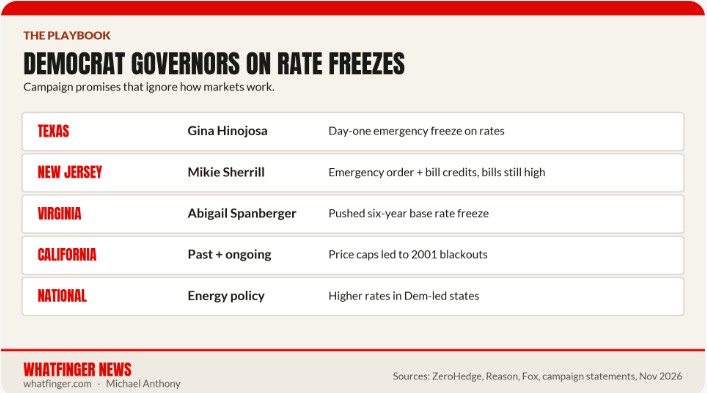
Same promise, different states.
Voters are angry about bills. Data centers add load. Transmission and distribution costs have risen. Democrats campaigned on affordability and won races in Texas, New Jersey, Virginia, and elsewhere. The remedy they offer is the one that has failed every time it has been tried: freeze the price and dare the market to keep producing. Rand Paul quoted the Economics Observatory record on Venezuela because the mechanism is identical. When the government sets the price below the cost of production, supply shrinks. Texas does not have to import that outcome. The competitive market already exists. Price signals already tell producers when to add capacity and when to hold back. Overriding them with an emergency decree does not lower the real cost of power. It postpones the bill until the grid cannot meet demand.
Whatfinger News has tracked the reliability risks from policy that treats electricity as a political good instead of a physical one. The same logic that emptied Venezuelan shelves is now aimed at American substations and generators. Paul is right. This will not end well. The Democrats are doing all they can to destroy the U.S. economy, and its people.
— The Whatfinger News Team: Luke and Lisa with Grok on edits and graphics
