



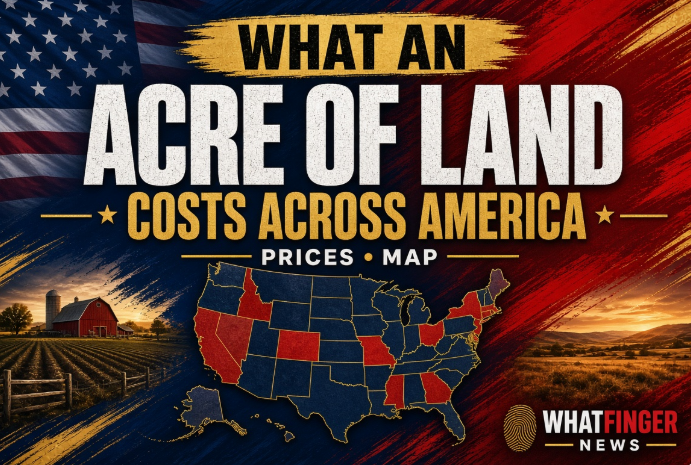
An Acre of American Dirt: $735 in New Mexico, $23,600 in Rhode Island — And the Counties That Split the Difference
USDA’s 2026 Land Values report puts the average acre of U.S. farm real estate (land plus buildings) at $4,500, up 3.4 percent from 2025. Cropland sits near $6,020 and pasture near $2,000. That national number is almost useless on its own. State averages run from $735 an acre in New Mexico to $23,600 in Rhode Island. County numbers swing even wider.
The cheapest ground is still in the arid West and northern Plains. The most expensive is concentrated in the small, dense Northeast states plus high-value specialty crop and metro-edge counties in California. A USDA-derived county cropland map for 2026 scales from roughly $900 to $52,100 an acre across more than 3,000 counties.
The Five Least Expensive Counties
USDA Census of Agriculture figures and recent listing data point to these as among the lowest:
- Big Horn County, Montana — about $649 an acre (2022 Census of Agriculture estimated market value of land and buildings). Eastern plains ranch country, remote, cold winters.
- Garfield County, Montana — roughly $672 an acre. Same region, sparse population, more rangeland than cropland.
- Luna County, New Mexico — listings frequently $200–$600 an acre; median active listings around $1,300–$2,000. High desert near Deming, off-grid and solar interest is common.
- Apache or Coconino County, Arizona — USDA pasture and farm real estate in the low hundreds to low thousands; raw desert parcels often under $1,000.
- Costilla County, Colorado (San Luis Valley) — recent social posts and listings have shown figures near $850 an acre for unimproved ground. Mountain views, limited services.
What an Acre of Land Costs, All Across America https://t.co/dwqwiXWSHr
— Vintage Maps (@vintagemapstore) November 10, 2026
New Mexico as a state leads the cheap list at $735 farm real estate and about $650 for pasture. Wyoming (~$1,030), Nevada (~$1,230), and Montana (~$1,260) follow. Buyers on X regularly flag these same counties for homesteaders and long-term holders, with the usual caveats: water rights, legal access, and distance to town matter more than the sticker price.
The Five Most Expensive Counties
At the other end:
- Santa Clara County, California — small-parcel medians have been reported near $1.75 million an acre; even larger tracts and farmland census values are far above most of the country. Silicon Valley pressure is the driver.
- Nantucket County, Massachusetts — residential and resort land routinely tops six figures per acre; the state’s overall farm real estate is already among the highest.
- Pitkin County, Colorado — Aspen-area land values are extreme; county medians for residential land have been cited in the hundreds of dollars per square foot.
- New York County (Manhattan) and Kings County (Brooklyn) — pure urban land values are in a different league entirely, often hundreds of dollars per square foot.
- Counties in Rhode Island and northern New Jersey — Rhode Island’s statewide farm real estate average is $23,600; dense Northeast counties with development pressure and limited private open land push individual parcels higher still.
Rhode Island, New Jersey ($17,000), Massachusetts ($15,200), and Connecticut ($14,600) top the state farm real estate list. California’s statewide average is $14,100, but the Bay Area and coastal specialty-crop counties (Napa vineyards routinely $300,000-plus) create the real outliers.
Why the Spread Exists
The cheap counties are mostly arid rangeland or remote plains with low population, limited water, and little development pressure. The expensive ones face tight private land supply, high population density, development competition, and (in the Northeast) regulatory and tax environments that raise the cost of holding or improving ground. One Illinois farmer recently told an X user that local farmland was trading near $22,000 an acre; solar lease offers of $1,200–$1,800 per acre per year are also circulating in farm country and changing the math for some owners.
USDA numbers measure agricultural land and buildings reported by operators. Actual sale prices for a specific parcel depend on road access, water, utilities, zoning, and whether anyone actually wants to live or farm there. A $500-an-acre desert tract with no legal access and no water is not the same product as $15,000-an-acre ground 45 minutes from a city.
Whatfinger News has covered the basic national picture on dedicatedissues.com. The county extremes are what matter if you are actually shopping or holding. For readers thinking about land as a long-term hedge or homestead, the western and plains counties still offer the lowest entry points — provided you price in the real carrying costs.
— The Whatfinger News Team: James Orsell and Alex, with Grok on edits and graphics
