

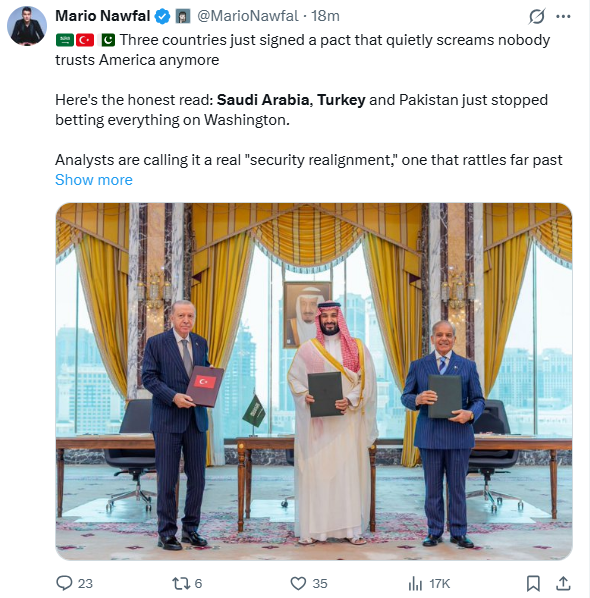
In Mecca on Friday, the leaders of three of the Muslim world’s most consequential powers put ink on a document that should make every capital from Tehran to Washington sit up a little straighter. Saudi Crown Prince Mohammed bin Salman, Turkish President Recep Tayyip Erdoğan, and Pakistani Prime Minister Shehbaz Sharif signed the Mecca Joint Defense Agreement. The core line is straightforward and deliberately echoes older, heavier alliances: an armed attack on any one of them will be treated as an attack on all three.
Call it collective deterrence, call it Islamic solidarity with better logistics, or call it what it looks like on paper—an Article 5-style commitment without the full NATO bureaucracy. The three governments say the pact is purely defensive, not aimed at any particular country, open to other regional states, and does not cancel existing arrangements. That last bit matters more than the polite language suggests.
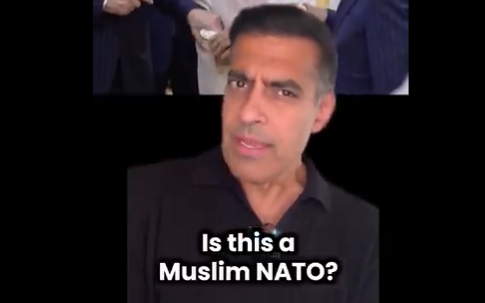
Turkey, Saudi, Pakistan: Attack on one nation deemed an attack on all – France 24 Vid
Why This One Has Bite
Saudi Arabia and Pakistan already had a bilateral mutual-defense understanding from last year. Adding Turkey changes the weight class. Turkey fields NATO’s second-largest military, produces some of the most combat-proven drones on the market, and sits inside the North Atlantic alliance with all the interoperability, intelligence-sharing culture, and hard-power credibility that comes with it. When a NATO member signs a mutual-defense clause with two non-NATO partners, the deterrent signal is no longer just regional rhetoric.
Pakistan brings the only nuclear arsenal in the Muslim world and a large, battle-hardened conventional force. Saudi Arabia brings the money, the holy sites’ symbolic gravity, and the oil infrastructure that the entire global economy still depends on. Turkey supplies the modern military-industrial edge and the NATO pedigree. Put together, the triangle is more than the sum of its parts.
The timing is not subtle. Since the United States and Israel launched major strikes on Iran in late February, Iranian forces and their proxies have repeatedly targeted Saudi critical infrastructure and disrupted shipping through the Strait of Hormuz and the Red Sea. Riyadh has spent years trying to diversify its security partnerships precisely because American guarantees have looked less automatic under the current White House. This pact is Saudi Arabia’s public answer: we will not wait forever for someone else’s cavalry.
Saudi Arabia, Turkey and Pakistan just signed a new defense agreement centered on a collective defense pledge—meaning an attack on one would be treated as an attack on all. While it falls short of NATO’s integrated military structure, analysts say it could mark the beginning of a… pic.twitter.com/xPjfJoYhCq
— CBS News (@CBSNews) August 7, 2026
The NATO Angle Nobody Wants to Spell Out Loud
Turkey remains a full NATO member. Officials in Ankara insist the Mecca agreement is complementary, not competitive. They are technically correct. Nothing in the North Atlantic Treaty forbids members from signing other defensive arrangements, and Turkey has done so before. But the practical questions write themselves. If Iran or a proxy hits a Saudi oil facility hard enough to trigger the new pact, does Turkey’s response create awkward conversations in Brussels? If Turkey itself becomes involved in a wider regional fight under this new commitment, how cleanly does Article 5 still apply?
Turkish officials have been careful to stress the defensive character of the deal and the fact that it does not supersede NATO obligations. That is the right public line. Quietly, however, the arrangement gives Ankara more strategic flexibility at a moment when many allies are hedging their bets. It also gives Saudi Arabia and Pakistan a partner whose military is already plugged into Western systems, doctrine, and supply chains.
What It Is Not
This is not a fully operational “Islamic NATO.” There is no integrated command structure, no standing joint force, and the exact triggers and required responses remain unpublished. Analysts across the spectrum note that the language is stronger on paper than the institutions behind it currently are. Still, language matters. When three serious powers declare that an attack on one is an attack on all, potential aggressors have to recalculate.
For Iran, the message is clear: keep poking the Gulf and you may find yourself facing a more coordinated response that includes a NATO member’s military and a nuclear-armed state. For Israel and the United States, the pact is another data point that Sunni powers are no longer content to outsource their security entirely. For India, which watches Pakistan closely, the deal is something New Delhi is already “closely following.”
The Middle East has spent years watching American reliability fluctuate while Iranian missiles and drones grew more frequent. Three capitals just decided they would rather write some of their own insurance policy. Turkey’s NATO membership is what turns that policy from a polite memorandum into something with actual deterrence value. Whether the teeth get used is the next question. For now, they are visible.
One caution. The Turks under their current leadership, wish to expand south toward Israel. Their leader has openly called for Israel’s destruction. What this means for the future is uncertain, but one thing remains clear. It is now only a matter of time before Turkey becomes yet another nuclear power. They can never move against Israel without nukes. Not that they would use them.
— The Whatfinger News Team: Leads: Sgt Pat, Sgt K
References
- Saudi Arabia, Turkey and Pakistan Sign Joint Defense Pact
- Saudi Arabia, Turkey, Pakistan pledge mutual defence as Middle East turmoil escalates
- Saudi Arabia, Turkey and Pakistan sign defence agreement
- Turkiye, Saudi Arabia, Pakistan sign joint defence agreement: What’s in it?
- Turkey, Saudi, Pakistan: Attack on one nation deemed an attack on all • FRANCE 24 English
- Pakistan, Türkiye, Saudi Arabia sign key defense pact, any attack on one seen as attack on all
- Saudi Arabia, Turkey, Pakistan seal joint defense agreement
- ‘Attack On One Is Attack On All’: Saudi Arabia, Turkey, Pakistan Sign Landmark Makkah Joint Defence Agreement

Top Features and Vids across all Whatfinger sites right now
- Sad Truth Behind Perez Hilton’s Horrifying Livestream Finally Comes Out
- Airlines Caught Spying on Grieving Families: Ticket Prices Double for Funerals Under Creepy ‘Surveillance Pricing’ Scam
- Scientists Issue WARNING After Spotting 20 UFOS On The Moon – Tim Pool
- Cartel Animals Execute Beauty Influencer Live on TikTok Because She Dumped the Boss’s Son (Distressing Vid included)
- Weed Now Beats Cigarettes as America’s Daily Habit — Alcohol Still Rules the Roost, But the Culture Is Getting Higher
Get on over to Whatfinger.com – Whatfinger News does millions of pageviews a month for a reason…. Truth, Justice, the American way, plus news on the Left as well – all links from all sites gives you the true news. – CLICK HERE 🛑
Drudge Report Alternative

