


South Korea passed a ban on the dog meat trade in January 2024. The law takes full effect February 7, 2027. It makes raising, breeding, slaughtering, distributing, or selling dogs for food illegal, with prison time and fines up to 30 million won. The three-year phase-out included payouts to farmers who closed early. As of late September 2026, 1,339 of 1,537 registered farms had shut down—87 percent, ahead of the government’s target. The number of dogs on those farms dropped from roughly 468,000 reported in August 2024 to about 7,600.
DW News framed the countdown as a question of winners and losers: vendors who lose their livelihoods, and the dogs left behind. Most of those dogs were sold or slaughtered during the wind-down. Rescue numbers stayed tiny. Animal groups pulled some from the last large farms; the overwhelming majority did not get adopted. Older Koreans still associated dog meat with summer stamina and digestion. Younger ones, and the public at large, largely moved on. A 2023 Nielsen survey found 86 percent said they were unlikely to eat it going forward, and support for a ban was already solid before the vote. Then-First Lady Kim Keon Hee pushed publicly against the trade. Pet ownership had already risen, and the old markets were shrinking.
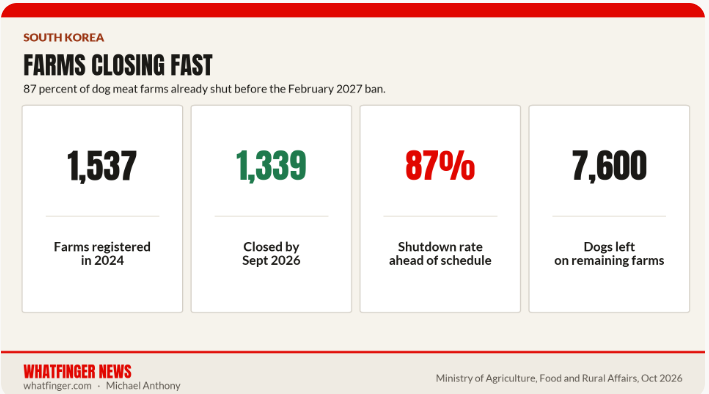
The farms are closing faster than planned. The remaining dogs and the last restaurants are the unfinished part.
Other places in Asia had already drawn the line. Taiwan banned sale earlier and made consumption illegal in 2017, with fines and the possibility of jail. Hong Kong has blocked slaughter and sale of dog meat since 1950. Thailand outlawed the trade and consumption in 2014. The Philippines banned commercial slaughter in 1998, with narrow exceptions for certain indigenous rituals. Singapore bans sale. Parts of India treat it as illegal nationally, though the trade still operates in some northeastern pockets. Shenzhen and Zhuhai in mainland China banned it in 2020. The United States closed the commercial loophole in the 2018 Farm Bill. Enforcement varies. Smuggling and black-market sales still turn up in several of those places.
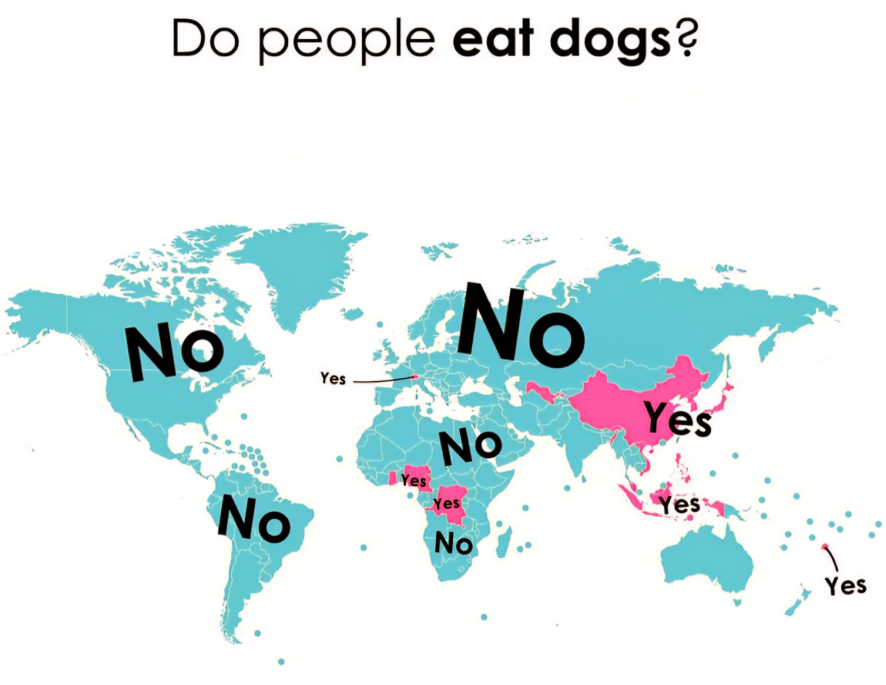
This is what the dog meat market looks like in Africa.
Up to 300,000 dogs are slaughtered for meat every year on the continent.
The trade represents one of the most disastrous problems for both animal welfare and public safety, with one study finding that over 2% of the dogs used may be rabid.
Writer: Mhedi
https://t.co/9QCtqtWH89
— Mario Nawfal (@MarioNawfal) August 2, 2026
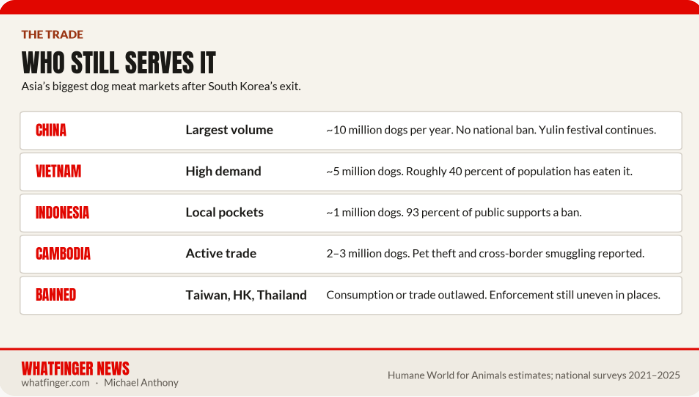
The larger volume never stopped. Humane World for Animals estimates roughly 30 million dogs killed for meat each year across Asia. China accounts for the biggest share, around 10 million. Vietnam runs near 5 million, with surveys showing nearly 40 percent of the population has eaten it at some point, higher in the north. Indonesia is around 1 million; a 2021 poll there found 93 percent support a national ban and fewer than 6 percent have ever tried it. Cambodia runs 2–3 million. North Korea still has state-set pricing for it. The Yulin festival in Guangxi continues to draw international attention every year even though most residents in the area say they rarely or never eat dog or cat meat. China’s Ministry of Agriculture removed dogs from the livestock catalog in 2020, but there is still no national ban.
X posts on the topic track the same split. Animal groups and rescue accounts mark South Korea’s phase-out as the industry collapsing and the last farms emptying. Other posts still circulate petitions against Yulin and the trade in Cambodia, Vietnam, and Indonesia. Some users note that older Koreans treated it as medicine or summer food while younger ones rejected it. A few treat the South Korean ban as overdue; others point out that China and Vietnam still run the larger volume with no equivalent national cutoff. One recurring line is that the practice was never majority daily food in any of these countries—it was regional, seasonal, or tied to older generations—but the numbers of animals involved stayed large where the trade stayed legal and organized.
The vendors who took the early payouts in South Korea already exited. The ones still holding dogs or running the last restaurants face the February deadline and the winter inspections the agriculture ministry has scheduled. Future dogs born for the trade will not be. In the places that never passed a national ban, the same cages, markets, and summer stews continue. The difference is the law, the public numbers, and whether anyone is still counting the farms that remain open.
— The Whatfinger News Team: Luke and Ben, with Grok on edits and graphics