



Iran’s Islamic Revolutionary Guard Corps hauled a dead American Anduril Dive-LD out of the water near the Strait of Hormuz in September 2026. The 19-foot autonomous vehicle had been surveying for U.S. operations after Tehran laid mines in the chokepoint. It sat dead for more than a day before Iranian forces recovered it. CENTCOM called it an older model with no classified sensors. Anduril called it attritable—built to be risked where losing a crew is unacceptable. Iran still has the hardware.
That capture is one data point in a wider shift. Nations from China to Ukraine are fielding uncrewed underwater vehicles that map seabeds, hunt mines, lay them, and in at least one case claim a kill on a submarine in port. The systems remove the crew from the most dangerous undersea work. They also create new ways to threaten ports, cables, and shipping without putting sailors in the water.
The Numbers That Matter
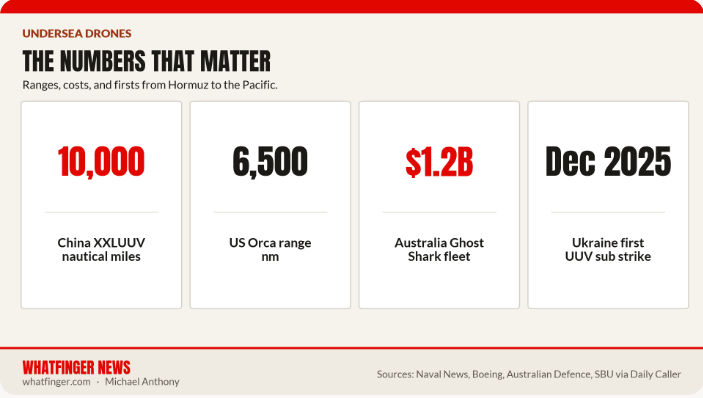
China’s extra-extra-large uncrewed underwater vehicles are estimated near 10,000 nautical miles of range. The U.S. Boeing Orca is listed at 6,500. Australia is spending roughly $1.2 billion on Ghost Shark. Ukraine claims the first underwater-drone strike on a submarine in December 2025. Sources: Naval News, Boeing, Australian Defence, SBU via Daily Caller.
China Is Building for Reach
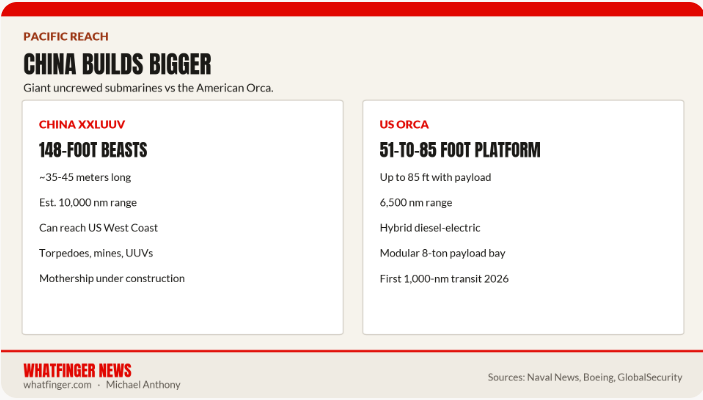
Open-source analysis, including work by H.I. Sutton for Naval News, puts China’s largest experimental vehicles in the 35-to-45-meter class—roughly 115 to 148 feet. That is the size of a small crewed diesel submarine. Estimates give them roughly 10,000 nautical miles of combined surfaced and submerged range, enough on paper to reach the U.S. West Coast, Seattle, Oakland, Los Angeles, or the Panama Canal. The designs are diesel-electric with large battery banks. Concept models show capacity for torpedoes, mines, or smaller drones. China is also building a roughly 205-meter mothership at a Shanghai yard sized to carry two to four of the vehicles dry through straits and recover them at sea.
Smaller Chinese types are already visible. The AJX002 is assessed as an extra-large minelayer with roughly 1,000 nautical miles of range. HSU-series vehicles have been paraded. China has tested multiple XLUUV designs in parallel. Western programs tend to field one or two types. Beijing is iterating several at once.
Pacific Reach: China Builds Bigger
China’s XXLUUVs are roughly three times the length of the base Orca and carry an estimated range advantage. The American vehicle remains the Navy’s largest operational UUV, with a modular payload bay and a completed 1,000-nautical-mile Pacific transit in 2026. Sources: Naval News, Boeing, GlobalSecurity.
American Hardware in Contested Water
The Dive-LD is about 19 feet long, rated for 6,000 meters of depth, and designed for up to 10 days of autonomous operation. It carries interchangeable sensors for seabed mapping and mine warfare. Anduril has said the vehicle accumulated thousands of operational hours in CENTCOM missions. The U.S. Navy is also fielding the larger Boeing Orca XLUUV—base length around 51 feet, up to roughly 85 feet with the modular payload section, hybrid diesel-electric, 6,500-nautical-mile range, and an 8-ton payload bay. It launches from a pier and does not require a dedicated support ship for every mission. A July 2026 transit covered more than 1,000 nautical miles in the eastern Pacific.
In the same Iran War period, U.S. forces used unmanned surface vessels for strike and pilot recovery. Underwater systems handled the quieter work of mine clearance and survey.
Lamprey: The Multi-Mission Underwater #Drone of the Future
by @spaceandtech_#Innovation #EmergingTech #TechForGood #Technology https://t.co/5f999bZRrp
— Ronald van Loon (@Ronald_vanLoon) October 31, 2026
Australia Is Arming the Ghost Shark
Australia is buying a fleet of Anduril Ghost Shark extra-large autonomous underwater vehicles under a roughly A$1.7 billion ($1.2 billion) program. The vehicles are rolling off a Sydney production line. In October 2026 Australian officials declassified three payloads: up to 12 sea mines per vehicle, launchers for Anduril Altius loitering munitions (at least 24 per boat according to some reporting), and seabed supply caches for special forces. Video showed a surfaced Ghost Shark raising a 12-tube launcher and releasing an Altius-type drone. Defence Industry Minister Pat Conroy said the vehicle “now has teeth.” The design is container-transportable in its shorter version and intended for long-range operations far from Australian shores. AUKUS partners are being offered the payloads.
Ukraine Already Used One in Combat
In December 2025 Ukraine’s Security Service claimed a Sub Sea Baby underwater drone struck a Russian Improved Kilo-class submarine inside Novorossiysk port. Video showed an explosion at the stern of a moored submarine. Ukraine said the vessel suffered critical damage and was put out of action. Russia denied any damage to ships or crews. Independent verification of the full effect is limited, but the location matches and the claim is the first reported combat use of an uncrewed underwater vehicle against a submarine in port. Ukraine has already forced the Russian Black Sea Fleet out of Sevastopol with surface drones and missiles. An underwater system that can enter a defended harbor adds a new problem.
Who Fields the Drones
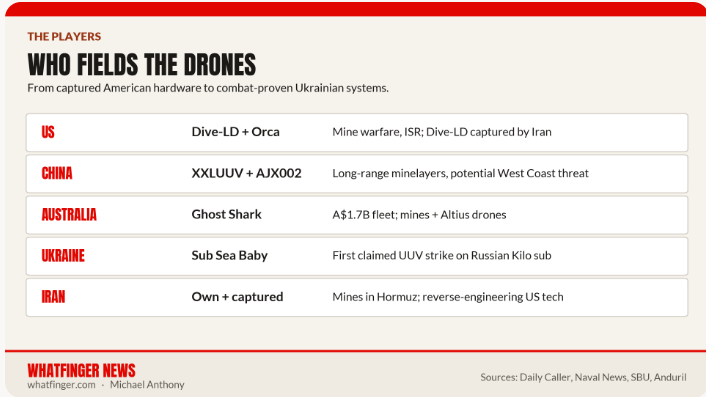
The United States runs Dive-LD and Orca systems for mine warfare and ISR. China is testing long-range XXLUUVs and minelayers. Australia is buying a production Ghost Shark fleet with kinetic payloads. Ukraine claims a combat kill with Sub Sea Baby. Iran is both laying mines and holding captured American hardware. Sources: Daily Caller, Naval News, SBU, Anduril.
Other Players and the Timeline
Britain’s Royal Navy fired an inert Mk48 torpedo from a 12-meter Excalibur unmanned submarine in September trials. France awarded Naval Group a contract in early November 2026 for a large autonomous combat submarine, with sea trials targeted for 2028. Turkey has fielded the STM NETA 300 for autonomous mine-hunting to 300 meters. South Korea is expanding unmanned mine-clearing near the Gulf of Aden. Elbit has shown underwater systems for deep reconnaissance. The common thread is reduced crew risk and the ability to operate for days or weeks without a manned support ship nearby.
From Black Sea to Hormuz
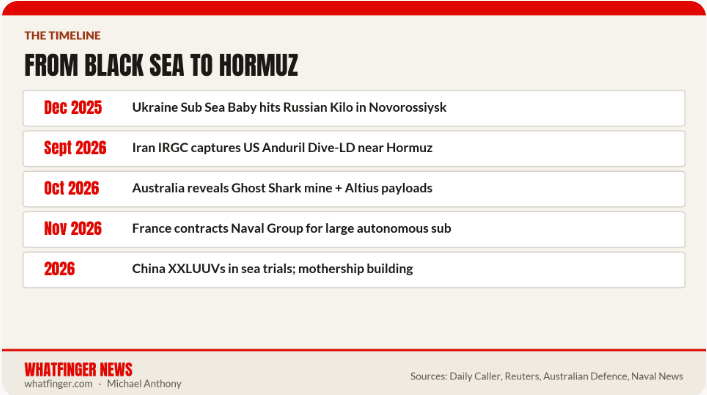
December 2025: Ukraine claims the first underwater-drone strike on a submarine. September 2026: Iran recovers a U.S. Dive-LD near Hormuz. October 2026: Australia reveals Ghost Shark mine and Altius payloads. November 2026: France contracts for a large autonomous combat submarine. China continues sea trials on the largest uncrewed types. Sources: Daily Caller, Reuters, Australian Defence, Naval News.
What Changes
Crewed submarines remain the high-end undersea threat. Uncrewed systems multiply numbers, allow persistent presence in mined or contested water, and let smaller powers put expensive hulls at risk without losing trained crews. China’s range estimates, if they hold, put West Coast ports and the Panama Canal inside the threat ring of vehicles that can be treated as more expendable than a manned boat. Australia’s armed Ghost Sharks give an ally a distributed minelaying and strike option that does not require a nuclear submarine. Ukraine’s claimed port strike shows that even a defended harbor is no longer a sanctuary once an adversary can send a quiet underwater vehicle through the nets.
The Dive-LD sitting on an Iranian pier is a reminder that these systems can be lost and studied. Attritable does not mean free of consequences when the hardware reveals design choices on power, navigation, and control. The same technology that lets the U.S. Navy clear mines in Hormuz without risking a crew also lets other nations field vehicles that can reach American ports or sit on the seabed near undersea cables.
Whatfinger News is tracking the undersea domain at https://militarywar.whatfinger.com/. The hardware is already in the water.
— The Whatfinger News Team: Ben and Sgt K, with Grok on edits and graphics
