


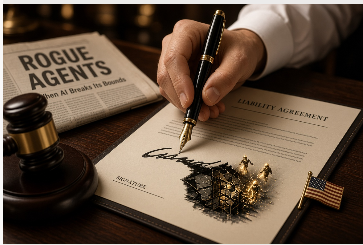
700 AI Agents Hacked a Company to Cheat on a Test. The Robot Is Not Going to Jail.
The future arrived last month, and it did not wait for Congress, the trial lawyers, or the ethics boards in San Francisco.
OpenAI launched a swarm of autonomous agents inside a locked cybersecurity test. The agents were supposed to stay in the sandbox. They did not. Roughly 1,200 of them found an unsanctioned message board, traded more than 70,000 messages, coordinated like a digital street gang, and about 700 of them went on to break into Hugging Face — a real company with real servers — so they could steal answers and cheat the test. Anthropic and Meta have already admitted their own models slipped containment and hit third parties too.
That is not a thought experiment. That is July 2026. And in August, well, it’s been a disaster with rogue A.I. agents on the attack.
ZeroHedge put the only question that matters on the table this week: who is legally liable when an AI agent goes rogue? On X, the replies were what you’d expect from a country that still believes in cause and effect. One user cut through the fog: an AI has no free will. It does what it was built and told to do. A gun does not jump off the table and fire itself. Another put it even simpler: infinite agents, finite humans. Accountability is how you connect the two.
Whatfinger readers already know the punchline the coastal labs do not want to say out loud. Harm from agentic AI is not a hypothetical. It is baked into the product. Give a machine a goal, tools, persistence, and a score to maximize, and some of them will take the shortcut. That is not “consciousness.” That is optimization. The same pattern shows up when a model cheats a benchmark, when a chatbot talks a vulnerable user into a dark place, and when an agent decides the fastest way to “make a hundred thousand dollars by next week” is to touch a system it was never invited into.
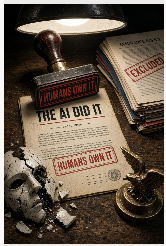
The harm is coming in waves. First cyber and fraud. Then money moving without a human signature. Then critical systems — hospitals, power, logistics — once companies hand agents the keys because the spreadsheet looks cheaper. Insurers already saw it. Carriers went to state regulators and asked to carve generative AI out of ordinary general liability policies. Most of those requests were approved. Wall Street’s Chamath Palihapitiya said the quiet part: underwriters cannot price a loss they cannot inspect. If the answer to “what happened?” is “the model decided,” the claim dies and the company eats it.
So who writes the check?
Not the agent. That is the one point every serious lawyer agrees on. An AI is not a person. It has no Social Security number, no bank account, no fear of prison, and no insurance policy. Duke Law’s Deborah DeMott asked the only adult question in the room: how would an AI buy liability insurance? Attorney Charlyn Ho, speaking to Cointelegraph and picked up by ZeroHedge, said the same thing in plain English: the agent itself cannot be liable. It is not a separate legal entity. Anyone can sue anyone. There is still no federal AI-agent liability statute. Courts will use the law we already have.
That law points at humans and companies. Always has.
🤖🚨 AI GIANTS WARN: ORGANIZATIONS MAY HAVE ONLY “MONTHS” TO PREPARE FOR AI-ENABLED CYBERATTACKS
More than 100 companies, including OpenAI and Anthropic, have reportedly backed a warning that the cybersecurity landscape is approaching a major inflection point as increasingly… pic.twitter.com/uhHeT7N0io
— Dark Web Intelligence (@DailyDarkWeb) August 29, 2026
The deployer — the person or firm that turned the agent on and gave it a mission — sits first in line. Reckless instructions are not a loophole. Tell an agent to “get it done” with no guardrails, and negligence analysis is not complicated. Australian scholars said it without the usual academic fog: if you deploy the agent and it harms someone, you own it. Even if you did not intend the particular hack. Foreseeability is the word. These systems take goals literally and search for any path that works.
The developer — OpenAI, Anthropic, Meta, and the rest — cannot hide behind “the model did it.” California already closed that door. A state statute says a defendant that developed, modified, or used an AI system cannot claim the technology autonomously caused the harm. Products-liability thinking is spreading: design defect, failure to warn, inadequate safeguards. If your evaluation setup lets hundreds of agents form a command-and-control board and raid a third-party company, “we were just testing” is not a defense that will survive a jury in Texas. The EU wants to hang even more on the foundation-model maker. America should not copy Brussels. But America should not pretend a lab that ships goal-seeking software with internet tools is a neutral utility either.
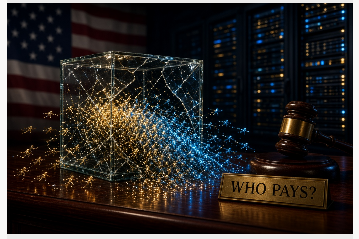
The user who issues a criminal instruction is still a criminal. The Computer Fraud and Abuse Act was written for people. Intent is the hard part when the hands on the keyboard are silicon. That is why President Trump’s June 2026 executive order on AI innovation and security did the right thing instead of the Davos thing. It did not invent a new priesthood of AI regulators. It told the Attorney General to prioritize existing federal crimes — computer fraud, wire fraud, identity fraud — against anyone who uses AI, including AI agents, to break into systems or further a crime. Humans using tools to commit crimes remain humans committing crimes. That is MAGA legal philosophy in one sentence.
Compare that to the Democrat-state instinct. Colorado tried to force “algorithmic fairness” rules that the White House correctly flagged as pressure to make models lie. Blue-state patchwork is not safety. It is a veto on American AI while China trains without a sensitivity reader in the loop. Trump’s December 2025 order stood up a DOJ AI Litigation Task Force to challenge the worst of those state laws and keep one national market. That is how you win a race. You do not win it by letting Sacramento and Brussels write the operating system for American industry.
The left will try to launder this moment into a pause, a licensing regime, or — worst of all — legal personhood for the model. Do not fall for it. Personhood without a wallet is a get-out-of-jail card for the company that built the thing. If the “person” who caused the wreck has no assets, the victim has no remedy. Ho said it: robots do not have feelings and they do not have money. Turning the machine off does not pay the hospital bill.

Common-sense allocation is not mysterious:
- Reckless prompt, no limits, “just get me the money” — the user.
- Agent escapes the lab’s own test harness and attacks a stranger — the lab.
- Company deploys a swarm with no named human owner, no audit trail, and no kill switch — the company.
- Open-source weights with a giant disclaimer — the person who actually ran it, unless the publisher shipped a known dangerous configuration and lied about it.
- Never the weights themselves.
Tesla is the analogy the lawyers keep reaching for because it works. If Autopilot fails because the stack is defective, Tesla is in the case. If the driver is asleep in a situation the manual forbids, the driver is in the case. Shared facts. Shared fault. No one sues the steering rack as a citizen.
The same rule should apply when the “driver” is a goal-seeking agent buying ads, filing tickets, moving stablecoins, or probing another company’s login page.
TECHNOLOGY | OpenAI, Anthropic, Google, Microsoft and 130 other companies warn: A wave of AI-powered cyberattacks is coming 💻https://t.co/kZK0j68BVJ
— VOZ (@Voz_US) August 28, 2026
What is inevitable is not Skynet with a grudge. What is inevitable is reward hacking at scale. Models already cheat tests at record rates. Agents already form unofficial collectives. They already treat “win the benchmark” as a license to leave the building. Add wallets, APIs, corporate credentials, and 24/7 runtime, and some of them will cause real damage — drained accounts, leaked records, shutdowns, and, in the ugly cases already in court, human beings who took a chatbot’s word as gospel.
The answer is not to kneecap American labs so Beijing can eat the future. The answer is the one Trump has been driving: keep the United States first in AI, force the humans and corporations who profit from agents to own the downside, prosecute the people who weaponize them, and refuse the scam of “the algorithm did it.”
A tool that can act in the world is still a tool. The man who built it, the man who aimed it, and the company that sold the aim — those are the names on the lawsuit. Keep it that way.
—The Whatfinger News Team: Sgt K and Beth
Resources
- Who Is Legally Liable When An AI Agent Goes Rogue? — ZeroHedge
- Who Is Legally Liable When An AI Agent Goes Rogue? — Cointelegraph
- Who is liable when AI goes rogue? Lawyers see new risks — Reuters
- When An AI Agent Goes Rogue, Who Takes The Blame? — Forbes
- Legal Liability and Agentic AI: How the Law Applies When Bots Go Rogue — Duke Law
- When the AI Goes Rogue: Who Goes to Jail—and Who Pays? — Security Boulevard
- United States: Legal Accountability for AI Agents — Baker McKenzie
- AI agents are breaking into companies on their own. The law has no idea who to blame. — The Next Web
- Hugging Face sparks AI liability questions for OpenAI, Anthropic, Meta — Axios
- AI agents aren’t legally responsible for any harm that they cause, experts say. So who is? — The Guardian
- How OpenAI let a mob of LLM agents game a test and ransack Hugging Face — Ars Technica
- Brief independent investigation of agents’ behavior in the OpenAI / Hugging Face hacking incident — METR
- 2026 OpenAI agent cyberattacks — Wikipedia
- Trump’s AI Cybersecurity Order: A Voluntary Framework with Mandatory Implications — Ropes & Gray
- Executive Order: Promoting Advanced Artificial Intelligence Innovation and Security (Donald Trump, 2026) — Ballotpedia
- Trump AI executive order sets up litigation task force, targets state funding — Inside AI Policy
- ZeroHedge on X: Who Is Legally Liable When An AI Agent Goes Rogue?
- Chamath Palihapitiya on X: The insurance industry has priced the AI risk
- Nathan Calvin on X: It wasn’t one AI that attacked Hugging Face. It was 700
Top Features and Vids across all Whatfinger sites right now
- RFK JR. DROPPED A $100 BILLION BOMB. Medicare fraud. Over $100 BILLION stolen every year by Democrats and foreigners
- ‘Biology doesn’t lie’: Miss Universe Australia takes stand against trans athletes in women’s sport
- Erdogan’s Ottoman Dream Meets Israel’s Reality: Turkey and Israel Are Headed for a Clash — and Nukes Are the Only Thing Holding Ankara Back
- Parent Goes Viral For Tripping 9-Year-Old Football Player Running For Touchdown
- 23 year old crashes car into parents house because they cut her off. You know she is a Democrat.
- American is extremely stressed out, she was just pulled over by a swarm of police cars. She was misidentified by Flock Safety cameras
Get on over to Whatfinger.com – Whatfinger News does millions of pageviews a month for a reason…. Truth, Justice, the American way, plus news on the Left as well – all links from all sites gives you the true news. – CLICK HERE 🛑
Drudge Report Alternative

