


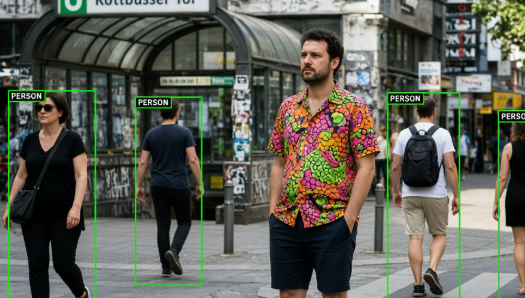

The ugliest Hawaiian shirt in Berlin might be the most honest piece of clothing on the market.
A Berlin artist made a shirt that makes you invisible to AI surveillance cameras. Like, the camera sees everyone else but skips right over you.
The pattern looks like a loud Hawaiian shirt to humans. But to AI detection systems, it breaks the outline of a human body so… pic.twitter.com/a0pcowiQYF
— Vaibhav Sisinty (@VaibhavSisinty) August 31, 2026
Berlin artist Simon Weckert — the same guy who once pulled a wagon of 99 phones down an empty street and tricked Google Maps into painting a phantom traffic jam — has printed a garment that does something more interesting than fool a mapping app. It fools the first thing an AI camera does when it looks at a crowd: decide whether a human is even there.
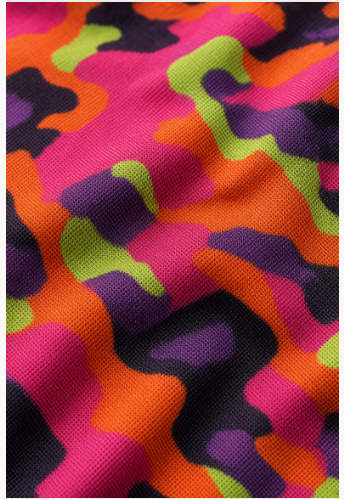
To your eye it is a loud, saturated mess of pink, orange, green and overlapping blobs. To an object detector like YOLO, the outline of a body never quite coheres. The camera boxes everyone else. The person in the shirt is just empty space. Weckert calls it Digital Camouflage. He is selling it for about $75. He built it because Berlin just switched on an AI behavior-scanning pilot at Kottbusser Tor.
Loud shirt, quiet algorithm. Everyone else gets a box. He doesn’t.
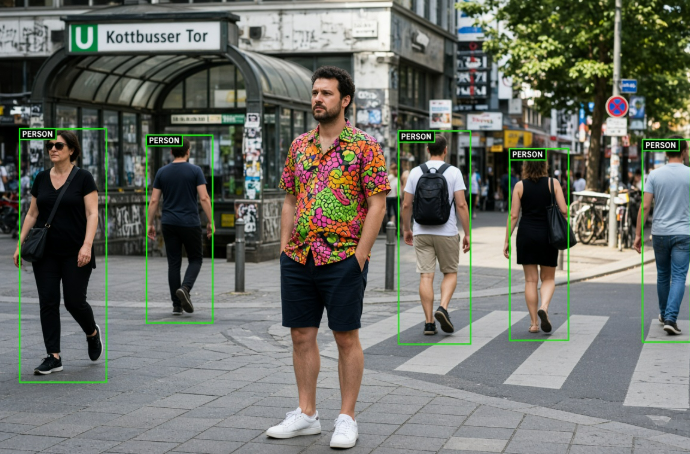
The idea is not magic. It is a statistical attack.
Modern person detectors do not “see” people the way you do. They never learned what a human is. They learned what humans statistically look like across millions of training images: edges, contrast, a head-and-shoulders silhouette, the continuous outline of a torso against background. Early layers of the network fire on texture and color transitions. Deeper layers try to bind those pieces into one figure.
Weckert’s pattern is optimized against that pipeline, not against human taste. Saturated color jumps hammer the early layers. Overlapping shapes break the continuity the later layers need. The detector’s confidence that “a person is standing here” collapses. He generated candidates, showed them to the model, measured the drop in confidence, and repeated — an adversarial loop — until the machine stopped registering a body. A method called TC-EGA helped make the texture tileable so folds, angles and movement would not instantly kill the effect the way earlier “sticker on the chest” patches did.
That is the whole trick. Not invisibility. Not a Faraday cage. Just a printed attack on the cheapest, most common first step in automated watching: is there a person in this frame?
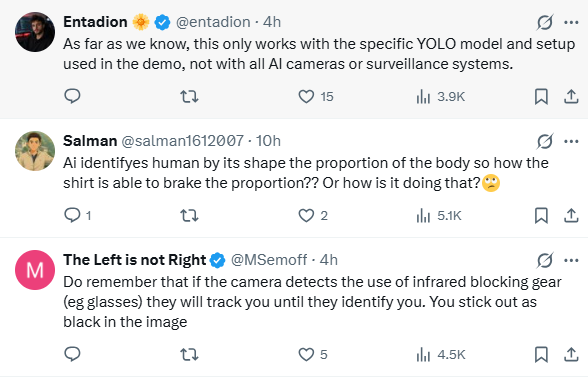
Weckert is careful about the claim. Demos use open-source YOLO. Closed government systems — the ones actually running in Berlin, London, or a hundred U.S. cities — cannot be independently tested. The shirt is the question. The system that cannot be questioned is the problem. That line is the real product.
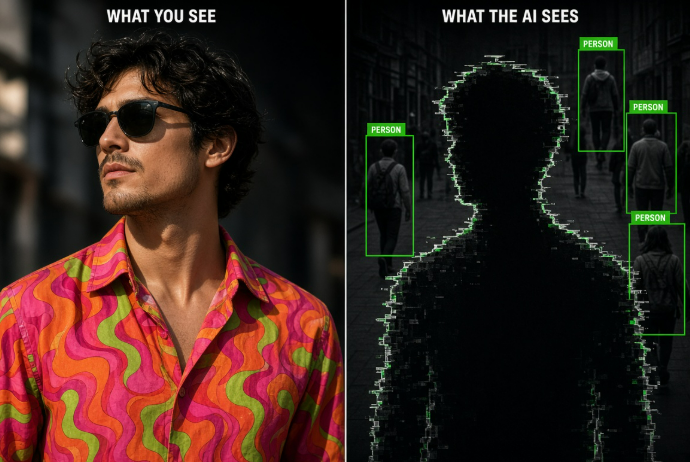
Split: what humans see vs what the model sees – The whole thesis in one frame.
What mass adoption would actually do
If this stayed a $75 art object, it would be a punchline and a protest shirt. If it became clothing — cheap prints, knockoffs, whole lines of “anti-detection” hoodies, dresses, and workwear — the effects would not stay cute.
First, automated crowd analytics would get worse before they got better. City systems that count bodies, flag loitering, score “suspicious behavior,” or feed live maps of who is where would start dropping people. Retail heat maps, transit flow models, and some “smart city” dashboards would quietly degrade. That is a feature if you think public space should not be a training set. It is a bug if you run the camera network.
Looks like vacation wear. Built like an attack.
Second, the response would not be “well, we guess people have a right to walk around.” Vendors would retrain. Adversarial training on these exact textures is already a research topic. Models would learn the new “ugly Hawaiian” class the same way they learned backpacks and umbrellas. Multi-sensor stacks — visible plus thermal, plus gait from a second camera, plus phone pings, plus license plates — would be sold as the fix. Infrared adversarial clothing is already being studied separately. One printed shirt does not beat a fusion system.
Third, law would follow fashion. Face-covering bans already exist in parts of Europe. “Anti-surveillance garments” are an easy next statute once a few high-profile crimes get blamed on people who “disappeared” from the feed. The same shirt worn by a journalist covering a protest and a guy walking out of a store with unpaid goods will be treated as one category. Expect “designed to defeat automated detection” to show up in legislation the way “designed to defeat radar” showed up for license-plate covers.
Fourth, the look itself would stop being camouflage. If half the street is wearing high-frequency visual noise, the pattern becomes the new default silhouette. Detectors adapt to the distribution in front of them. The first-mover advantage dies. You would then need the next generation of pattern — or a different modality entirely — and the clothes would get louder, stranger, or more specialized. Fashion as arms race is not new. This version just has a loss function.
How the trick works (explainer card)
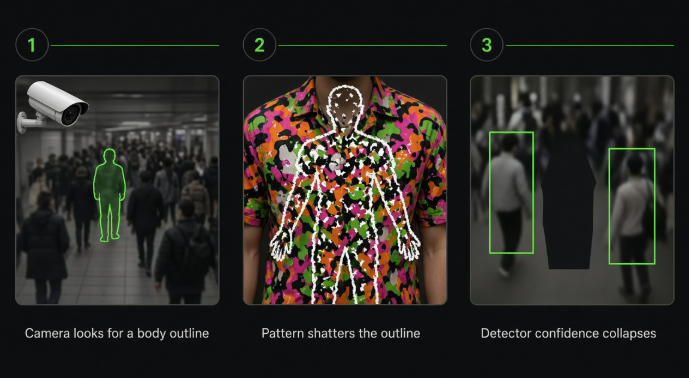
Fifth, human review does not go away. A detective scrubbing footage still sees the shirt. A store cop still sees the shirt. The win is against scale: the cheap, always-on, no-warrant, behavior-scoring layer that treats a public square as a spreadsheet. That layer is the one governments and contractors are installing because it is cheaper than officers. Break the cheap layer and they either spend more money or accept more blindness. Historically they spend the money.
There is also the false-security problem. People will treat a $75 print as a cloak. It is not. Lighting changes, different model families, a camera that already has you from another angle, your phone in your pocket, your face on a second system — any of those can put you back on the map. Weckert’s own site says no pattern promises to beat every system under every condition. Believe him.
What mass adoption would change is the politics. A city full of people who chose not to be automatically counted is a city that has made the surveillance bargain visible. That is why the shirt matters more as a signal than as armor. It is fabric asking a question the camera network is not built to answer: who consented to being read?
The pattern looks ridiculous on purpose. The system it is aimed at was never supposed to be questioned in public. That mismatch is the point. I’m buying one now. Screw the A.I. cameras and government. One word of advice – do not go to China with these shirts on. You may just end up in prison on some fake charges of daring to not allow the CCP to track your every move.
—-The Whatfinger News Team: Ben and Luke
From the people
- A Berlin artist made a shirt that makes you invisible to AI surveillance cameras. Like, the camera sees everyone else but skips right over you. The pattern looks like a loud Hawaiian shirt to humans. But to AI detection systems, it breaks the outline of a human body so completely that the model can’t register a person is there. He built it by testing patterns against YOLO until the AI stopped seeing a human. Now he’s selling it for $75. If his name sounds familiar same guy who tricked Google Maps into showing a fake traffic jam by pulling 99 phones through an empty street in 2020. It won’t fool every system. But the government systems watching you are closed, proprietary, and impossible to test independently. The shirt is the question. The system that can’t be questioned is the problem. – Original post at X
Resources
- Simon Weckert — Digital Camouflage (official project page)
- Simon Weckert creates Digital Camouflage to avoid AI surveillance — Dezeen
- This Hawaiian Shirt Tricks AI Surveillance Cameras Into Thinking You’re Not Human — PetaPixel
- Artist designs $88 shirt that tricks AI surveillance into ignoring the wearer — Dexerto
- This hideous Hawaiian shirt makes you invisible to AI — Geekspin
- Designer Creates World’s Most Hideous Hawaiian Shirt to Hide From AI Surveillance Cameras — Futurism
- Simon Weckert Digital Camouflage Anti-AI Surveillance Wear — Hypebeast
- Trend Alert: Is Anti-AI Fashion This Season’s Hottest New Look? — Gizmodo
- A man walked down a street with 99 phones in a wagon. Google Maps thought it was a traffic jam. — The Washington Post
- Vaibhav Sisinty’s original post
Top Features and Vids across all Whatfinger sites right now
- PANIC: Christians Mass Boycott WNBA After League BANS ‘Jesus Christ’ From Jerseys, Allows ONLY Islam…
- RFK JR. DROPPED A $100 BILLION BOMB. Medicare fraud. Over $100 BILLION stolen every year by Democrats and foreigners
- ‘Biology doesn’t lie’: Miss Universe Australia takes stand against trans athletes in women’s sport
- Erdogan’s Ottoman Dream Meets Israel’s Reality: Turkey and Israel Are Headed for a Clash — and Nukes Are the Only Thing Holding Ankara Back
- Parent Goes Viral For Tripping 9-Year-Old Football Player Running For Touchdown
