



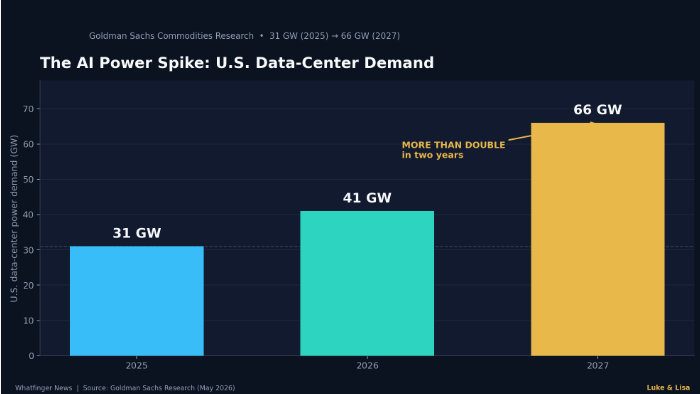
1. The spike — U.S. data-center demand 31 → 41 → 66 GW (Goldman). This is the “why now” chart.
Every few years Elon Musk does the same thing. The world says a bottleneck is “structural.” The consultants say wait until 2030. The three companies that own the choke point send a polite invoice and a calendar. Then Musk looks at the calendar, looks at the invoice, and builds the factory.
Lisa: This time the choke point is not chips, batteries, or rocket engines. It is the hottest metal parts inside a natural-gas turbine — the blades and vanes that have to spin in gas hotter than the melting point of the alloy they are made from. That shortage is now one of the main reasons America may not be able to turn on the AI compute it is already manufacturing. And Musk just called his fix “a profound game-changer.”
That is not hype language from a press release. That is the man who builds the rockets saying SpaceX will cast the parts itself so turbines can come online as much as 18 months sooner.
The crunch America is walking into
The United States is not running out of natural gas. It is running out of the machines that turn that gas into dispatchable electricity on the schedule the AI buildout requires.
Turbines are effectively sold out through 2030. Industry reporting and Musk’s own comments put the hard constraint on a tiny global club of foundries that can cast hot-section blades and vanes — commonly described as three specialist casters, with the order books full. Those parts are not “just metal.” They are single-crystal nickel superalloy castings with internal cooling channels and thermal-barrier coatings, designed to survive 3,000–3,600°F. You cannot farm that out to a random machine shop.
Meanwhile the demand side is exploding:
- Goldman Sachs has projected U.S. data-center power demand more than doubling from about 31 GW in 2025 to 66 GW in 2027.
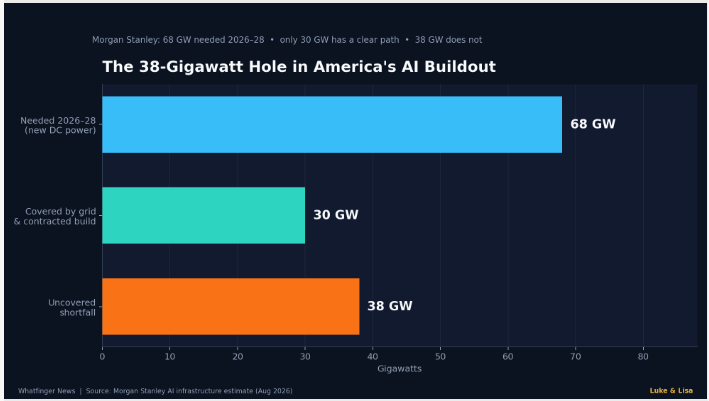
- Morgan Stanley has put a 38 GW power shortfall for AI infrastructure through 2028, after accounting for what the grid and already-contracted projects can actually deliver.
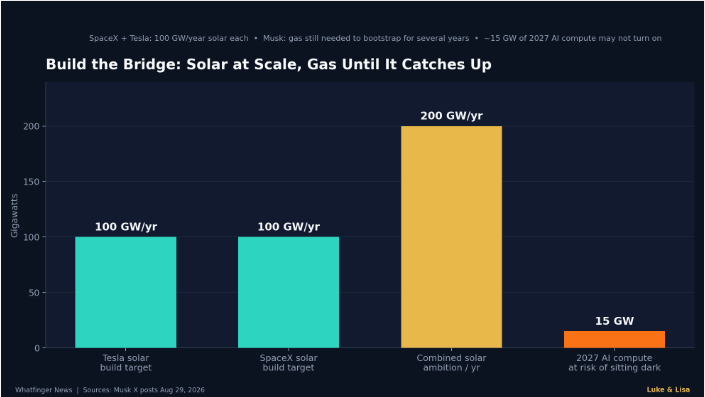
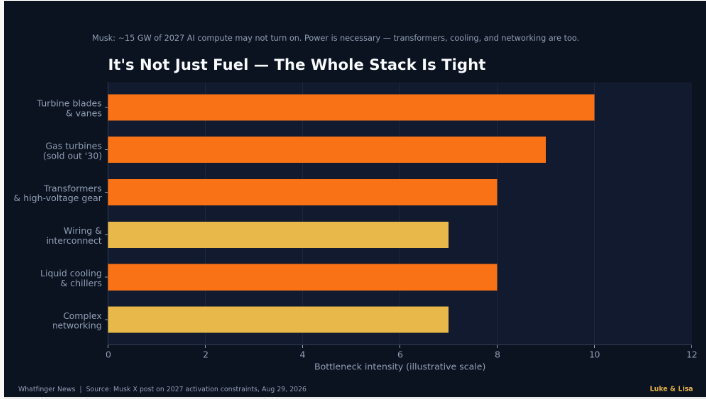
- Musk has cited a consensus estimate that roughly 15 GW of AI compute produced in 2027 cannot be turned on in 2027 — not only because of raw megawatts, but because of transformers, wiring, liquid cooling, massive chillers, and networking.
Lisa: That last point matters. People talk as if “finding power” is the whole problem. It is not. You can have a turbine on a truck and still be dead in the water if the rest of the stack is missing. Musk is treating the entire stack as one engineering problem.
Luke: And he is not waiting for a seven-year interconnection queue to become a personality trait.
2. The hole — 68 GW needed through 2028, 30 GW covered, 38 GW short. This is the scare-and-share chart.
The plan: cast the bottleneck in Texas
The Information first reported that SpaceX is laying groundwork for a blades-and-vanes foundry in Bastrop, Texas, next to the company’s growing Starlink industrial footprint. SpaceX quietly assembled roughly 830 acres in the area between March and June. Job listings dating to April 2026 already name the thing out loud: senior materials, automation, tooling, and operations engineers for a “Blades and Vanes Foundry,” including nickel-superalloy castings for power generation and an operations role that owns construction, buildout, and ramp-up.
Musk confirmed the strategy on X:
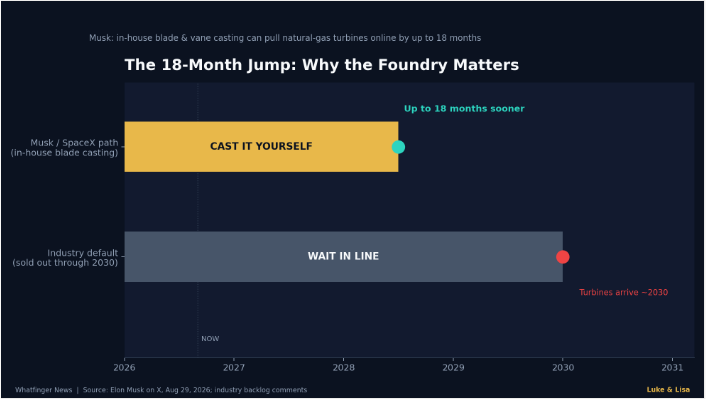
SpaceX and Tesla are each building 100 GW per year of solar production capacity as fast as they can. Natural gas will still be needed for several years to supplement and bootstrap that solar. The limiting factor for nat-gas turbine production is casting the blades and vanes. In-house casting at SpaceX, he said, can accelerate turbines coming online by up to 18 months. “A profound game-changer.”
He had already telegraphed the same idea on a podcast: turbines sold out through 2030; SpaceX and Tesla would probably have to make the blades and vanes internally because only a handful of casters exist and they are massively backlogged.
Lisa: Notice what he did not say. He did not say solar is canceled. He did not say America should live on diesel forever. He said the physics of the next several years still requires firm power while solar manufacturing scales at a pace almost no other company on Earth is even attempting.
That is the adult version of an energy transition: build the clean capacity at industrial speed, and do not pretend the grid can wait for sermons.
3. The punchline — wait-in-line until 2030 vs cast-it-yourself and pull turbines in by up to 18 months. Put this right under Musk’s quote.
What Musk already bought and what he is trying to power
This foundry is not a lone science project. It sits on top of a pile of hardware and capital already pointed at the same problem.
- Musk acquired APR Energy, a mobile gas-turbine power provider used by data centers, utilities, and industry. The fleet is built around units such as GE TM2500 and Mitsubishi FT8 machines, typically in the 20–35 MW range per unit. Reports put the deal in the neighborhood of $1 billion and the mobile fleet above 1 GW.
- SpaceX has already been running large numbers of portable turbines at xAI/Colossus sites and has committed billions toward gas turbines for AI operations, including additional large-frame machines for more permanent plants.
- SpaceX has talked about on the order of 10 GW of terrestrial AI computing capacity by the end of 2027, with Musk saying the company wants substantially more power and cooling than that.
There is a second customer inside the same company: Raptor. The same family of high-temperature alloys, vacuum furnaces, and foundry skill that makes a turbine blade can feed rocket-engine turbopumps. Morgan Stanley and others have flagged the dual-use logic. One plant, two brutal thermal problems, shared workforce. That is how you amortize a capability the rest of the industry treats as a priesthood.
Luke: If you have been paying attention to Musk for twenty years, this is the pattern. When the supply chain becomes the product, he nationalizes the supply chain — not with a press conference, with a foundry.
4. The strategy — Tesla + SpaceX solar targets vs the 15 GW of 2027 compute that may never turn on. Good mid-article graphic. Caption note: the 100/200 figures are manufacturing targets per year, not power already on the grid. Different units from the 15 GW of dark compute — say that in the caption so nobody dunks on the math.
Prospects: what this can actually do for the crunch
Be precise. An 18-month pull-in does not conjure 38 GW out of thin air. Casting is hard. Qualifying a new hot-section supplier for industrial turbines is not a weekend project. Analysts have warned that a greenfield foundry can take years to reach meaningful, certified output even if the buildings go up fast. Permitting details are still thin in public reporting. None of that is small print we should hide.
What the move can do is change the slope of the curve for the one actor who is simultaneously:
- building the compute,
- buying the turbines,
- manufacturing the solar,
- running the mobile generation fleet, and
- now attempting to manufacture the scarce parts that determine when those turbines exist.
If SpaceX can feed its own plants first, that is 10 GW of AI load that does not have to stand in the same 2030 line as everyone else. If the foundry works at scale, the spare capacity is not just a SpaceX toy. It is a new domestic source of the rarest parts in the American power stack at the exact moment hyperscalers, utilities, and manufacturers are all bidding for the same three casters.
Lisa: Zoom out from xAI for a second. The energy crunch is not a Silicon Valley lifestyle issue. Data centers are becoming a visible share of U.S. peak demand. Grid interconnection in some regions takes five to seven years. Behind-the-meter gas is already the industry’s default workaround because the public grid cannot move at AI speed. Goldman, McKinsey, Bank of America, EIA, SemiAnalysis — pick your shop. They are arguing over the size of the gap, not whether the gap exists.
Abundant, reliable power is how you keep factories open, hospitals cold, air conditioners running in Texas August, and a new industrial base from getting rationed by a queue. AI is the demand spike that made the shortage impossible to ignore. The shortage itself was already in the wiring.
5. The stack — blades, turbines, transformers, cooling, networking. Use this when you hit Musk’s point that power alone is not enough. Caption note: intensity scale is illustrative, not a measured index.
Advancing humanity is not a slogan if the lights stay on
Luke: The fashionable critique writes itself: more gas turbines, more emissions, more “fossil lock-in.” That argument treats time as free. Time is not free. Chips that cannot be powered are scrap. Models that cannot be trained do not discover drugs, design materials, or improve the grid. A country that cannot add firm megawatts does not get a gentle decline. It gets brownouts, offshored compute, and a strategic industry owned by whoever still pours metal.
Musk’s bet is the opposite of degrowth theater. Scale solar at 100 GW a year per company. Use American natural gas as the bridge and the night-shift partner. Break the foundry oligopoly so the bridge can actually be built. Reuse rocket metallurgy for power metallurgy. Put the plant in Texas, next to the people who already know how to weld, pour, and ship.
ELON MUSK: “Turbines are sold out through 2030. In order to bring enough power online, SpaceX and Tesla will probably have to make the turbine blades and vanes internally. There are only three casting companies in the world that make these, and they’re massively backlogged.”
ELON MUSK: “Turbines are sold out through 2030. In order to bring enough power online, SpaceX and Tesla will probably have to make the turbine blades and vanes internally. There are only three casting companies in the world that make these, and they’re massively backlogged.” pic.twitter.com/YlKHznBXhK
— DogeDesigner (@cb_doge) August 29, 2026
Lisa: That is how you advance humanity in the real world. Not by announcing a target for 2050. By refusing to let three backlogged casters decide whether 2027’s compute turns on.
Will the Bastrop foundry hit the 18-month number on day one? Nobody honest can swear to that yet. The physics is brutal and the qualification clock is real. But the direction is the same direction that put reusable orbital rockets and a domestic EV/battery industry on the map: identify the part nobody else will make fast enough, then make it.
America’s expected energy crunch is not a mystery. It is a manufacturing problem wearing a utility costume. Musk just announced he is putting on the costume and walking onto the factory floor.
That is the story. The rest is whether the rest of the country decides to compete with him — or wait in line until 2030 and call the wait “policy.”
—- The Whatfinger News Team: Luke and Lisa
From the people…
- BREAKING: Elon Musk has just confirmed SpaceX’s plan for an in-house factory to cast critical gas-turbine blades and vanes, eliminating the biggest bottleneck slowing turbine production. He says producing these components at SpaceX could bring new natural-gas turbines online up to 18 months faster, a profound game-changer for the massive power buildout supporting SpaceXAI’s rapidly expanding data centers. SpaceX and Tesla are also each building 100 GW per year of solar production capacity as fast as possible. Musk says natural gas will still be needed for several years to supplement and bootstrap solar. Classic Elon: when the supply chain cannot move fast enough, build the factory yourself. – Doge Designer

Resources
- “Profound Game-Changer”: Musk Launching New Turbine Blade Factory To Solve Shortage Threatening AI Boom
- Exclusive: SpaceX Lays Groundwork For Turbine-Blade Factory to Solve Data Center Power Crunch
- Musk’s faster path to more gas turbines comes with pollution problem
- Elon Musk pursues in-house production of gas turbine components
- SpaceX Lays Groundwork for Bastrop Gas-Turbine Blade Foundry
- SpaceX starts in-house turbine blade manufacturing to boost gas-powered generator output
- SpaceX to Build Its Own Gas Turbines in a Game-Changing Move
- The Blade Problem
- Morgan Stanley estimates AI data centers face a 38 gigawatt power shortfall through 2028
- US Data Center Power Demand Projected to Double by 2027
- Powering AI: How real is the risk of overbuilding?
- Fossil generation could rise with faster-than-expected growth in data center power demand
- AI data center growth could force US utilities to rethink generation plans, BofA says
- Data Centers Are Driving an Alarming Gas Power Expansion in the US
- Elon Musk on X: solar scale-up, blade casting, and the 18-month acceleration
Top Features and Vids across all Whatfinger sites right now
- PANIC: Christians Mass Boycott WNBA After League BANS ‘Jesus Christ’ From Jerseys, Allows ONLY Islam…
- RFK JR. DROPPED A $100 BILLION BOMB. Medicare fraud. Over $100 BILLION stolen every year by Democrats and foreigners
- ‘Biology doesn’t lie’: Miss Universe Australia takes stand against trans athletes in women’s sport
- Erdogan’s Ottoman Dream Meets Israel’s Reality: Turkey and Israel Are Headed for a Clash — and Nukes Are the Only Thing Holding Ankara Back
- Parent Goes Viral For Tripping 9-Year-Old Football Player Running For Touchdown
Get on over to Whatfinger.com – Whatfinger News does millions of pageviews a month for a reason…. Truth, Justice, the American way, plus news on the Left as well – all links from all sites gives you the true news. – CLICK HERE 🛑
Drudge Report Alternative

