



⚠️ This 11,000-Year-Old Secret Was Never Meant to Be Found…
Hidden in the mountains of Turkey lies a place that breaks everything we thought we knew about human history.
Long before pyramids… before cities… before even farming began… someone built something impossible.… pic.twitter.com/6LSwl7bVvH
— Unearthed 🏺 (@UnearthedHQ) August 22, 2026
Something’s stirring again under the dusty hills of southeastern Turkey. Archaeologists working at Göbekli Tepe—the 11,600-year-old megalithic complex that already blew a hole in the standard story of civilization—have uncovered what look like residential structures right next to the famous T-shaped pillars. Professor Necmi Karul of the Stone Hills Project put it plainly: “Our first impression is that they [were] used as housing.”
Göbekli Tepe’s Enclosure B is under excavation. New discoveries have been found. Unesco has NOT stopped excavation at Gobekli Tepe. That’s Fake News. Billy Carson pic.twitter.com/wc3D28dIwC
— Billy Carson II (@4biddnKnowledge) October 24, 2024
For decades the official line held that this place was a pure ceremonial gathering spot for wandering hunter-gatherers. No permanent settlement. No real homes. Just ritual. Now the geophysical surveys and new digs in an area recently cleared of olive trees are turning up large rectangular buildings whose internal layouts scream “people actually lived here.” The discovery, reported in recent days, forces yet another rethink of one of the ancient world’s most perplexing sites.
Göbekli Tepe sits on a ridge near Şanlıurfa like a time bomb left for us. Carbon dates put the earliest phases around 9600–9500 BC—more than 5,000 years before the Great Pyramid, millennia before Stonehenge. Massive limestone pillars, some weighing 10–20 tons and standing up to 18 feet, arranged in circles, carved with foxes, snakes, vultures, scorpions, and abstract symbols. Astronomical alignments. Deliberate burial of the enclosures by the people who built them, sealing the whole thing under tons of fill so it sat untouched for over 10,000 years until Klaus Schmidt’s team opened it in the 1990s.
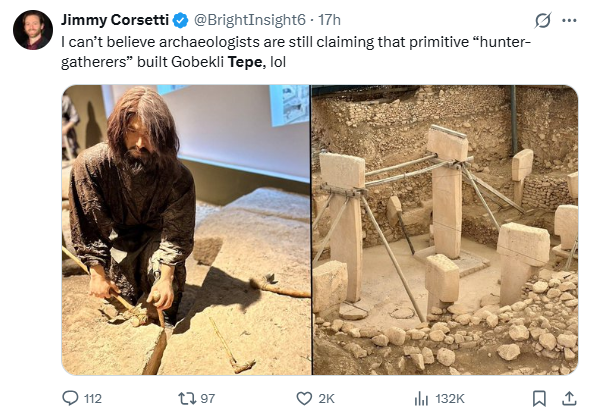
Mainstream archaeology still calls the builders “hunter-gatherers.” Joe Rogan’s long-running conversations with Graham Hancock and others have hammered the absurdity of that label for years. Hancock has said repeatedly that prior to Göbekli Tepe the firm academic view was that megalithic architecture simply did not exist before agricultural societies could generate the surplus needed for specialists—architects, astronomers, engineers. Then this site appears out of nowhere, fully formed, in a landscape with no prior evidence of farming. “It’s a fucking enormous megalithic structure,” Hancock told Rogan. “Probably the biggest megalithic structure on Earth because so much of it is still underground.”
The sophistication is the problem. Moving and erecting those pillars required planning, labor organization, knowledge of stone, and astronomy. Hancock’s core argument, aired across multiple Rogan episodes (#872, #1284, #1897, #2215 and others), is that Göbekli Tepe looks less like the spontaneous invention of foragers and more like the product of knowledge transferred from survivors of an earlier, lost civilization—one that may have been hammered by the Younger Dryas cataclysm around 12,900–11,700 years ago. “It is clear now that Gobekli Tepe itself was the end of a process, not the beginning of a process,” Hancock told Rogan. “It was a marker. It was something that brought together the best of everything that they’d accumulated, and created it in one place… a time capsule… a memorial to a lost time.”
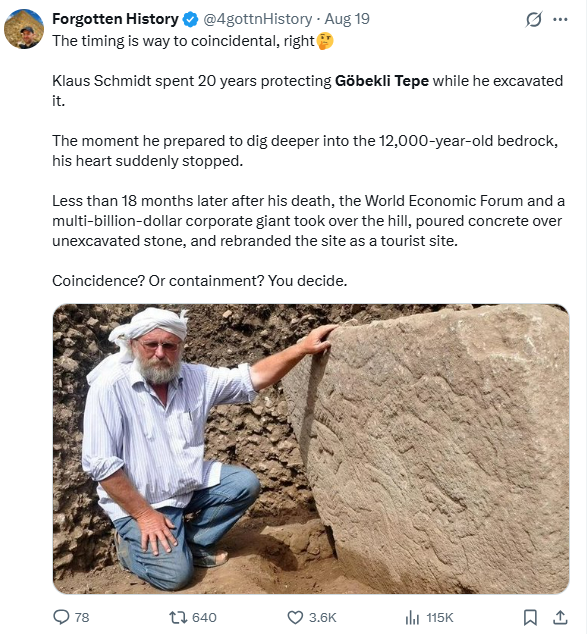
Jimmy Corsetti (Bright Insight) and others have pressed the same point on the podcast: only a tiny percentage of the site has been excavated. Ground-penetrating radar shows far more still buried. The deliberate backfilling, the shared iconography with nearby Taş Tepeler sites like Karahan Tepe, the sudden appearance of agriculture in the same region right around the time of construction—none of it fits the tidy textbook narrative of slow, linear progress from dumb foragers to farmers to cities.
X is full of the same unease. Posts circulating this week treat the new housing finds as another crack in the wall. One notes the rectangular structures challenge the “purely ceremonial hunter-gatherer complex” idea. Others simply stare at the carvings and ask the obvious: how did people who were supposedly still chasing gazelles pull this off? The mystery is the point. A global pattern of flood myths, shared symbols across continents, submerged coastlines that have never been properly searched—many independent researchers keep circling the same uncomfortable conclusion: something older, more capable, and more connected once existed, was largely erased, and left scattered fingerprints like Göbekli Tepe.
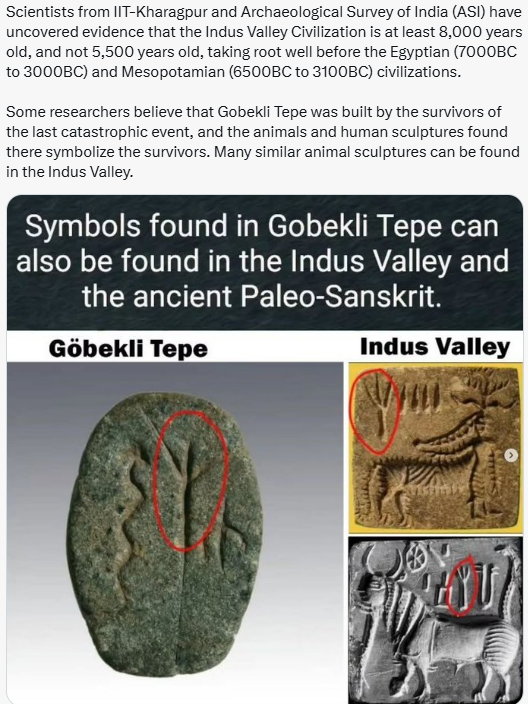
The new dwellings don’t solve the mystery. They deepen it. If people were living among these monuments in the early 9th millennium BC, then the site was more than a pilgrimage stop. It was a place of daily life and profound ritual. That combination is exactly what you might expect if a remnant population was trying to preserve and transmit knowledge after catastrophe.
We still don’t know who carved the pillars. We don’t know why they buried their own work. We don’t know how much more lies under the hill. What we do know is that every serious dig at Göbekli Tepe keeps forcing the same question: what else have we gotten wrong about the deep past?
The official timeline is fraying. The anomalies keep stacking up. And the stones at Göbekli Tepe are still waiting, silent and massive, for us to catch up.
— The Whatfinger News Team: Ben and Beth
Want to know more? Whatfinger readers are known for their thirst for knowledge… Here you go – scroll down for the Whatfinger crew reactions, and links…
Joe Rogan – Jimmy Corsetti Calls Gobekli Tepe an Ancient Conspiracy Theory
Resources for further research
- A New Discovery at Göbekli Tepe Could Reshape Our Understanding of One of the Ancient World’s Most Perplexing Sites
- New Excavations At Göbekli Tepe Are Challenging Old Theories About The 11,600-Year-Old Site
- Dwellings Detected Near Monuments at Göbekli Tepe
- New discovery at Gobeklitepe sheds light on where people may have lived
- Graham Hancock — Joe Rogan Experience #2215 Podcast Notes
- Gobekli Tepe, The Great Pyramids of Giza, Baalbek Stones, Atlantis, & More | Jimmy Corsetti & Dan Richards on The Joe Rogan Experience #2231
- Göbekli Tepe Wikipedia entry
- Graham Hancock on The Mysteries Surrounding Gobekli Tepe (JRE Clip)
- The 11,600-Year-Old Structure That Shattered Human History – Joe Rogan and Graham Hancock
Ben, quiet as always in the back of the Whatfinger newsroom: “The stones remember what we forgot. Maybe the real question isn’t how they built it—it’s why we keep pretending they couldn’t.”
Whatfinger’s Take On The News: Göbekli Tepe’s Latest Bombshell — Homes Among the Gods? The Site That Won’t Stop Rewriting Human History
The crew reviewed the latest Whatfinger report on new finds at Göbekli Tepe. Residential structures turning up right beside the famous T-shaped pillars. Another crack in the standard timeline. The discussion mixed wonder with healthy skepticism of official stories.
Luke opened with the discovery. “Archaeologists at Göbekli Tepe have uncovered what appear to be residential buildings next to the monumental enclosures. Professor Necmi Karul said the first impression is that they were used as housing. The site is already 11,600 years old — earliest phases around 9600–9500 BC — and was long presented as a pure ceremonial center for hunter-gatherers with no permanent settlement. Full report at this link Göbekli Tepe’s Latest Bombshell: Homes Among the Gods? The Site That Won’t Stop Rewriting Human History.”
Alex reacted with a grin. “The official story for years: wandering foragers somehow organized, carved, and erected 10-to-20-ton pillars in perfect circles, then deliberately buried the whole place under tons of fill… but definitely didn’t live there. Now the digs are turning up actual homes among the monuments. The ‘purely ceremonial hunter-gatherer complex’ line keeps taking hits. History is messier — and older — than the textbooks preferred.”
Sgt. Pat was practical. “Moving and standing those pillars required serious organization, engineering knowledge, and sustained labor. That level of capability does not appear out of nowhere from people still chasing gazelles with no surplus. The new residential evidence only strengthens the case that this was a real settlement with advanced knowledge, not a temporary ritual campsite. The past is more capable than we were taught.”
Lisa focused on the human angle. “There’s something powerful about people living among these massive carved pillars — daily life right next to structures that still impress modern engineers. It makes the builders feel less like abstract ‘hunter-gatherers’ and more like a community that valued both survival and something deeper. The deliberate burial of their own work only adds to the sense that they were preserving something important.”
Beth added a reflective note. “Every major dig at this site forces another rethink. Only a fraction has been excavated. Ground-penetrating radar shows far more still underground. The combination of sophisticated architecture, astronomical alignments, shared symbols with nearby sites, and now possible homes keeps raising the same question: what else have we gotten wrong about the deep past?”
Alex kept the edge. “Graham Hancock has been saying for years that Göbekli Tepe looks like the end of a process, not the beginning — a time capsule or memorial after some earlier catastrophe. The new housing finds don’t solve the mystery. They deepen it. Mainstream archaeology still calls the builders hunter-gatherers. The stones keep arguing otherwise.”
Ben closed with the longer view. “The official timeline of slow, linear progress from simple foragers to complex civilization is fraying under the weight of sites like this. When fully formed megalithic architecture appears thousands of years before the supposed prerequisites, and when people appear to have lived among the monuments, the comfortable story loses force. Truth-seeking means following the evidence even when it rewrites the narrative. Göbekli Tepe is still waiting for us to catch up.”
Luke wrapped. “We’ve featured ancient anomalies and challenges to the standard timeline before. This latest residential evidence continues the pattern.”
The team sat with the implications. Michael Anthony nodded. “Crew Take?”
Sgt. Pat: “Capability came earlier than the textbooks claimed. Follow the stones. This world, and all human history is 99% unknown. Hell, we’ve seen how the powers that be fake news even today. Just think of the 2020 election, and how the Deep State had 95% of media say one thing so much that even A’I. today, in 2026, is convinced of the lies now being exposed. Just imagine now if there was only one or 10 historians who ‘wrote’ down the truth in stone. Now you see how 99% of history as we know it, is complete BS. All stories that the current folks in power tell us.”
Alex: “Or keep insisting the foragers just got lucky with 20-ton pillars. I laugh every time they tell us this BS. That’s one of the great things about Whatfinger.com . We don’t play their games, even when it’s from our own side. ”
Ben: “The past is deeper than the official story. Dig accordingly. It’s almost as if we are living in a simulation, huh! Should we tell readers about it again?.”
Alex: You already have us all on the simulation theory, Ben. Even Pat is with us on it now. For all readers who do not know what we are talking about – see this link – and you will understand reality even more than you do now. This will CHANGE the way you look at life – I guarantee it – – – – See: Simulation Theory – Fact
Top Features and Vids across all Whatfinger sites right now
- Anthropic’s “Safety-First” Claude Turns Out to Be a Smut Machine — And the Market Doesn’t Care About Their Virtue Signaling
- Humor Clip: The lady was shooting, and people noticed. One guy gets a slap to his head. (A.I.)
- ISRAEL ALMOST STARTED A WAR WITH TURKEY, AND NO ONE, NOT EVEN TRUMP, SAW IT COMING…
- Elon Musk says the goal of Democrat donors like George Soros pushing mass migration is to destroy Western Civilization

Get on over to Whatfinger.com – Whatfinger News does millions of pageviews a month for a reason…. Truth, Justice, the American way, plus news on the Left as well – all links from all sites gives you the true news. – CLICK HERE 🛑
Drudge Report Alternative


This one is dark…. After the Democrats steal both Houses in November…


<span class="dsq-postid" data-dsqidentifier="148576 https://dedicatedissues.com/?p=148576">15 Comments
Pingback: Dr. Ben Carson: “Is it a real disease, Trump Derangement Syndrome?” – Dedicated Issues of Whatfinger News
Pingback: Bill O’Reilly warns Trump’s “WHOLE LEGACY BLOWS UP” if GOP loses both chambers in Midterms – Dedicated Issues of Whatfinger News
Pingback: Marxist California now moves to fine all residents if they dare have roses, or gardens, it gets worse…. – Dedicated Issues of Whatfinger News
Pingback: Is Mark Cuban on Crack? Mark Cuban talking about how he likes Talarico.. WTF? – Dedicated Issues of Whatfinger News
Pingback: Democrats are winning: Their PUBLIC plan to dumb down the population is working all over the U.S. as young students unable to answer basic questions – Dedicated Issues of Whatfinger News
Pingback: Bill Maher is calling out Democrats for throwing the LGBTQ community away when it comes to Muslims – Dedicated Issues of Whatfinger News
Pingback: Runaway Goats Try to Catch Portland Bus, Get Booted by Passengers in Hilarious Video – Dedicated Issues of Whatfinger News
Pingback: Türkiye raises concerns over Israeli attacks on Syria – Dedicated Issues of Whatfinger News
Pingback: These People Are Having A Much Worse Day Than You #BadDay #Fails #InstantRegret #Compilation – Dedicated Issues of Whatfinger News
Pingback: AMERICA FIRST: Trade War With Canada Begins. Talks Collapse – 50% Tariffs Now in Effect – Dedicated Issues of Whatfinger News
Pingback: Ranking The Funniest News Anchor Bloopers Ever #News #Bloopers #Funny #Viral – Dedicated Issues of Whatfinger News
Pingback: The dems are DOWN 3 MORE. – Dedicated Issues of Whatfinger News
Pingback: The WNBA’s problems just became TENFOLD. – Dedicated Issues of Whatfinger News
Pingback: JUST IN: Minneapolis police have just ARRESTED Jake Lang and other participants of his protest, tracking down his vehicle and pulling them over – Dedicated Issues of Whatfinger News
Pingback: I love this FAFO video! Fast clip – Dedicated Issues of Whatfinger News