



The gloves are off. After weeks of high-stakes negotiations and a last-minute three-day pause that gave Canada every chance to close the deal, trade talks between the United States and Canada collapsed late Friday night. At 12:01 a.m. Saturday, President Trump’s 50% tariffs on roughly $20–28 billion worth of Canadian goods slammed into effect. Whatfinger readers who followed Sundance at the Conservative Treehouse already saw this coming: the structural gap between the two economies is simply too wide for Canada’s current political class to bridge.
U.S. Trade Representative Jamieson Greer laid it out without the usual diplomatic soft-pedaling. Canada declined to finalize the deal under terms that had been agreed earlier in the week. Despite an American offer that would have given Canada the best treatment of any major exporter to the U.S. market—including significant tariff reductions on steel, aluminum, autos, and lumber—Ottawa introduced new demands and walked back prior commitments. Canada also continued its prolonged retaliation against American goods and services, including flat-out prohibitions in key sectors.
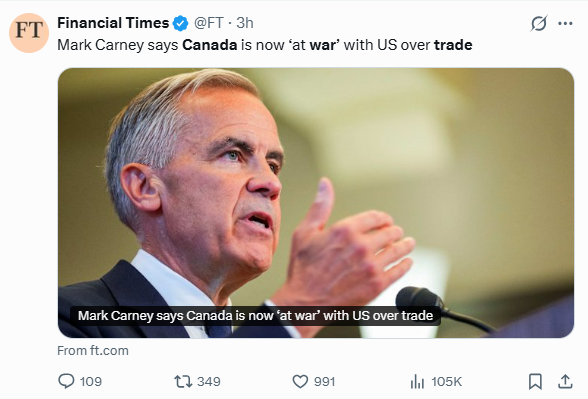
Mark Carney says Canada was “attacked.” “You’re at war when you get attacked.” Then listen to what comes next.
Mark Carney says Canada was “attacked.”
“You’re at war when you get attacked.”
Then listen to what comes next.
Carney says Ottawa is looking at the tax system and how to “shift the burden to those who are most able to pay.”
Trade talks collapse.
Declare Canada under attack.… pic.twitter.com/NTXXaJXKBp— The Real Mr Bench (@therealmrbench) August 22, 2026
For decades Canada has enjoyed the most favorable access to the American market of any country on earth. Even after retaliating against the United States the same way China did, Canada still received preferential treatment under President Trump’s America First trade program. This week the U.S. offered even better terms plus a historic economic and national security partnership covering export controls, transshipment, digital trade, aerospace supply chains, critical minerals, forced-labor enforcement, and formal USMCA negotiations. Canada said no.
Prime Minister Mark Carney’s response was pure Ottawa: suspend the talks, recall the negotiators, and vow “dollar-for-dollar” retaliation starting September 8. The Canadian measures are expected to target steel, dairy, appliances, agricultural equipment, pulp and paper, and electronics. Carney claimed last-minute American changes were “unfair” and “uneconomic.” Greer’s side says the opposite—Canada moved the goalposts after the hard work was done.
The numbers tell the real story of who holds the leverage.
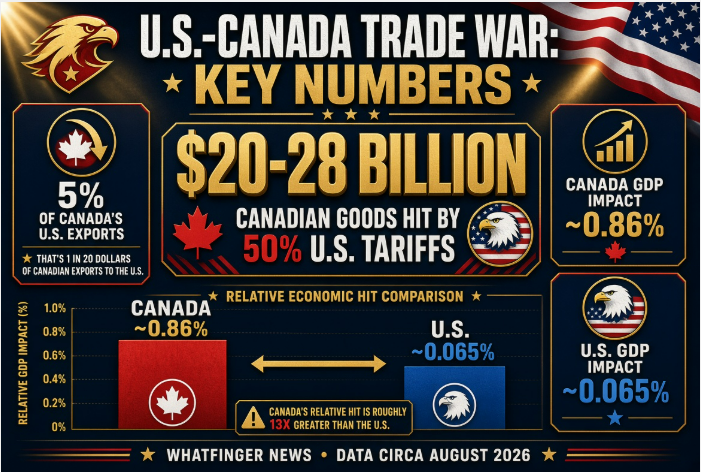
The tariffs hit products ranging from hockey sticks and wine to cement, furniture, clothing, and certain agricultural goods. Energy, potash, critical minerals, and fish were carved out—exactly the commodities Canada needs to keep selling south. Roughly 5% of Canada’s annual exports to the United States are affected. Relative to the size of the two economies, the hit lands about 13 times harder on Canada. That is not a coincidence. It is leverage.
This was never just about one list of goods. It is about whether Canada is willing to stop discriminating against American dairy, alcohol, autos, and lumber while maintaining protectionist rules, digital taxes, carbon schemes, and industrial policies that punish U.S. producers. Former Prime Minister Justin Trudeau’s government spent years building those walls. Carney inherited them and, when offered a path to lower them in exchange for preferential access to the fastest-growing G7 economy, chose the walls.
X has been flooded with the predictable reactions. MAGA accounts celebrated the hard line. Canadian liberals declared the country “at war” and floated boycotts. One viral Canadian clip even compared buying American booze to wearing a MAGA hat—complete with threats of eggs. The contrast could not be clearer: America is protecting its workers and supply chains; parts of Canada still treat fair trade as an insult.
Sundance at the Treehouse put the deeper point best. The economic, regulatory, and ideological distance between the two countries has grown too large for a simple free-trade patch. Banking rules, intellectual property, media policy, energy policy, and the carbon trading scheme all pull in opposite directions. A true partnership would require Canada to make structural changes its current political class refuses to consider. Bilateral deals may eventually replace the trilateral USMCA framework precisely because the old assumptions no longer hold.
President Trump did not start this fight for sport. He started it because American workers, farmers, and manufacturers have been playing on a tilted field for too long. Canada got every opportunity to level it. When the deadline arrived, Ottawa chose confrontation over cooperation. The tariffs are now reality. The ball is in Canada’s court—and the American economy is not the one that needs to blink first.
America First is not a slogan. It is policy. And it is working.
—-The Whatfinger News Team: Sgt K, Lisa
Resources
- Talks Collapse – Tariffs Begin Now – A Direct and Confrontational U.S-Canada Trade War is Now a Reality
- USTR Statement on Canada Declining Trade Deal
- Mark Carney Statement on Suspending Talks and Retaliation
- American tariffs on Canadian goods take effect after trade talks fall apart – CBC News
- Canada says it will match US tariffs ‘dollar for dollar’ as trade talks break down – BBC
- Fact Sheet: President Donald J. Trump Imposes Additional Tariffs on Canada – The White House
- Trump trade chief warns Canada walked away from ‘the best deal’ – Fox News
Top Features and Vids across all Whatfinger sites right now
- Göbekli Tepe’s Latest Bombshell: Homes Among the Gods? The Site That Won’t Stop Rewriting Human History
- Florida Opens the Door on Ivermectin & Mebendazole Cancer Research — The Revolution Just Got Official
- Anthropic’s “Safety-First” Claude Turns Out to Be a Smut Machine — And the Market Doesn’t Care About Their Virtue Signaling
- Humor Clip: The lady was shooting, and people noticed. One guy gets a slap to his head. (A.I.)
- ISRAEL ALMOST STARTED A WAR WITH TURKEY, AND NO ONE, NOT EVEN TRUMP, SAW IT COMING…
- Elon Musk says the goal of Democrat donors like George Soros pushing mass migration is to destroy Western Civilization

Get on over to Whatfinger.com – Whatfinger News does millions of pageviews a month for a reason…. Truth, Justice, the American way, plus news on the Left as well – all links from all sites gives you the true news. – CLICK HERE 🛑
Drudge Report Alternative


This one is dark…. After the Democrats steal both Houses in November…

- Canada’s Trade-War Denial Canada does not need “time to adjust.” It needs a political class willing to stop confusing indignation with economic policy. And it needs access to the US market. President Trump is focused on economic sovereignty, this is not personal this is business. I assumed Mark Carney understood that. He has spent enough time around markets and capital to know that a country cannot posture its way out of a competitiveness crisis. Yet Ottawa’s turn toward symbolism and performative retaliation suggests that faith was misplaced. Canada does not need another era of Pierre Elliott Trudeau-style progressive theatre: moral signalling, state direction, and lofty ambition detached from the hard work of building productive capacity. It needs an adult willing to confront vested interests, make trade-offs, and put economic strength ahead of political performance. The last adult, it seems, has just left the room. The elbows-up strategy is embarrassing and hurts Canada long term, like a teenager emotional response to the reality of the world. Carney’s use of it helps neither negotiation nor leverage, and it wounds Canada more than the U.S. The central strategic objective is obvious: preserve access to the United States, the world’s largest and most dynamic market, Canada’s neighbour, and the foundation of its export economy. That access is not a talking point. It supports Canadian jobs, investment, supply chains, and growth. Canada focus on China is an own goal. China cannot replace it. China is distant, strategically uncertain, and separated from Canada by geography, institutions, and infrastructure. It cannot reproduce continental integration: shared energy systems, cross-border capital, integrated factories, common standards, and decades of commercial interdependence. Canada does not get to trade on sentiment while depending on geography. Nor can it “win” a trade war with its largest customer. Ottawa can impose targeted costs where it has genuine leverage. It can negotiate firmly. But broad retaliation is not a strategy. It is emotional performance masquerading as economic policy. Too many in the political and economic elite appear to believe retaliation can force the structural adjustment Canada has avoided for years. It cannot. Tariffs do not raise productivity. They do not attract investment, reduce regulatory costs, or make Canadian businesses more competitive. They raise prices for households, increase costs for manufacturers, and encourage mobile capital to locate elsewhere. Retaliation for its own sake is an expensive expression of national frustration. Canadians pay the bill. The deeper problem is not merely American pressure. It is Canadian failure: weak business investment, poor productivity growth, regulatory paralysis, provincial trade barriers, slow approvals, inadequate infrastructure, and a subsidy culture that protects incumbents rather than rewards builders. Canada is rich in assets and poor in execution. It has energy, minerals, capital, skilled people, and privileged proximity to America. Yet it has made investment too slow, too risky, and too expensive. The answer is not submission. It is reform: deregulate, accelerate approvals, remove barriers to capital and internal trade, and lower the cost of building. Canada may need time to adjust. But first it needs to end its denial. – James Thorne
-
BREAKING: Trade talks between the US and Canada have collapsed and the US has imposed new 50% tariffs on billions of dollars of Canadian goods. Details include: 1. Canada‘s Prime Minister Carney vows to retaliate with “dollar for dollar” tariffs on the US 2. The tariffs will cover hundreds of items the US buys from Canada, such as plywood, liquor, electrical equipment and hockey gear, totaling ~$20 billion 3. US Trade Representative Greer said Canadian negotiators had “upset the balance” worked out over days of negotiations 4. The two sides had been discussing a deal that included lowering tariffs on Canadian steel and aluminum to 25% and autos to 15% The US-Canada trade war appears to be back. – K Letter
Continue below in comments please

<span class="dsq-postid" data-dsqidentifier="148886 https://dedicatedissues.com/?p=148886">1 Comment
Pingback: US-Canada trade war: The cost of fighting back – Dedicated Issues of Whatfinger News