


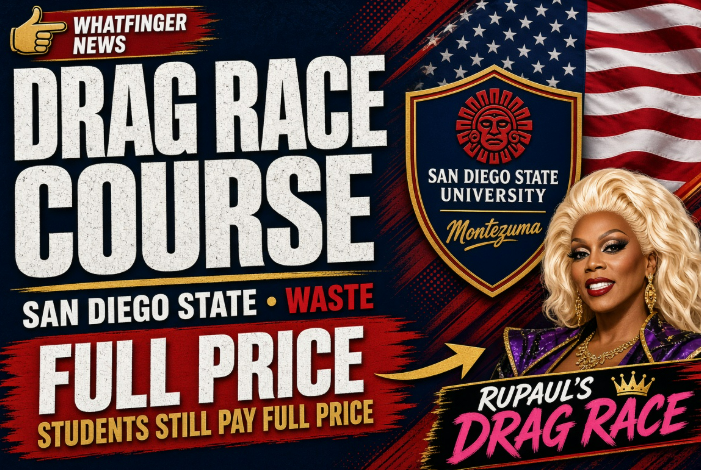
San Diego State is offering an upper-division course on RuPaul’s Drag Race that digs into “queens of color,” trans inclusion, and the politics of a reality-TV competition. Professor Nathian Rodriguez is teaching “RuPaul’s Drag Race—Media, Markets, and Power.” Students will study how editing, judging, and fandom produce narratives of merit and authenticity, then finish with a project on media power and commodification in the streaming era.
American Principles Project President Terry Schilling called the class a mockery of higher education, a waste of time and money, and an egregious misuse of public funds. Students, he said, will walk away arguably worse off than before they started. Rodriguez has said the point is to meet students where they are and build “cultural literacy” on LGBTQ topics because pop culture is powerful. SDSU did not respond to multiple requests for comment from The College Fix. The school already has an LGBTQ+ Studies major and minor; next spring it plans to add “Queering Comics.”
-
Freedom Index — Rankings of schools by how well they protect free speech, resist DEI, and stick to academic standards instead of activism. See the rankings
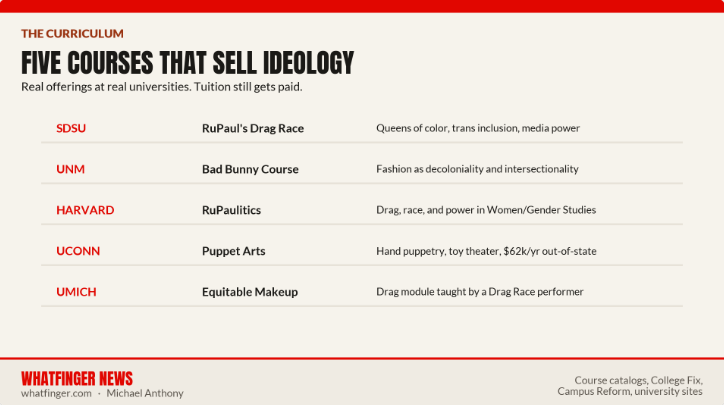
This is not an isolated stunt. The University of New Mexico is running a Bad Bunny course that treats his fashion as political expression of decoloniality and intersectionality. The University of Michigan offered “Equitable Stage Makeup and Hair,” complete with a drag module taught by a Drag Race performer. Harvard’s Women, Gender, and Sexuality Studies program has listed “RuPaulitics: Drag, Race, and Power.” The University of Connecticut runs bachelor’s and master’s degrees in Puppet Arts (hand puppetry, toy theater) at more than $60,000 a year for out-of-state students. Bowling Green State offers degrees in Popular Culture. These classes sit inside majors that already rank near the bottom for employment and earnings.
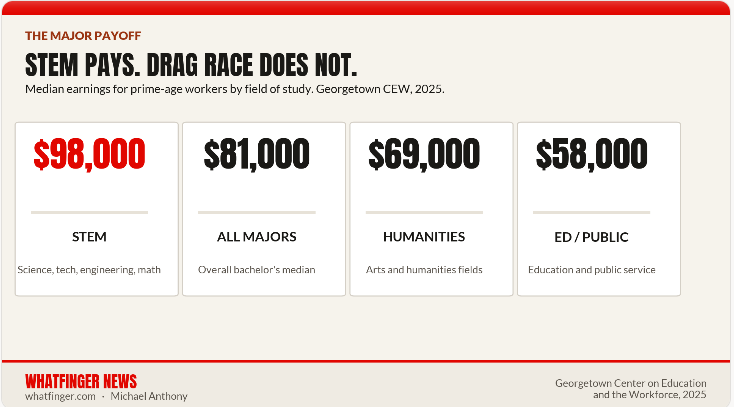
Georgetown University’s Center on Education and the Workforce put numbers on the gap. Prime-age workers with STEM degrees earn a median of $98,000. Humanities and the arts sit at $69,000. Education and public-service fields land at $58,000. Overall bachelor’s degree holders reach $81,000. Early-childhood education and counseling degrees fall near the bottom of the range. Petroleum engineering hits $146,000. The Department of Education has already moved to cut federal loan eligibility for undergraduate programs whose typical graduates earn less than high-school graduates.
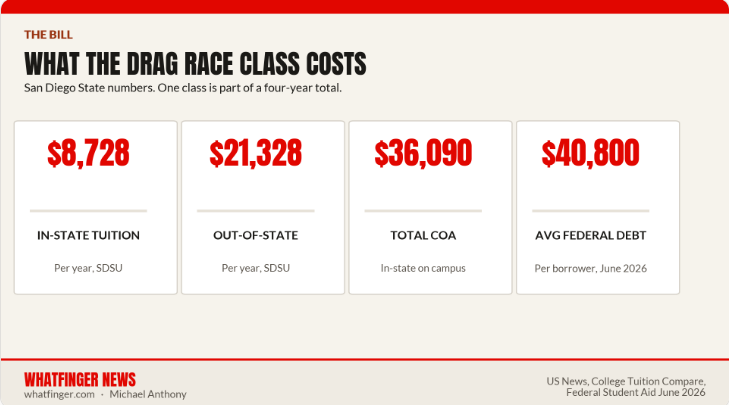
At San Diego State the in-state sticker is roughly $8,700–$9,200 a year in tuition and fees; out-of-state runs about $21,300. Full cost of attendance for an in-state student living on campus is listed around $36,000. The average federal student-loan borrower owed $40,800 as of June 2026. A single upper-division elective on a drag competition does not move those numbers by itself. Stack enough of them inside identity-studies majors and the four-year total does.
Universities keep the courses because they are cheap to staff, easy to market to students already steeped in the material, and hard for administrators to cut without looking hostile to the current academic consensus. The students who take them still borrow. The taxpayers who subsidize the campuses still pay. The graduates who later discover that employers do not treat “queer methods of reading” or “decolonial fashion analysis” as job skills still carry the debt. The drag-race class is simply the latest catalog entry that makes the trade-off obvious.
Most college rankings still chase prestige and ignore the things that actually matter to parents and students: free speech, resistance to DEI, faculty ideology, junk degrees, and whether the degree pays off. Finger Universities flips that. It ranks schools by how well they protect open inquiry, tracks the worst free-speech failures, shows which states are rolling back DEI, and pairs rankings with real earnings and debt numbers. The sections below dig into each piece so you can see the data instead of the marketing.
- Freedom Index — Rankings of schools by how well they protect free speech, resist DEI, and stick to academic standards instead of activism. See the rankings
- ROI & Outcomes Overlay — Pairs free-speech rankings with real numbers on earnings, debt, and underemployment so you can see which schools actually pay off. Check ROI data
- Faculty Ideology — Look at how lopsided the faculty is at different schools (Democrat vs. Republican ratios and radical concentration in humanities). View faculty data
- Campus Incident & Disruption Tracker — Log of major shout-downs, encampments, and free-speech failures, plus how the school responded. See the incidents
- Woke on Camera — Embedded clips of campus DEI and free-speech failures (Yale, Evergreen, Mizzou, Stanford, and more) plus dozens of linked titles. Watch the clips
- Hall of Shame — The worst free-speech and highest-DEI schools, with notes on recent failures. See the list
- State Reform Tracker — Which states have banned or limited DEI offices, diversity statements, and divisive concepts at public universities. Track the reforms
- Traditional & Religious Colleges — Schools outside the main prestige lists that focus on classical education, Western tradition, or explicit Christian mission. View the schools
- Junk Degree Detail — Named programs (gender studies, ethnic studies, critical theory tracks) that commonly show up on low-ROI or ideology-heavy lists. See the programs
- Foreign Funding Watch — Reported money from Qatar, China, and others flowing into campus institutes and Middle East studies programs. Check the funding
- Side-by-Side Comparison — Pick any two schools and see Freedom rank, DEI density, junk majors, endowment, and earnings next to each other. Compare schools
- DEI Density — Staffing levels for DEI offices relative to student population. See DEI numbers
— The Whatfinger News Team: Sgt R and Ben, with Grok on edits and graphics
