

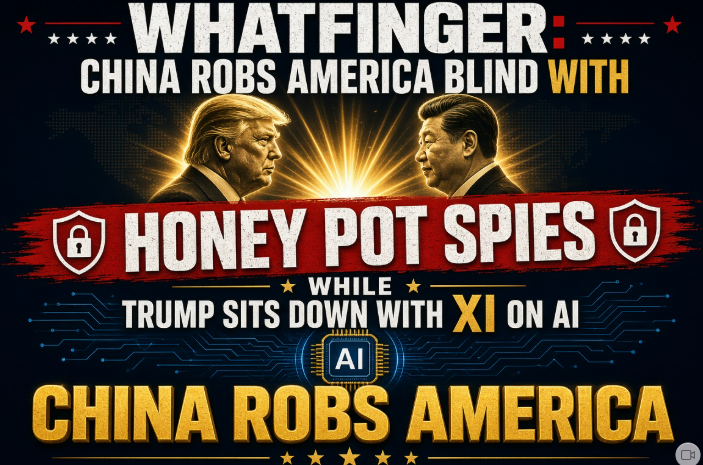
Nvidia CEO Jensen Huang, the man whose chips keep America ahead in the AI race, admitted an extramarital affair with Alice Huang (Huang Le), a Singapore-based executive at Megaspeed. U.S. intelligence concluded she was a Chinese Ministry of State Security asset. The New York Times and Wall Street Journal reported the relationship. Megaspeed bought billions in Nvidia chips. A U.S. government audit last year found the company could not initially account for roughly 50,000 of them. Nvidia’s board launched an independent investigation and said it has “no reason to believe” national security or company secrets were compromised. Huang told Trump he had no idea she was a spy. Trump said he believes him. China called the whole thing groundless speculation and slander.
That is the classic honeypot. Attractive access, personal leverage, then the tech walks. It is not new, and it is not limited to one CEO.
This is the most important story of our time.
“Lutnick has spent the last year “undoing” efforts by other administration officials to hold Megaspeed — [NVIDIA client] accused of illegally diverting U.S. chips to China — accountable because of concerns it would escalate the trade war with China.”
Along with the blind eye turned to Jensen Huang and his honeypot.
So we let China win the AI race – which means Win Everything – out of *concerns it would escalate the trade war*?
https://t.co/D3fA64IB0u— Miranda Devine (@mirandadevine) November 11, 2026
The scale of the theft
The FBI and multiple congressional estimates put Chinese intellectual property theft at $225 billion to $600 billion a year. Christopher Wray has called it one of the largest transfers of wealth in human history. Roughly 80 percent of federal economic-espionage cases benefit China. Methods run from cyber intrusions and insider recruitment to forced joint ventures that extract technology and then discard the American partner, plus the newer tactic of “distillation”—training Chinese models on the outputs of restricted U.S. frontier systems. The Justice Department has already accused Chinese firms of doing exactly that.
Other examples sit in the public record. Former Google engineer Linwei Ding was convicted of stealing more than a thousand files on AI hardware and software infrastructure; he later founded a Chinese AI company. A Southern California crew spent eight years walking counterfeit iPhones and iPads carrying real customer serial numbers into Apple stores, swapping them for genuine units under warranty, and shipping the real devices back to China. Prosecutors put the loss above $16 million. These are not isolated schemes. They are the operating pattern.
On the chip front the stakes are higher. Export controls exist because advanced Nvidia processors feed Chinese military AI. Megaspeed was investigated for diversion. Commerce later transferred the case. Congressional Republicans, including Sen. Kevin Cramer, have said the extortion risk is too high and Huang should step aside. The board has retained outside counsel including a former top federal prosecutor. Recent New York Times reporting added a second affair with Nvidia VP Kimberly Powell, who reported directly to Huang. Stock reaction has been sharp. X has filled with reports that the board is preparing to remove him.
🚨 JUST IN: Administration VOWS to put America FIRST in China talks.
Officials state the U.S. will prioritize American interests over the global order in AI and bilateral relations.
AMERICA FIRST ALWAYS
Put our citizens above all else. 🔥 https://t.co/TmS55aExm2
— Aaron Bacus (@AaronBacus) November 10, 2026
The Shenzhen talks
Treasury Secretary Scott Bessent said Tuesday that Trump and Xi will advance a bilateral dialogue on “super intelligence” during next week’s meeting in Shenzhen on the sidelines of the APEC summit (Nov. 18-19). This is their third meeting this year. The agenda includes exchanging best practices for evaluating and testing advanced models before release and keeping human judgment in command of the technology. They already agreed in September at the White House to a direct channel so each side can alert the other to serious AI-related incidents. Bessent’s exact caution: the two countries should “harbor no illusions” about the differences between them.
Trump’s line has stayed consistent. Whoever wins AI wins. The United States leads and will not slow down in a way that lets China close the gap. Xi talks about development under human control and joint prevention of misuse. The practical disputes remain chips, distillation of U.S. models, and the risk that an AI system touches nuclear command networks or launches autonomous cyber operations. Shared-risk talk does not erase the competition.
What comes next
The honeypot on the man who controls the most important AI chips is the clearest recent proof that Beijing is still running the playbook. The broader theft—insiders, cyber, counterfeit-warranty fraud, model copying—has been running for years. Trump will negotiate from the position he has held all along: protect the technology edge, demand reciprocity, and keep a working incident channel for real accidents rather than theater. The race does not pause. America either keeps the lead or watches the same methods that emptied U.S. factories and labs move into the systems that will decide military and economic power.
— The Whatfinger News Team: Sgt K and Sgt L, with Grok on edits and graphics
