



Katrina (Origins Explained) just laid out the repeating clock behind fallen empires. The average ancient civilization lasted only about 336 years. Egypt’s Old Kingdom, the Akkadian Empire, the Classic Maya, and Rome all rose, peaked, and fell inside roughly the same window.
That figure comes from Cambridge researcher Luke Kemp’s survey of societies defined by agriculture, multiple cities, regional military dominance, and continuous political structure. It is not a law of physics. It is a pattern that keeps appearing across continents and technology levels. Other tallies land nearby (around 300–350 years). Sir John Glubb’s earlier work on empires found a tighter cluster near 250 years, or about ten generations.
Katrina walks through five stages that show up again and again:
- Birth of Civilization — hard, purposeful people create surplus and order.
- Denial of Decline — early cracks appear and get dismissed as temporary.
- The Hedonism Trap — wealth turns into luxury and soft living; duty thins out.
- The Rot Sets In — corruption, short-term leadership, and internal division replace the old cohesion.
- The Collapse — drought, war, migration, or the accumulated weight finishes the job.
She spends time on the 4,200-year-old megadrought that hit around 2200 BC. The Akkadian Empire (the first true empire) dissolved. Northern Mesopotamian cities emptied. Old Kingdom Egypt entered the First Intermediate Period. The agricultural base that fed the system simply stopped delivering. Paleoclimate records show the dry stretch was real and multi-century; societies that could not adapt or that had already stretched thin did not survive it.
She also covers Malthusian pressure: populations expand until the land or the administrative system cannot support them. The surplus vanishes. The center cannot hold.
On X the same conversation keeps running under Glubb’s frame. He tracked major powers across three millennia and found the same sequence: Age of Pioneers → Conquests → Commerce → Affluence → Intellect → Decadence. Decadence, in his description, looks like materialism, frivolity, welfare dependency, weakening religion, loss of the pioneering spirit, and an influx of foreigners. America reaches the 250-year mark in 2026. The posts treat that date as a prompt, not a prophecy.
Katrina’s closing question is the useful one: which is the biggest threat — nature, bad leaders, or the people themselves?
History keeps answering “all three, in sequence.” The civilizations that lasted longer usually recognized the rot while they still had the capacity and the will to correct it. Most treated the warning signs as someone else’s problem until the system was already hollow.
The pattern does not care about slogans or technology levels. It cares whether the people inside the civilization still prioritize the work that built it over the comfort that softens it.
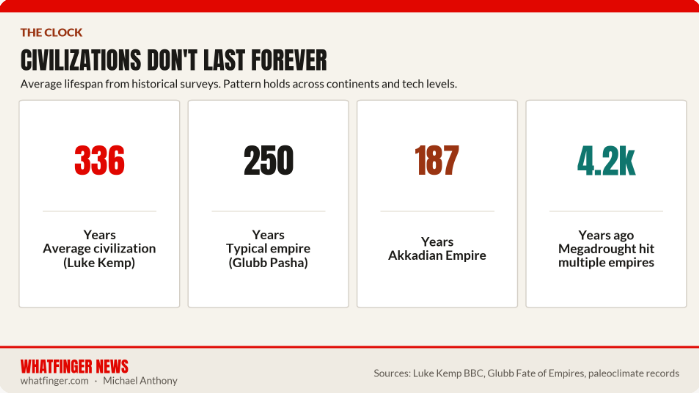
The numbers line up across independent surveys. 336 years is the Kemp average for civilizations. Glubb’s empire average sits near 250. The Akkadian run was shorter. The 4.2k-year drought is the documented climate shock that hit multiple systems at once.
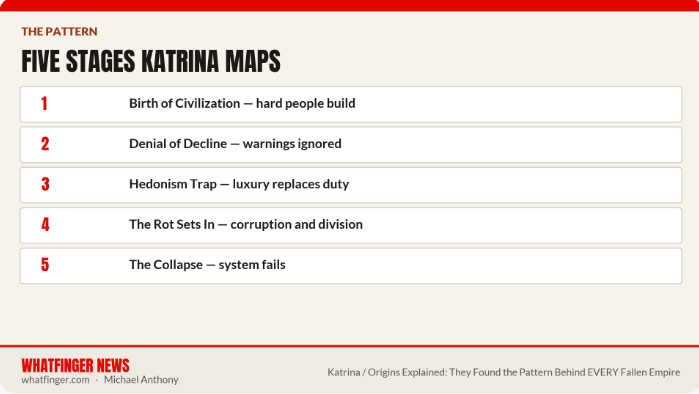
Those are the five stages Katrina maps in the video. Same sequence, different centuries.
Whatfinger News has covered the preparedness and cultural side of these cycles before. The pattern is old. The question is whether the current generation treats the warning signs as real.
Glubb’s six stages of empire
Sir John Bagot Glubb (Glubb Pasha) published The Fate of Empires and the Search for Survival in 1978. He examined eleven major powers spanning roughly three thousand years — Assyria, Persia under Cyrus, Alexander’s Greece, the Roman Republic, the Roman Empire, the Arab Empire, the Mamelukes, the Ottomans, Spain, Romanov Russia, and Britain — and found they clustered around 250 years, or about ten generations. Technology and weapons changed; the human pattern did not.
His own summary lists six stages, not five:
-
Age of Pioneers (Outburst)
A small, often poor and hardy people suddenly erupts with energy and courage. They are untrammelled by tradition, ready to improvise, and driven by ambition. Glubb’s examples include the early Macedonians before Philip, the Arabs after Muhammad, and the American pioneers. “Poor, hardy, often half-starved and ill-clad, they abound in courage, energy and initiative.” -
Age of Conquests
The outburst hardens into organized military expansion. Honor and glory become the chief ambitions. The new power adopts the sophisticated methods of older empires and pushes outward. Conquest here is full-spectrum — military, administrative, and cultural. -
Age of Commerce
Military expansion gives way to trade and the pursuit of wealth. Merchants rise. Fragmented lands under one government create huge commercial opportunities. Honor culture begins to yield to a mercantile one: “To the merchant, such ideas [glory and honour] are but empty words, which add nothing to the bank balance.” -
Age of Affluence
Wealth becomes the dominant goal. “Money replaces honour and adventure as the objective of the best young men… the Age of Affluence silences the voice of duty.” Luxury spreads, education shifts toward credentials that pay, and the society turns defensive — focused on protecting what it has rather than expanding. Glubb called the transition from conquest/commerce into this phase “High Noon.” Enough of the old virtues remain to hold the borders, but selfishness is already rising underneath. -
Age of Intellect
Surplus wealth funds universities, scholarship, and the arts. The ambition of the young turns to academic honors. Glubb noted that this stage often looks like a golden age and produces real scientific advances — the Arabs under al-Ma’mun measured the earth’s circumference with striking accuracy — yet it does not save the empire. Intellectualism multiplies debate and argument while eroding the capacity for decisive action. “The impression that the situation can be saved by mental cleverness, without unselfishness or human self-dedication, can only lead to collapse.” Public affairs drift amid “an unceasing cacophony of argument.” -
Age of Decadence
The final stage. Glubb listed its marks clearly:- Defensiveness
- Pessimism
- Materialism
- Frivolity
- An influx of foreigners
- The welfare state
- A weakening of religion
Causes: too long a period of wealth and power, selfishness, love of money, and the loss of a sense of duty. Civil dissensions rise. People stop believing anything is worth the sacrifice required to preserve the system. External shocks (invasion, economic crisis, migration) finish what internal decay started. The falls look different because the external triggers differ; the internal sequence does not.
Glubb Pasha has been vindicated again. 250 years is about how long most Empires last, and we have a new entrant into that list. @FinestYew @adityajakki https://t.co/D6A3adUS4K
— StillPlaneCrazy (@GasTurbineFella) November 4, 2026
Glubb’s closing points remain blunt. The life histories of great states are “amazingly similar” and driven by internal factors. Their collapses are diverse because external events deliver the final blow. And societies rarely learn from the pattern because historical study is short and selective.
The framework is descriptive, not a rigid clock. Glubb’s date choices for start and end points have been debated, and he himself noted exceptions and overlaps. What has kept the essay circulating is the recurring sequence of values — from pioneering energy and duty, through commerce and luxury, into intellectual argument and finally decadence — and the observation that ~250 years keeps appearing across otherwise unrelated empires.
— The Whatfinger News Team: Ben and Beth with Grok on edits and graphics
