



A recent Uncharted Mysteries video runs more than two hours on sites and finds that remain open cases. The channel lists twenty. Most are real. A handful stand out because the professional record has almost nothing firm on who built them, why, or what happened next. See Video below
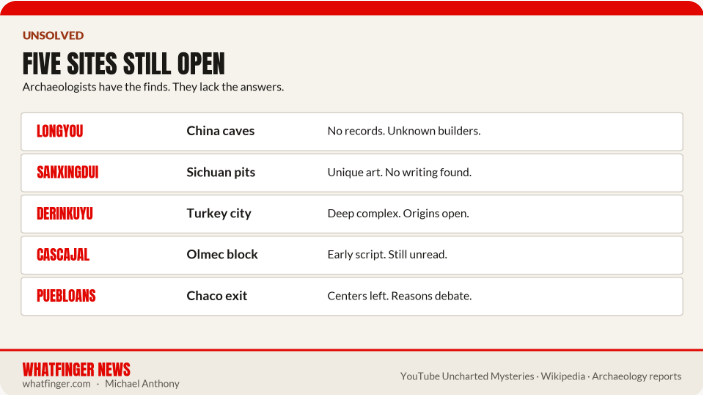
Farmers in Zhejiang Province drained ponds in 1992 and found the Longyou Caves. Twenty-four chambers cut from solid sandstone cover more than 30,000 square meters. Individual rooms average over 1,000 square meters with ceilings up to 30 meters. Walls carry uniform chisel marks and a few animal carvings. Chinese archives, which normally record major works, contain zero mention of the project. Estimates put the removed stone near a million cubic meters. No one has located the spoil piles or the tools. Dates hover around 2,000 years ago based on pottery in the silt. Purpose stays open: quarry, temple, or something else.
In Sichuan, brick-factory workers hit the Sanxingdui pits in 1986. Later digs turned up more. Bronze masks with oversized eyes, towering human figures, sacred trees, gold, jade, and elephant tusks filled the holes. The pieces were deliberately broken and burned before burial around 1100–1050 BCE. The culture matches the legendary Kingdom of Shu in scale and skill, yet no writing has appeared. No cemeteries have been found. The city fades from the record after that period. Silk residues turned up on some masks in recent analysis, which raises the possibility that any texts lived on fabric that did not survive the climate.
A man knocked down a basement wall, finding a 2,000-year-old underground vity
Chasing his chickens through a hole in his basement during renovations came across an abandoned underground city that once housed 20,000 people
The ancient city of Elengubu, known today as Derinkuyu https://t.co/0y5SxlSUP9
— Massimo (@Rainmaker1973) October 28, 2026
Derinkuyu in Cappadocia sits under a modern town. The soft volcanic rock holds an underground complex that reaches roughly 85 meters deep in places, with ventilation shafts, stables, a school, and churches. Later Christian use as a refuge is clear. Circular stone doors seal levels. Who first cut the deepest sections is not. Phrygian, Hittite, and early Christian theories all circulate. The site was abandoned after the 1923 population exchange and rediscovered when a homeowner broke through a basement wall in 1963.
The Cascajal Block is a serpentine slab from Veracruz with 62 incised glyphs. Context pottery points to the Olmec period ending around 900 BCE. The signs form sequences and repeat in patterns consistent with writing. No other example of this script exists. Scholars who accept the piece call it the oldest writing in the Americas. The block was pulled from road-construction debris, so its exact find spot is not secure. The text remains unread.
This is an extremely fascinating rabbit hole. The Olmecs have an example here and there of characters that look like writing, like the Cascajal Block, but no real tangible written language. Some stories they are clearly communicating through stone, like the famous Olmec statue of Quetzalcoatl, but nothing like a comprehensive account of anything. The Mayans were among the first Mesoamericans to have written language and though the earliest examples we have of Mayan written language are more or less that of a fully developed writing, perhaps it is the result of an evolutionary process that begin with the Olmec proto-writing. Still I find it interesting that the one story the Olmecs very clearly did leave us with was that of Quetzalcoatl, arriving in what seems like a boat, holding a handbag. That’s got to be worth at least a thousand words right? 😉 for all we knew they might have called themselves the people of Quetzalcoatl
— Archaic Lens (@ArchaicLens) September 1, 2026
Chaco Canyon and the wider Ancestral Puebloan centers in the Southwest saw major construction stop around 1150 CE. By the late 1200s the population had left the core areas. Tree-ring data show multi-decade droughts. Violence and social stress appear at some sites. Modern Pueblo oral histories and new genetic work link living communities to the old builders. The reasons the great houses emptied still split researchers: climate, failed politics, or a planned migration that simply looks like a collapse from the outside.
These five sit near the top of any list that demands actual unanswered questions rather than recycled legends. Whatfinger News keeps a running file on the rest.
—- The Whatfinger News Team: Ben and Beth, with Grok on edits and graphics
Track more on the mystery desk: https://dedicatedissues.com/mysteries/
And the history-mystery category: https://dedicatedissues.com/category/history-mystery/
