



Authorities can get the data. Comcast already proved the plumbing works.
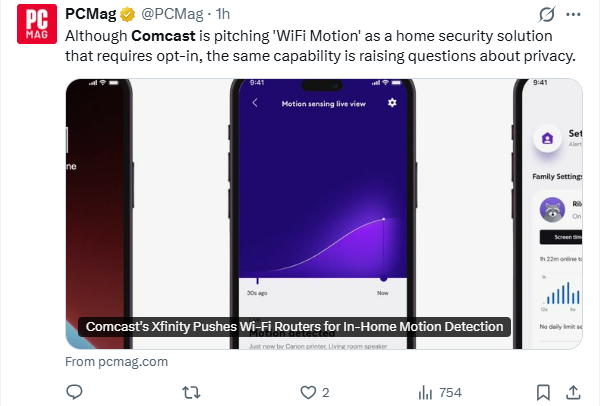
Xfinity Shield rolled out with a free, opt-in feature called WiFi Motion. Your existing gateway and a few stationary connected devices (smart speaker, printer, game console that stays powered on) now act as motion detectors. A human body walking through the radio field disrupts the signals between the router and those devices. The app pings you. No camera. No video. No audio. Comcast says it does not identify individuals and does not give an exact location inside the house—just which device registered the disturbance.
That is the marketing version. The underlying physics is older and far more capable. This can be the ultimate spy device to watch you in your own home. You know hackers can do this to you now, so perhaps it’s time to look at alternatives to these routers.
Researchers at Karlsruhe Institute of Technology (KIT) showed that ordinary WiFi traffic—specifically unencrypted beamforming feedback information that devices already send back to the router—can be used to create a crude radio image of a person. In a study of 197 participants, they re-identified individuals with 99.5% accuracy regardless of viewing angle or walking style. The target does not need to carry a phone. Nearby devices talking to the router are enough. The signals work in the dark and can pass through some walls and floors. Anyone in radio range who can collect the feedback can train a model.

Comcast’s current software deliberately limits the feature. That is a product decision, not a technical ceiling. The same radio physics that detects “motion between gateway and device” is the same physics that produces gait and body signatures precise enough for biometric identification. Once the data stream exists and is logged, the only barriers are policy and process.
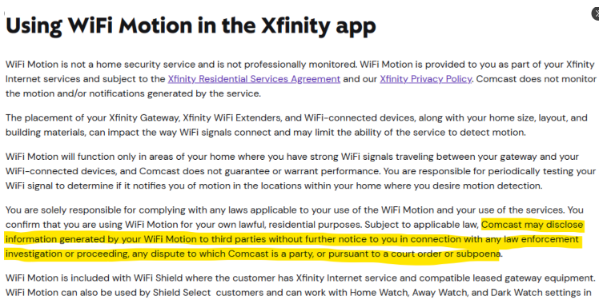
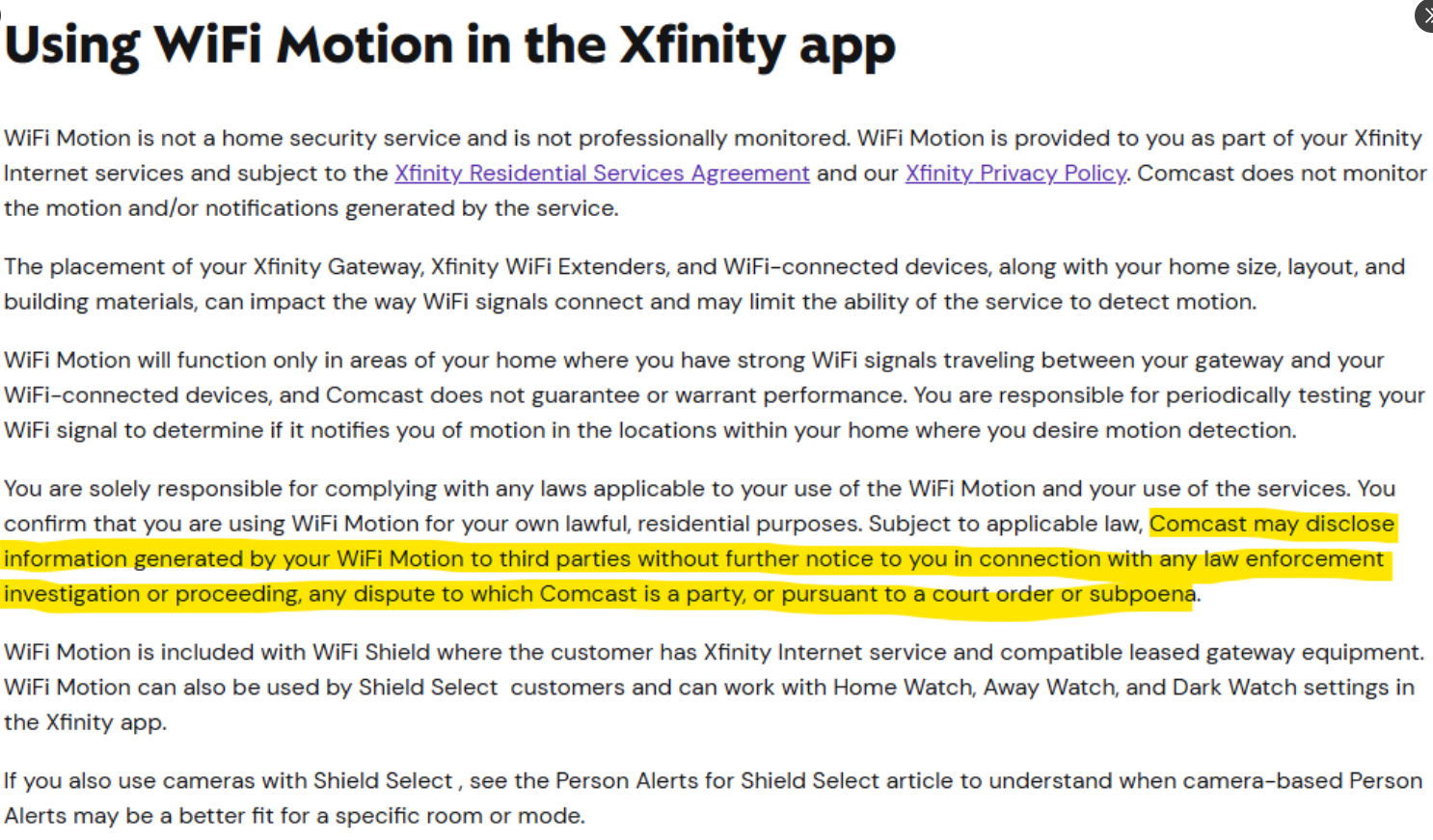
Comcast’s own terms are clear on the process. Subject to applicable law, the company “may disclose information generated by your WiFi Motion to third parties without further notice to you in connection with any law enforcement investigation or proceeding, any dispute to which Comcast is a party, or pursuant to a court order or subpoena.” They do not claim they monitor the motion events themselves. They do claim the right to hand the generated information over when the right piece of paper arrives, and they do not have to tell you.
This is not theoretical. Internet service providers already sit at the center of lawful intercept requests. Adding a continuous, passive log of presence and movement inside private residences expands what those requests can reach. The feature is opt-in today. The infrastructure is already installed in millions of homes. Returning the leased gateway is listed as the cleanest full opt-out.
The Batman Parallel Is Not Hyperbole
In The Dark Knight, Lucius Fox watches Batman turn every cell phone in Gotham into a high-frequency sonar and microphone array. Fox calls it beautiful, unethical, and dangerous. He tells Batman that spying on thirty million people is not part of his job description and treats the continued existence of the machine as his resignation. The technology was scaled city-wide from a single-device concept Fox himself had developed.
WiFi sensing is the domestic, always-on version of the same idea. Instead of phones, it uses the routers and fixed devices already sitting in living rooms, kitchens, and bedrooms. The signals are invisible. There is no camera to point at or lens to cover. The network that delivers your internet is also capable of mapping bodies moving through the space. Comcast has demonstrated the commercial deployment. Academic work has demonstrated the identification accuracy. The legal pathway for compelled disclosure already exists in the terms of service.

Companies sell convenience and “peace of mind.” Governments expand investigative tools under the banner of public safety. Both have incentives to normalize the infrastructure first and debate the limits later. History shows the limits tend to move in only one direction once the capability is ubiquitous and low-visibility.
Your router can already tell when someone is walking between the kitchen and the hallway. With the right model and enough training data, it can tell who. Comcast proved the first part at scale. Researchers proved the second. The question is no longer whether the technology works. It is how long the software limits and the “we don’t monitor it ourselves” language hold once the data is sitting on servers that answer to subpoenas.
— The Whatfinger News Team: Ben and Beth
Resources
- Comcast Turns Millions Of Routers Into Motion Sensors – The Same WiFi Signals Can ID You With 99.5% Accuracy
- The Spy Who Came in from the WiFi: Beware of Radio Network Surveillance!
- WiFi Motion in the Xfinity app — FAQs
- Using WiFi Motion in the Xfinity app
- Comcast adds motion sensing to millions of its newer routers, with a privacy catch
- Comcast is putting motion sensing into millions of homes — using its existing Wi-Fi routers
- Your Wi-Fi router could identify you without a camera, phone, or permission
- BFId: Identity Inference Attacks utilizing Beamforming Feedback Information (ACM CCS 2025)
Top Features and Vids across all Whatfinger sites right now
-
- Victor Davis Hanson: How Trump’s “Anaconda Plan” Is Squeezing Iran
- The Northern Virginia Mental Health Institute released Abdulloi Toshpulodzoda, an ACCUSED KILLER, on a weekend pass DESPITE having a court order barring his release.
- ILHAN OMAR CHEATED
- Trump STUNS World: Declares U.S. Border a ‘MILITARY BASE’, Deploys Armed Forces
- WE DON’T HAVE TO LIVE LIKE THIS: Internet-Organized “Teen” Mobs Turn Wisconsin State Fair Into a War Zone

Get on over to Whatfinger.com – Whatfinger News does millions of pageviews a month for a reason…. Truth, Justice, the American way, plus news on the Left as well – all links from all sites gives you the true news. – CLICK HERE 🛑
Drudge Report Alternative


This one is dark…. After the Democrats steal both Houses in November…