




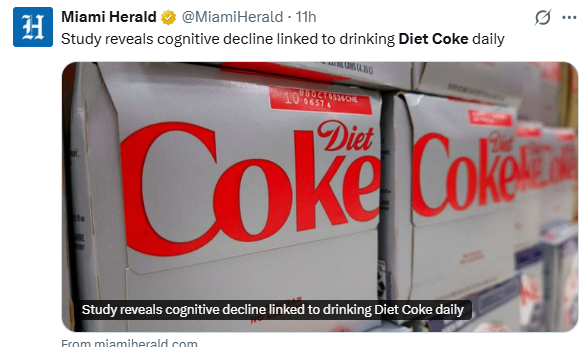
The latest round of hand-wringing over Diet Coke is making the rounds again, this time via a recent MSN write-up that digs into a Brazilian study published in Neurology. The short version: people who regularly knocked back the highest amounts of low- and no-calorie sweeteners—including the aspartame that makes Diet Coke what it is—showed noticeably faster cognitive decline over eight years.
Researchers followed 12,772 Brazilian adults (average age about 52) from the ELSA-Brasil study. They tracked intake of seven common sweeteners: aspartame, saccharin, acesulfame-K, erythritol, xylitol, sorbitol, and tagatose. Participants took cognitive tests measuring memory, verbal fluency, and overall thinking at the start, middle, and end of the roughly eight-year period.
Those in the highest consumption group (averaging about 191 mg of sweeteners per day) declined 62% faster in global cognition than the lowest group. Researchers equated that to roughly 1.6 extra years of brain aging. The middle group was still 35% faster—about 1.3 years. For context, the high-intake level for aspartame lines up with roughly one can of diet soda a day.
Dr. Robert Lustig just destroyed the “diet soda is harmless” myth in one brutal minute.
Dr. Robert Lustig just destroyed the “diet soda is harmless” myth in one brutal minute.
Those sugar substitutes in your can? Especially aspartame and sucralose?
Not safe.
A brand-new study in Annals of Neurology links them directly to increased dementia risk through massive… pic.twitter.com/5nN5JmAgLb
— Camus (@newstart_2024) April 22, 2026
Six of the seven sweeteners were linked to the faster decline, particularly in memory and verbal fluency. Tagatose was the odd one out with no clear association. The effect showed up most clearly in people under 60. Those 60 and older didn’t show the same link. It was also stronger among people with diabetes—exactly the group often told to reach for the “diet” option.
Lead author Claudia Kimie Suemoto of the University of São Paulo has been careful not to overclaim. In interviews she has said the findings alone don’t mean you need to quit the occasional Diet Coke cold turkey. She has, however, personally dialed back her own use after seeing the data, and the study adds to a growing pile of research tying these sweeteners to other problems (cardiovascular risk, diabetes associations, etc.).
Important Caveats Before You Panic-Pour Your Next Can Down the Sink
This is observational research. It shows association, not proof that the sweeteners cause the decline. Diet was measured mainly at baseline via food-frequency questionnaires (people’s memories of what they ate are never perfect). The paper also went through corrections after publication, though the authors say the main conclusions held. Some outside epidemiologists have poked at the statistical choices and residual confounding. In other words: interesting signal, not settled science.
Still, the pattern is hard to ignore when you stack it against earlier work linking diet sodas to higher stroke and dementia risk in some cohorts. The “diet” label has always been a marketing win more than a health guarantee. Sugar is bad; the chemical replacements may simply be bad in different ways.

Practical Take for the Whatfinger Crowd
If you’re under 60 and living on multiple Diet Cokes a day, this is a decent nudge to cut back. Sparkling water, plain seltzer, or the occasional real soda (in moderation) are less complicated options. If you’re using the stuff because of diabetes or weight, talk to a doctor who doesn’t just default to the “switch to diet” script. Midlife is when a lot of the long-term brain trajectory gets set. Treating your brain like an afterthought while chasing zero-calorie buzz is classic short-term thinking.
The study doesn’t turn Diet Coke into poison. It does remind us that the “healthier alternative” industrial food complex has a long track record of selling us solutions that create new problems. Your brain is not a soft-drink marketing demographic. Treat it accordingly.
— The Whatfinger News Team: Leads: Ben and Beth
Dr Lustig:. Those sugar substitutes in your can? Especially aspartame and sucralose? Not safe. A brand-new study in Annals of Neurology links them directly to increased dementia risk through massive generation of reactive oxygen species (ROS) — oxidative stress that damages brain cells. Dr. Lustig couldn’t find the same data yet for monk fruit, stevia, or allulose, but for the two most common artificial sweeteners? The evidence is getting uncomfortably strong. One casual sip at a time, we might be trading sugar for something worse for the brain. Have you been drinking diet sodas thinking they’re the healthier option — or are you rethinking artificial sweeteners after this?
References
- Association Between Consumption of Low- and No-Calorie Artificial Sweeteners and Cognitive Decline: An 8-Year Prospective Study (Neurology)
- Sweeteners in diet drinks may steal years from the brain (ScienceDaily / American Academy of Neurology)
- Study reveals cognitive decline linked to drinking Diet Coke daily (MSN)
- Artificial sweeteners aged the brain by over 1.5 years, study says (CNN)
- Are Artificial Sweeteners Really Worse For Your Brain Than Sugar? An Epidemiologist Explains (ScienceAlert)
- Artificial Sweeteners Like Aspartame Linked To 1.6 Years Of Extra Brain Aging In 8-Year Study (IFLScience)

Top Features and Vids across all Whatfinger sites right now
- Sad Truth Behind Perez Hilton’s Horrifying Livestream Finally Comes Out
- Airlines Caught Spying on Grieving Families: Ticket Prices Double for Funerals Under Creepy ‘Surveillance Pricing’ Scam
- Scientists Issue WARNING After Spotting 20 UFOS On The Moon – Tim Pool
- Cartel Animals Execute Beauty Influencer Live on TikTok Because She Dumped the Boss’s Son (Distressing Vid included)
- Weed Now Beats Cigarettes as America’s Daily Habit — Alcohol Still Rules the Roost, But the Culture Is Getting Higher
Get on over to Whatfinger.com – Whatfinger News does millions of pageviews a month for a reason…. Truth, Justice, the American way, plus news on the Left as well – all links from all sites gives you the true news. – CLICK HERE 🛑
Drudge Report Alternative

