



JUST IN – EU President Ursula von der Leyen says that people’s savings accounts are a problem and that she must put this money “to the service of European companies” says her plan to “securitize them” and “supervise them” They’re coming for your savings, Europe.
JUST IN – EU President Ursula von der Leyen says that people’s savings accounts are a problem
and that she must put this money “to the service of European companies”
says her plan to “securitize them” and “supervise them”
They’re coming for your savings, Europe. pic.twitter.com/zhlXndiAHg
— Tablesalt 🇨🇦🇺🇸 (@Tablesalt13) August 31, 2026
That’s the blunt read of Ursula von der Leyen’s remarks in Paris last week — and the viral X posts that followed are not inventing the language. (see clip above)
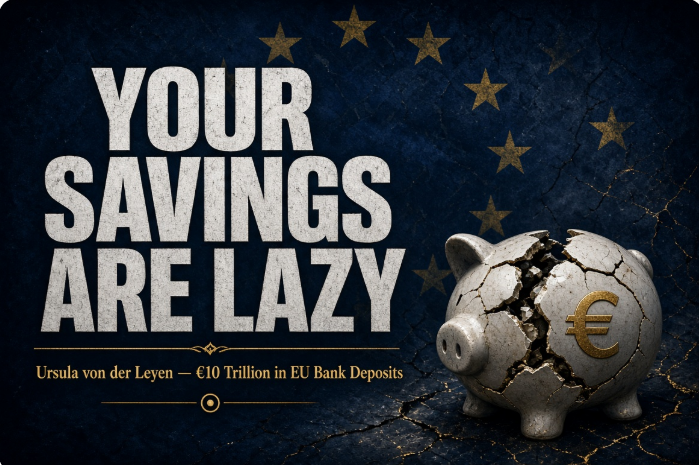
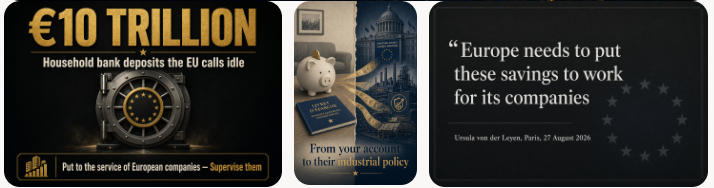
On August 27 at the MEDEF entrepreneurs’ summit, the European Commission president told French business leaders that Europe has a problem: too much of its people’s money is sitting in bank accounts instead of being put to work for “European companies.” She put a number on it: about €10 trillion in household deposits. In French she called that savings paresseuse — lazy. The official English transcript softened it to “sitting idle.”
Then came the policy pitch. Europe must put this money “to the service of its companies.” The vehicle is the Savings and Investments Union. The tools she listed: securitization, bank and insurance investment rules, market integration, and supervision. Brussels claims the package could unlock up to €470 billion in extra investment. She wants a deal by the end of 2026 — with all 27 member states if possible, “or, if necessary, with those that are ready.”
That last line is the tell. If the frugal countries balk, the willing ones move first. Enhanced cooperation. More Brussels, less national veto.
This is not a press release announcing that the Commission will empty checking accounts tomorrow. Officials and fact-checkers will say citizens keep “full control” and the plan is about incentives, better products, and deeper capital markets so Europeans choose to buy European stocks and funds instead of leaving cash in low-yield deposits. That is the official line. It is also how these projects always start.
The money problem they will not say out loud
The EU is not doing this from a position of strength. The next seven-year budget (2028–2034) is already a fight. The Commission floated a package approaching €2 trillion. Germany, the Netherlands, Denmark, Austria, Finland and Sweden — the net payers — want hundreds of billions cut and have ruled out new common borrowing as the answer. They say the proposal is unaffordable.
At the same time the bloc is trying to fund Ukraine, industrial policy, the Green Deal hangover, migration, and a new defense push (ReArm Europe). Frozen Russian assets are still being debated as a piggy bank for Kyiv; legal and political resistance remains. Public budgets are strained. Demographics are ugly. Energy is no longer cheap. The Draghi competitiveness report already flagged an investment gap in the hundreds of billions a year.
When politicians talk about “idle” household savings while their own books do not add up, people notice. X users immediately connected the dots: first they relabel your cash as unused European capital, then they build the pipes (securitization, EU-level supervision, tax and regulatory nudges), then staying in a simple deposit becomes the expensive or inconvenient option. Some went further and tied it to the digital euro timeline and possible future capital controls. That part is speculative. The speech is not.

“Supervise them”
The words that jumped out on X were “securitize them” and “supervise them.” Securitization means packaging loans so banks can sell them off and lend again. Supervision, in this context, means more of the market watched from the center instead of 27 national watchdogs. The Commission has already tabled a market integration and supervision package. National “deviations” that block capital flowing the way Brussels wants are the problem to be solved.
Europeans have seen this movie. Cyprus 2013. Greek haircuts. Bank levies and windfall taxes that keep appearing in national budgets. Dormant-account raids floated in Germany. Talk of tighter rules on non-EU accounts. A digital euro that the ECB insists is safe and limited — while critics see a payment rail the authorities can see, cap, and eventually condition. None of that is the same as von der Leyen signing a confiscation order. All of it is the same direction: more of your financial life designed, steered, and watched from above because “Europe needs” the capital.
The Commission’s own documents frame the Savings and Investments Union as connecting “savings with productive investments” and giving citizens better options. Fine. The president of the Commission standing in front of French bosses and calling household deposits lazy, then saying that money must now serve European companies under EU supervision, is a different register. It treats private savings as a policy resource. That is the part people heard.
How dictatorships talk about other people’s money
The EU is not a cartoon dictatorship. It is a dense, unelected, regulatory superstructure that already writes rules on speech, energy, farming, cars, borders, and now increasingly on where capital is “allowed” to sit. Von der Leyen’s line — we have the savings, they are lazy, we will put them to work and supervise the markets — is the language of planners who have run out of easy public money and have noticed there is still a lot of private money.
Budget holes do not stay holes. They get filled. First with joint debt, then with Russian assets, then with “idle” household deposits that need a better purpose. The official documents will always say voluntary. The political pressure, the tax treatment, the product design, the supervision, and the emergency language in the next crisis will do the rest.
Europeans who keep cash in a bank because they do not trust Brussels industrial policy, or because they remember what happened last time politicians needed “solidarity,” are not being lazy. They are being rational. Calling that rationality a problem that must be supervised is the tell.
The X post that started the latest wave put it simply: They’re coming for your savings, Europe. The speech did not prove a midnight raid on every account. It proved the mindset. That is usually enough. The EU is desperate for cash. Their socialism has destroyed their best nations, and illegals have decimated their budgets. Yet they continue their stupidity. As Trump loves to say ‘Everything woke turns to shit’ and there is no political entity on Earth more woke than the EU.
— The Whatfinger News Team: Sgt K and Lisa
Resources
- JUST IN — EU President Ursula von der Leyen says people’s savings accounts are a problem (Tablesalt13 on X)
- Speech by President von der Leyen at the 2026 French Entrepreneurs’ Summit (official English text)
- 10.000 milliards d’euros d’«épargne paresseuse» — Le Figaro
- Épargne « paresseuse » : Bruxelles vise 10 000 milliards — France Épargne
- Savings and investments union — European Commission
- Six EU net contributors demand hundreds of billions in cuts to bloc’s long-term budget — Reuters
- Four EU countries renew push to use Russia’s €210bn assets to support Ukraine — Euronews
- Von der Leyen: Europas Sparer sollen Investoren werden — Berliner Zeitung
- Fact check: Does the EU want to “steal” private savings? — DW (2025 context on earlier SIU claims)
Top Features and Vids across all Whatfinger sites right now
- Kindergarten teacher says half of her class wants a different gender…. What? – clip
- AOC Is the Democrats’ 2028 Frontrunner — And Most Americans Still Don’t Know She Just Rejoined the DSA Crowd That Wants a New Constitution
- RFK Jr: “We’re seeing an explosion in all cancers in young people and particularly soft tissue cancers.
- PANIC: Christians Mass Boycott WNBA After League BANS ‘Jesus Christ’ From Jerseys, Allows ONLY Islam…
- RFK JR. DROPPED A $100 BILLION BOMB. Medicare fraud. Over $100 BILLION stolen every year by Democrats and foreigners
- ‘Biology doesn’t lie’: Miss Universe Australia takes stand against trans athletes in women’s sport
