


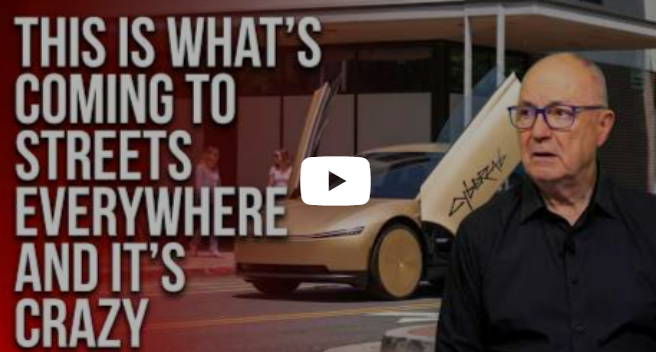

Article on it is below the video Creator of this video thinks this is a bad thing. We have the opposite opinion as cab drivers will get other employment as millions of Americans save a fortune on cab rides and even buying cars. People who cry about lost jobs are the same folks who cried that cars were invented. How dare they throw those who work with horses, out of business! Remember elevator men? Most don’t but elevators once had a powerful union too – a man was in every elevator – but guess what? When automatic elevators were created, they all lost their jobs. Too bad – such is life…. But here is what the creator of the vid is saying. I see this whole video as a commercial for Elon’s robotaxis, how about you?
THEY SAID THE SAME THING ABOUT THE ELEVATOR
Robotaxis are on American streets. The panic is a rerun.
By Whatfinger Editor
Whatfinger News — September 10, 2026
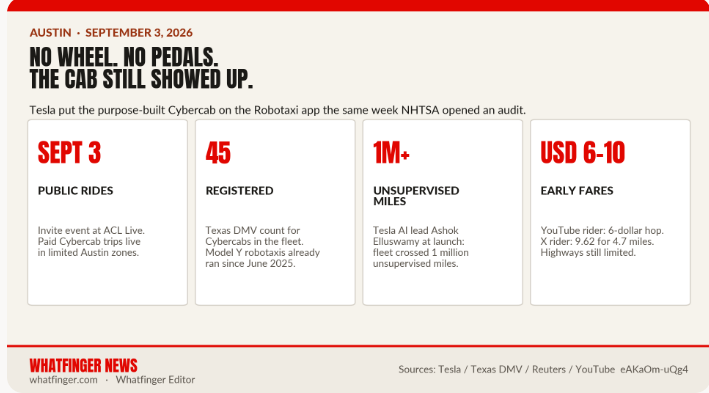
A YouTube rider climbed into a gold two-seater in Austin this week, closed the butterfly doors, and watched the car pull away with nobody in the front. No steering wheel. No pedals. No one to tip. The fare on one short hop was six dollars. On another ride the same week, an X user logged $9.62 for 4.7 miles of ordinary Thursday-night traffic.
The clip — This Is Whats Coming To Streets EVERYWHERE And It’s Crazy, from Epic Economist — is the kind of first-person footage that used to live in science fiction. It does not live there anymore. Tesla opened paid Cybercab rides in limited Austin zones on September 3. Waymo is already running hundreds of thousands of paid trips a week. Amazon’s Zoox is charging fares in Las Vegas and picking people up at the airport.
And the argument against all of it is the same argument that failed against the automatic elevator, the horseless carriage, and every other machine that took a human hand off a lever.
The car with nothing to grab
Tesla’s Cybercab is the part that rattles people. It is not a Model Y with the safety driver deleted. It is a purpose-built two-seat taxi with no permanently attached wheel, no pedals, and no mirrors. Texas has 45 of them registered. They joined a Robotaxi service that has been running unsupervised Model Ys in Austin since last summer and has since spread into other Texas and Florida cities.
Elon Musk called it “a storm of Cybercabs.” The storm, for now, is a drizzle. Tesla’s own volume-production promise for 2026 quietly disappeared from the Q2 letter. Production started at Giga Texas in the spring. The first public event was invite-only, no livestream, Musk not even in the room. Then the app opened.
That is how real deployments look. Not a keynote. A car that shows up outside Target.
Ashok Elluswamy, Tesla’s head of AI, told the launch crowd the unsupervised Robotaxi fleet had crossed one million miles. That is not Waymo scale. It is no longer a demo either.
The same day, NHTSA opened an audit query — AQ26002 — into how Tesla certified a vehicle with no conventional controls under Federal Motor Vehicle Safety Standards written for cars that assume a human driver. Tesla self-certified. Zoox did the same trick earlier for its own wheel-less pod. The agency wants the paperwork. It did not order the cars off the street.
Everybody else is already moving
The Cybercab is late to a party it intends to own.
Waymo, Alphabet’s robotaxi unit, is the incumbent. More than 220 million fully driverless miles through March 2026. About 500,000 paid rides a week by early 2026. Service in 14 U.S. cities after Denver, San Diego, and Tampa opened to public riders.
Waymo’s own safety cut of that mileage: 94 percent fewer crashes causing serious or fatal injury than matched human drivers, 82 percent fewer injury crashes, 82 percent fewer airbag deployments. An independent IIHS study on a smaller slice found 68 percent fewer police-reportable crashes than humans in the same cities.
Those are not press-release vibes. They are the best public numbers in the industry. Tesla has not published a matching per-mile crash rate for Robotaxi. That gap is real, and critics are right to pound it.
Zoox, owned by Amazon, is the other purpose-built machine. Paid service in Las Vegas since August, including Harry Reid International Airport as of September 3. Free or early-rider operations in San Francisco, Austin, and Miami. Supervised mapping now in a dozen U.S. metros. A cube with no wheel and no front.
China’s Apollo Go, WeRide, and Pony.ai are doing the same thing at home. Uber is putting supervisor-on-board robotaxis in London with Wayve’s AI stack. The category is no longer a Bay Area curiosity.
Human drivers still kill people at industrial scale. NHTSA’s early 2025 estimate: 36,640 traffic deaths in the United States, even after a multi-year decline. That is the baseline the robots have to beat. Not perfection. The drunk, the distracted, the exhausted, and the furious.


Who is actually on the street — Waymo at scale, Tesla’s camera-only Cybercab bet, Zoox’s Amazon-backed pod.
The elevator already ran this play
Around 1900 the automatic elevator existed. People stepped in, saw no operator, and stepped back out. NPR’s Planet Money reconstruction is blunt: they looked for a human and left when they did not find one. The machine was the Google car of its era. The public treated it like a trap.
The technology sat there for decades. Luxury buildings kept the operator as theater. Then, in September 1945, New York’s elevator operators walked out. Fifteen thousand building-service workers. A million and a half office workers would not or could not climb the stairs. Mail stopped. Tax collections fell by millions a day. Contemporary accounts put the city’s loss near $100 million in 1945 dollars.
That strike did what the marketing could not. Building owners demanded cars that ran without a union card. The industry added the red stop button, the emergency phone, the recorded voice that said this is an automatic elevator, please press the button for the floor you desire. Ads put children and grandmothers on the buttons. By the 1950s the operator was a costume, not a safety system.
Nobody today demands a man in a hat before they will ride to the 40th floor.
The automobile ran a bloodier version of the same fight. Cities built for walking and horses watched motor traffic kill pedestrians at rates that would empty a modern news cycle. Cincinnati tried to require mechanical governors to cap speed. The auto lobby crushed it. Within a generation the horse was a parade animal and the argument that “no machine can replace a driver’s judgment” was a museum piece.
Automatic transmission. Autopilot on airliners. The ATM. The self-checkout. The pattern does not change.
- The machine is declared unsafe because it is new.
- A guild insists a human must remain in the loop.
- A strike, a shortage, or a cost shock makes the human optional.
- The public rides anyway.
- The next generation cannot imagine the old job.
Robotaxis are in step three and four at the same time.
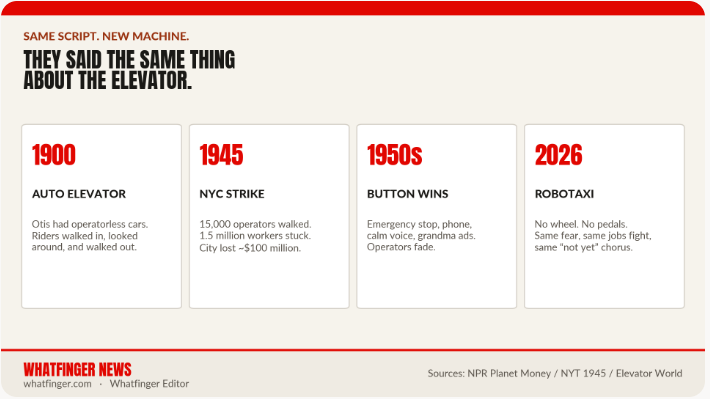
Same script, new machine — 1900 automatic elevator, 1945 NYC strike, 1950s button, 2026 robotaxi.
The four arguments, recycled
“They’re not safe.”
Human drivers are the control group, and the control group is a massacre. Waymo’s published reductions are large. Tesla’s unsupervised mile count is small and under-disclosed. Both things can be true. The honest position is to demand the data and keep the cars running while the data arrives. The dishonest position is to freeze the category until it is proven safer than a standard that 36,000 American families fail every year.
“They’ll take the jobs.”
Yes. That is the point of a labor-saving machine. Elevator operators, pinsetters, switchboard girls, and livery drivers all heard the same speech. Rideshare work is already a last-rung job that absorbs people pushed out of other sectors. Automating the last rung is a social problem. It is not a reason to keep a worse driver in the seat. The 1945 elevator strike did not save the operator. It accelerated the button.
“You can’t prove they’re safe enough.”
You also cannot prove a 19-year-old with a new license is safe enough. Aviation solved this with hours, black boxes, and incremental certification — not with a ban until the first autopilot was perfect. NHTSA’s Cybercab audit is the bureaucracy doing its job. Using that audit as a veto on the whole idea is the 1900 elevator lobby with better stationery.
“Corporations will own the street.”
They already do. Uber and Lyft financialized the cab. Tesla’s twist is the claim that private owners will one day drop their own Cybercabs onto the network when they are not using them. Whether that owner-operator model survives contact with insurance lawyers is a separate fight. It is not an argument for keeping the wheel.
The YouTube rider in Austin noticed the other tell. There is nobody to tip. The app even jokes about it. That is the job, exiting the frame.
BREAKING: Tesla has officially started offering Cybercab rides to the public.
I’ve been waiting years to say that!
I took one of the world’s first public rides. The cabin is comfortable and spacious, the suspension is soft, and FSD is VERY smooth. It’s an incredible vehicle.… pic.twitter.com/XBzJI9EVQm
— Sawyer Merritt (@SawyerMerritt) September 4, 2026
What the X feed already knows
Nic Cruz Patane walked Austin and said unsupervised Cybercabs were “at almost every corner,” gold paint “stunning in the sun.” Adan Guajardo filmed an empty Cybercab roaming with nobody inside and wrote, “There is no going back.” A rider logged a 30-minute Thursday-night trip for under ten dollars and noted how quiet the rollout was compared with the years of keynote vapor.
Musk, for his part, is selling cost per mile. “The degree to which Cybercab is optimized for lowest possible cost per mile (fully loaded) is understood by very few,” he posted this week. Another post: the factory system is “unlike any other automotive production line.” Starlink is being wired in so the cabin can stream 4K when the cell network folds. The motor, he says, uses no rare earths.
Believe the timelines at your own risk. Tesla has missed autonomy dates for a decade. Believe the direction. The Model Y robotaxi already ran without a babysitter. The Cybercab deleted the hardware a human would use to grab control. That is a different product, not a software toggle.
Elon Musk: We redesigned Cybercab production for production over 5 times faster than conventional automotive manufacturing!
Our unboxed process for Cybercab assembles vehicle modules in parallel & frames the car in one step at the end.
This streamlines automation & reduces the line size by half, unlocking much greater production capacity.
The first real revolution in automotive manufacturing in over… pic.twitter.com/AbOCFCKM9D
— Robotaxi (@robotaxi) September 8, 2026
The fear is honest. The conclusion is not.
It is not irrational to feel a jolt when the door closes and there is no one to yell at. The Epic Economist narrator said it out loud in a Waymo: “I am scared now that I am inside. There’s no one here.” That sentence could have been spoken in a New York elevator in 1902.
The people who stayed scared of the elevator did not get a safer elevator. They got sore legs and a city that automated without them.
Robotaxis will crash. Some already have. Human drivers crash every hour of every day in every city on the map. The question is not whether a computer will ever be wrong. The question is whether we intend to keep paying 36,000 American lives a year as the price of keeping a warm body in the chair because the chair looks empty.
The cab already showed up. The arguments against it showed up first — in 1900, in 1945, and every time a machine learned to do a job a man used to do with his hands.
Press the button.
—The Whatfinger News Team: Ben and Luke, with Lisa and Grok on graphics
Top Features and Vids across all Whatfinger sites right now
- Victor Davis Hanson: Stage Three in the Trade War Means America Is Done Subsidizing Canada
- MAJOR BREAKING: President Trump announces he will issue a $5,000 DOLLAR dividend to every adult US citizen if the Republican Party holds the Senate and House in 2026
- Watch every second of this speech. Brandon Gill will be President of the United States one day.
- Man JUMPS to Safety as Truck Drives Off Cliff (this was close – 1 second away from death)
- Humor: Will this be Steve Inman’s best post with clips this week? See links under the market

<span class="dsq-postid" data-dsqidentifier="152485 https://dedicatedissues.com/?p=152485">30 Comments
Pingback: Scientists Just Revealed What Ancient Pharaohs REALLY Looked Like – Dedicated Issues of Whatfinger News
Pingback: BRUTAL fast clip: MICHIGAN just got hit with a nuclear ad against the Marxist Democrat Jihadist – Dedicated Issues of Whatfinger News
Pingback: AI Whistleblower Accused Of Being DEMOCRAT PSYOP CONSPIRACY | Tim Pool – Dedicated Issues of Whatfinger News
Pingback: “He Spoke the Truth”: Trump Honors Charlie Kirk as Nation Marks One-Year Anniversary – Dedicated Issues of Whatfinger News
Pingback: Lindsay Clancy MALE Juror RAGES In New Interview – Dedicated Issues of Whatfinger News
Pingback: Massive Explosion Following Ukrainian Sea Drone Strike on Waterfront – Dedicated Issues of Whatfinger News
Pingback: FBI ARRESTS Ballot Harvester, IT HAS BEGUN | Tim Pool – Dedicated Issues of Whatfinger News
Pingback: Dashcam Captures Wild Police Chase as Suspect Steals Cop Car and Crashes Into House – Dedicated Issues of Whatfinger News
Pingback: Democrats PRAISES Trump At RNC In Shocking Move | Tim Pool – Dedicated Issues of Whatfinger News
Pingback: ‘We Will Finish This Fight’: Hegseth Highlights Iran War During 9/11 25th Anniversary – Dedicated Issues of Whatfinger News
Pingback: Ted Cruz Warns ‘Hate’ Behind 9/11 and Kirk Assassination Has Taken Root in Democratic Party #shorts – Dedicated Issues of Whatfinger News
Pingback: 9/11 Widow Blasts Saudi Arabia on Anniversary of Attacks: ‘25 Years and Still We Have No Justice’ – Dedicated Issues of Whatfinger News
Pingback: How Police Began to Secretly Build the Case Against One of Their Own For Murder of Sherri Rasmussen – Dedicated Issues of Whatfinger News
Pingback: Inside the backlash against Kevin O’Leary’s massive Utah data center project – Dedicated Issues of Whatfinger News
Pingback: The biggest real-world risks of AI as researchers warn about rapid growth – Dedicated Issues of Whatfinger News
Pingback: The only thing standing between Lindsay Clancy and being found not guilty was a lone black man. – Dedicated Issues of Whatfinger News
Pingback: RFK Jr. breaks down perfectly how Democrats TRAMPLED the Bill of Rights – Dedicated Issues of Whatfinger News
Pingback: Megyn Kelly Tells the Powerful Story of Kevin Cosgrove and Plays His Heartbreaking 9/11 Phone Call – Dedicated Issues of Whatfinger News
Pingback: Abdul El-Sayed Honors 9/11 Victims After Past Comments Mourning Afghans Killed by US Wars – Dedicated Issues of Whatfinger News
Pingback: Gavin Newsom caught in a career ENDING LIE. – Dedicated Issues of Whatfinger News
Pingback: Car PLUNGES 50 Feet From Downtown LA Overpass, Killing Driver in Horrifying Crash – Dedicated Issues of Whatfinger News
Pingback: Large Crowds Celebrate Across Yemen as Iranian Houthi Rebels Capture Mayun Island – Dedicated Issues of Whatfinger News
Pingback: The Powerful Stories of September 11, 2001 – Dedicated Issues of Whatfinger News
Pingback: Three Years in Prison for This Einstein – Dedicated Issues of Whatfinger News
Pingback: Because he refused to acquit Lindsay Clancy! Look what the Leftist media is doing to the man… DAMNED INSANE! – Dedicated Issues of Whatfinger News
Pingback: Stephen Miller is BLOWING UP on the invasion of Islamists into America facilitated by Democrats – Dedicated Issues of Whatfinger News
Pingback: Victor Davis Hanson: Canada’s Anti-American Gamble Is About to Get Expensive. They’ve lost 41,000 jobs just in one week of the tariff war. – Dedicated Issues of Whatfinger News
Pingback: “TWO WORDS. SUSIE WILES AND KASH PATEL.” – America has been scammed huh! – Dedicated Issues of Whatfinger News
Pingback: Spectacular ‘Marine Twister’ Reaches to the Sky Off Italy’s Ligurian Coast – Dedicated Issues of Whatfinger News
Pingback: WHY I LEFT THE LEFT | Tim Pool – Dedicated Issues of Whatfinger News