




In September 1991 a German couple hiking the Tisenjoch pass on the Italian-Austrian border found a body half out of the ice. They thought it was a recent mountaineer. Radiocarbon dating put the man at 5,300 years old. Ötzi carried a copper axe, an unfinished yew bow, a quiver, and clothing of animal hide and plant fiber. An arrowhead was still lodged in his shoulder. He died on a high Alpine route centuries before the first dynasties in Egypt and Sumer wrote anything down.
That single find opened the field. As mountain ice patches retreat, more of the same material appears. Norway’s Secrets of the Ice program, run by Innlandet County and the Museum of Cultural History in Oslo, has documented 73 sites and recovered more than 5,000 artifacts since 2006. This past season they pulled 48 prehistoric arrows from three patches in Jotunheimen. One slate arrowhead with part of its wooden shaft is estimated at 5,000 to 6,000 years old. Another complete arrow with a freshwater-mussel shell tip is about 3,600 years. They have also recovered the world’s oldest intact pair of wooden skis, a 3,400-year-old leather shoe, Iron Age tunics, and the bones of packhorses that carried gear across the passes. Continued below the vid
These are not one-off losses. The high mountains were hunting grounds and travel routes for millennia. Reindeer hunters worked the ice edges. Traders crossed the passes. The organic material—wood, leather, sinew, textile—survived only because it stayed frozen. Soil would have eaten it.
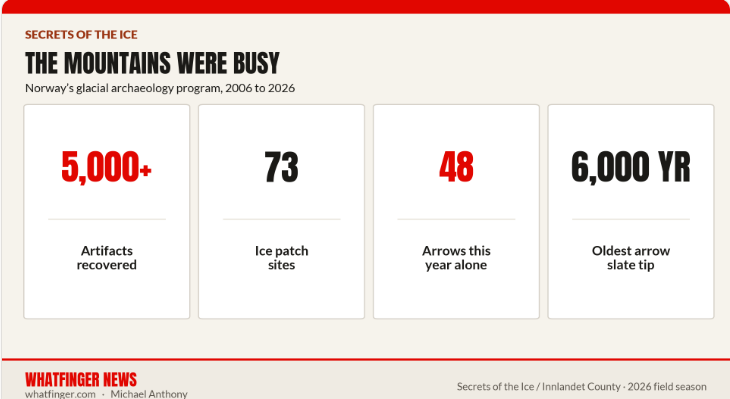
Norway’s glacial archaeology program has recovered thousands of objects that show intensive use of the high country long before recorded history.
Farther north the ice itself is the archive. In 1966 the U.S. Army drilled Camp Century in northwest Greenland under the cover of a science station. The real plan was Project Iceworm, a scheme to hide nuclear missiles in tunnels under the ice. The base was abandoned. The ice core went to a freezer in Denmark and sat for decades. When researchers finally examined the bottom sediment under nearly 1.4 kilometers of ice, they found twigs, leaves, mosses, fungal remains, insect fragments, and an Arctic poppy. Cosmogenic isotopes show the sediment was exposed at the surface within the last 1.1 million years. Similar material under the summit ice at GISP2 shows tundra vegetation in central Greenland. The ice sheet has melted and reformed at least once in that window. Greenland has not been a permanent white fortress for the entire Pleistocene.
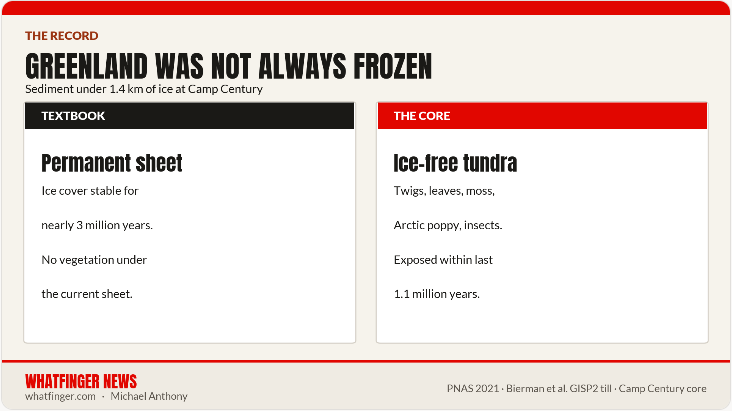
Sediment recovered from under 1.4 km of ice at Camp Century contains plant fossils from periods when northwest Greenland was open tundra.
Whatfinger’s Joe Rogan Mysteries – plus many more he hasn’t tackled
Antarctica is older and more sealed. Radar and seismic surveys have mapped the bedrock under the East Antarctic Ice Sheet. The topography preserves river valleys, hills, and large basins from before the ice sheet formed roughly 34 million years ago. Lake Vostok, roughly the size of Lake Ontario, sits under more than two miles of ice and has been isolated for about 15 million years. Russian drillers reached the lake in 2012. Analysis of the refrozen water later recovered DNA sequences from thousands of organisms, mostly bacteria, with traces consistent with fungi and other life that evolved in permanent darkness, likely powered by rock chemistry and possible hydrothermal activity. No sunlight has reached that water since before our genus existed.
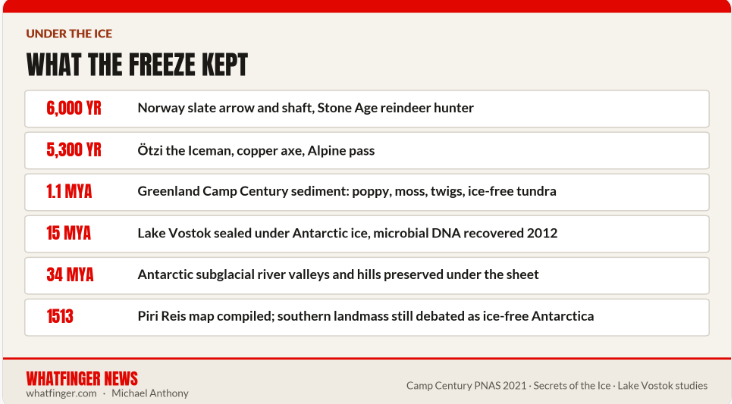
A short timeline of what the ice has preserved, from Stone Age arrows to sealed lakes that predate humans by millions of years.
The 1513 Piri Reis map keeps the argument going. The Ottoman admiral compiled it from about twenty earlier charts, one of which he said came from Columbus. Charles Hapgood and others later argued that the southern landmass matches the subglacial coastline of Antarctica, drawn when the ice was thinner or absent. Mainstream historians and cartographers point out that the Drake Passage is missing, the land sits too far north, and the features look more like a distorted South American coast or the speculative Terra Australis that appears on many maps of the period. Antarctica has been under ice for millions of years. The map is genuine. Whether it carries a lost survey is still contested.
What is not contested is the material the ice is delivering right now. Tundra under Greenland’s sheet within the last million years. Sophisticated hunting gear on Norwegian ice patches 6,000 years old. A sealed lake under Antarctica that has held life in darkness for 15 million years. Landscapes and ecosystems locked away longer than any written record. The poles have not always looked the way we found them. The melt is simply showing the older receipts.
— The Whatfinger News Team: Sgt Beth and Sgt Ben, with Grok on edits and graphics
