



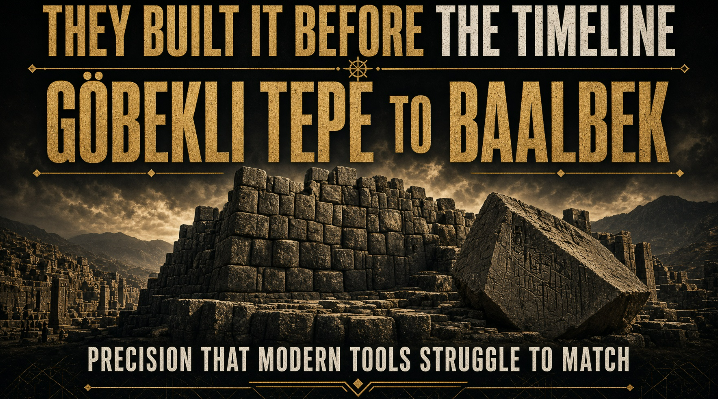
A Secret Origins video making the rounds this week lays out the same case the X accounts keep posting: structures that look impossible for the tools and timelines we assign them. Baalbek’s trilithon blocks, Puma Punku’s andesite cuts, Sacsayhuamán’s interlocking walls, Göbekli Tepe’s pillars raised by hunter-gatherers. The claim is not that aliens landed. The claim is that the engineering, in scale and fit and endurance, sits ahead of what the official story allows for the period.
The numbers are not small. At Baalbek the three finished trilithon blocks each run about 19 meters long and weigh in the 750-to-800-ton range. They sit in the podium wall of the Temple of Jupiter. In the quarry a short walk away sit even larger unfinished stones, one estimated near 1,650 tons. Roman cranes of the period topped out far below that. The joints are tight. No mortar. The stones are real. How they were moved the final distance and lifted into place is still argued. Continued below the vid
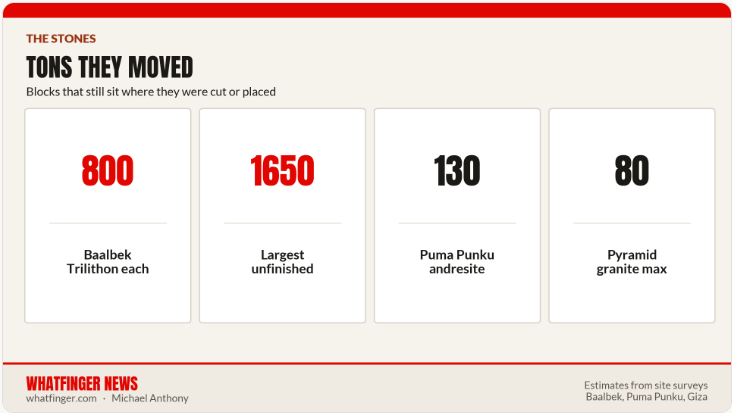
Puma Punku shows the same problem in a different stone. Andesite blocks, some over 100 tons, cut with straight edges, right angles, and interlocking shapes that look machined. The site is older than the Inca. Modern masons looking at the tightest fits say they would have trouble matching the precision with today’s hand tools. Sacsayhuamán’s walls use irregular polygons that lock together so well they have ridden out earthquakes that flattened later Spanish buildings above them. No mortar again. Just mass, shape, and time.
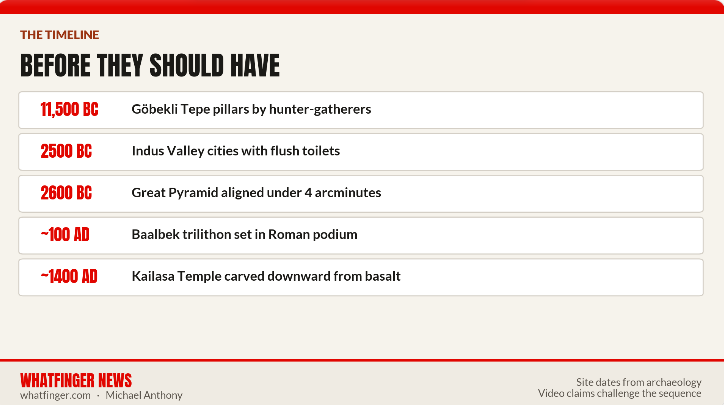
Göbekli Tepe pushes the calendar harder. Massive T-shaped limestone pillars, some ten tons, raised on a hill in southeastern Turkey around 9600 BC. That is before farming, before pottery, before metal tools, before writing. Hunter-gatherers organized enough labor to quarry, move, and erect them. The official sequence said farming came first, then monuments. The stones say otherwise.
Whatfinger’s Joe Rogan Mysteries – plus many more he hasn’t tackled
The Great Pyramid’s alignment is under four arcminutes off true north across a 230-meter base. That is tighter than most modern buildings need. The casing stones that remain fit so closely a blade will not slide between them. Kailasa Temple at Ellora was not assembled. It was carved downward out of solid basalt. Hundreds of thousands of tons of rock removed to leave a freestanding temple continuous with the mountain. One wrong cut and the whole thing fails.
X posts on the same topic run the same loop. Precision granite in Egypt and Peru. Interlocking megaliths with no mortar and no shift after millennia. Narrow tunnels under the Serapeum of Saqqara where multi-ton granite boxes sit with no clear path for how they were lowered and turned. Some accounts lean hard into lost civilizations or free-energy theories. Most stay on the measurable fact: the stones are there, the fits are tight, the weights are high, and the tool marks do not always match the story we tell about copper chisels and ropes.
Is the video right that some of this was “more advanced than our own”? On the tools available at the time, yes. On the endurance of the work, yes. Roman concrete self-heals because of volcanic ash and lime chemistry modern mixes still chase. Inca walls outlasted colonial construction because the joint design absorbed movement. We move heavier loads today with cranes and engines. We do not do it with the same combination of limited power, exacting fit, and multi-thousand-year survival under the same constraints. The knowledge of how to organize the labor and read the stone has not always carried forward. That is not the same as secret machines.
Mainstream archaeology has explanations for most of it: ramps, levers, wet sand for reduced friction, sheer numbers of people working for years, and deep material knowledge. Experimental teams have shown ways to shape and fit irregular hard stone with hammerstones. None of those explanations erase the scale or the precision. They also do not erase the sites that sit earlier than the models expected. Göbekli Tepe forced a rewrite. Other places keep forcing smaller ones.
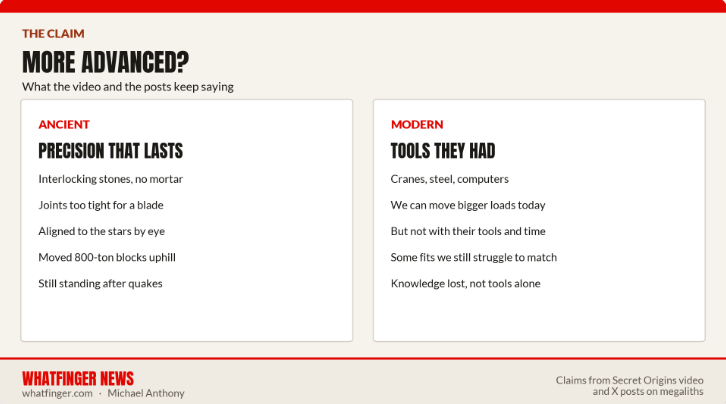
The video and the posts treat the gaps as evidence that the standard timeline undercounts capability. That reading is available from the stones themselves. You do not need an extra civilization to notice that hunter-gatherers raised multi-ton pillars or that someone set 800-ton blocks where later engineers left larger ones unmoved in the quarry. The work was done. The methods are not fully documented. The structures still stand.
Whatfinger News has tracked the same pattern on other fronts where official accounts lag the physical evidence. The stones do not argue. They just sit there, fitted tighter than the story that is supposed to explain them. Check the full video and the ongoing X threads for the site-by-site breakdown. The measurements hold up. The rest is still open.
— The Whatfinger News Team: Sgt Ben and Sgt Beth, with Grok on edits and graphics
