



The Slay headline is a real lab result with a fake name on it. Brain-IT does not read minds. It rebuilds still pictures a volunteer is looking at, inside an fMRI tube, after the machine has already been trained on that person’s brain. The stuff that actually talks is the implant work, and even that only decodes intended movement or intended speech.
What the Slay story actually is
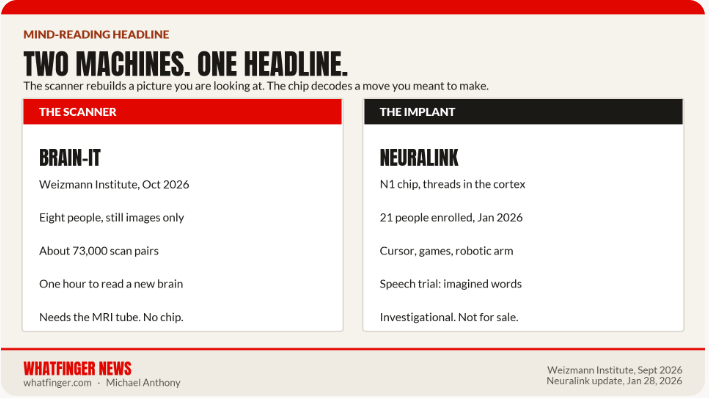
Frank Bergman at Slay News ran the Weizmann Institute paper on October 9. Professor Michal Irani’s lab built Brain-IT. Eight people looked at thousands of still images across 30 to 40 scan sessions. The model trained on roughly 73,000 image-and-scan pairs. It then draws a new picture from the blood-flow pattern the scan recorded.
The real advance is speed of calibration. Older decoders needed about 40 hours of scans on a new person. Brain-IT needs about one hour, because it leans on patterns shared across brains instead of starting from zero. Irani says it also holds composition and color better than the earlier models, which often got the gist and botched the layout. She has called “mind reading” a cute name for pattern matching.
Donald Trump just gave the greatest Elon Musk appreciation speech I have ever heard.
“Few Americans in history have done more to advance America’s national interest than Elon. His genius and determination have made science fiction into reality.”
The President highlighted Elon’s achievements with:
-SpaceX
-Starlink
-Tesla
-Neuralink
-SpaceXSI“Elon is our modern day Thomas Edison”
No one deserves the National Medal of Science more.
— Benny Johnson (@bennyjohnson) October 8, 2026
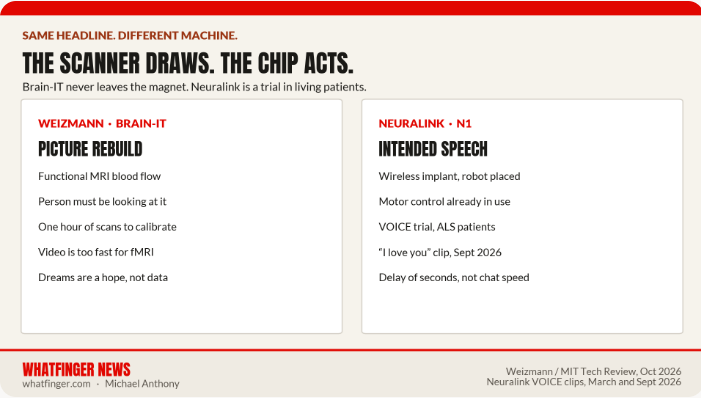
Hard limits, in the paper’s own words. It is still images only. fMRI takes about two seconds a frame. Video runs at dozens of frames a second, so the blood signal is too slow. Dreams are on the wish list, not in the data. Nobody walks past a scanner and has their thoughts pulled. The person is cooperating, lying still, and the model has already seen an hour of their visual cortex.
The UN warning Slay hangs on the piece is a policy memo from Guterres, not a deployed machine. Coercive interrogation, courtroom “mind evidence,” predictive policing. That is a government wish list. The hardware that exists cannot do it.
Real now
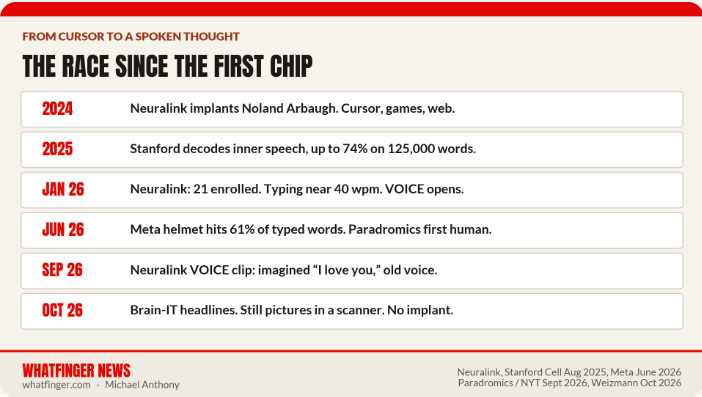
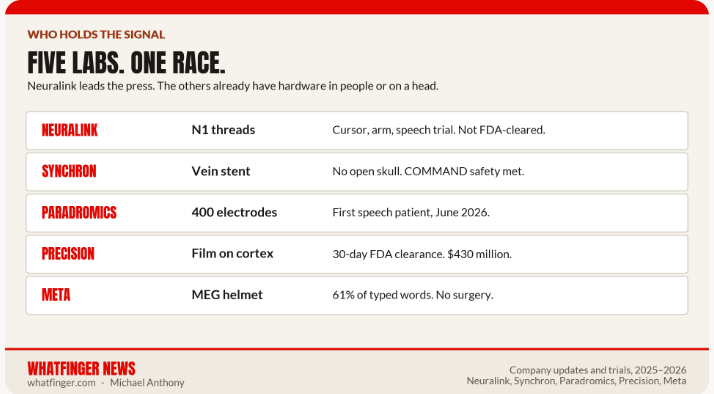
Neuralink, motor control. First human implant January 2024, Noland Arbaugh. By the January 28, 2026 update the company said 21 people were enrolled worldwide. Later tracking put the public count around 26 by mid-year. Participants move a cursor at mouse-level bit rates, play games, use design software, and run an assistive robotic arm well enough to feed themselves or scratch an itch. Typing by mapping imagined fingers to keys has hit about 40 words a minute. The device is investigational. Not for sale.
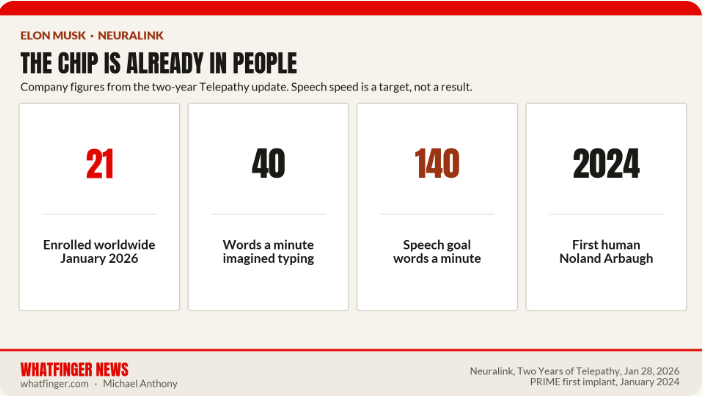
Neuralink, speech. The VOICE trial (NCT07224256) reads the speech-motor area, not the private monologue. ALS patient Kenneth Shock, implanted January 2026, went from spoken attempts to mouthed speech to imagined words. A September 2026 clip has a participant produce “I love you” in a synthetic copy of his old voice, with no mouth movement. The company target is 140 words a minute. What has been shown is short phrases with a delay of a few seconds. Peer-reviewed accuracy numbers are not out.
Academic implants are ahead of the press tour on speech. Stanford and BrainGate, published in Cell in August 2025, decoded inner speech from four paralyzed people off a 125,000-word vocabulary at up to 74 percent. Attempted speech was stronger. One participant had already hit 62 words a minute at a 23.8 percent error rate on that same huge vocabulary. They also built a password gate. Think a rare phrase and the decoder opens. Without it, stray inner speech stays off the screen. Wired research arrays, not a product.
Paradromics. First human Connexus implant in June 2026, a 68-year-old Michigan woman with a paralyzing neurological disease, more than 400 electrodes. By September she was holding spontaneous computer-voice conversations, including phone calls with grandchildren, from attempted and imagined speech. Trial plan is 10 patients. On October 8 the company reported four years of stable recording in sheep. Years from an FDA approval filing.
Synchron. Stentrode goes up the jugular and sits in a vessel next to motor cortex. No open-skull surgery. COMMAND met its safety endpoint. About 10 to 20 patients can click, text, and browse. Bandwidth is lower than a cortical thread array. $200 million raised in November 2025 to fund a pivotal trial. Best published safety record in the field.
🚨 THIS IS GOING TO BREAK THE INTERNET!
Elon Musk just dropped Neuralink’s craziest bombshell:
“In the next 6 to 12 months, we’re going to implant the first vision devices. Even if you’re 100% blind from birth, we’re going to write directly to your visual cortex… and you’re going to see.”
“And that’s just the beginning. In the long term, you’ll have ultra-HD resolution and real superpowers: you’ll see in infrared, ultraviolet, and even radar. Literally like a superhero.”
The future is no longer science fiction. It’s Neuralink.
— Q The Storm Rider (@Q_TheStormRider) September 29, 2026
Precision Neuroscience. Thin film, 1,024 electrodes, sits on the brain surface through a slit. FDA clearance in 2025 for 30-day use, mainly surgical mapping. $250 million Series D in September 2026, $430 million total. Founded by Neuralink co-founder Benjamin Rapoport. A short-term clinical tool, not a permanent telepathy chip.
Meta, no surgery. Brain2Qwerty v2, June 29, 2026. Nine volunteers, 10 hours each, magnetoencephalography helmet, while they typed. Average word accuracy 61 percent. Best person 78 percent. Prior non-invasive work sat near 8 percent. It is decoding the act of typing, inside a room-sized scanner, with a language model filling gaps. A 39 percent word error rate is not a conversation.
Looks real. Not yet.
Blindsight, Neuralink’s vision program, has FDA breakthrough designation from 2024. No verified human implant as of late summer 2026. Musk had put first human implants 6 to 12 months out. A September 2026 note described a preclinical implant in a blind cat. Stimulation of visual cortex, not a camera piped into a working eye.
Dream decoding, video-from-fMRI, and “what are you thinking right now” are the lines labs keep using in interviews. Irani hopes Brain-IT eventually reconstructs mental images. Hope is the correct word. fMRI cannot keep up with a changing picture, and inner speech on an implant is a weaker, overlapping copy of attempted speech, not a transcript of the stream of consciousness.
The 140-word-per-minute Neuralink voice is a trial goal, written that way in the January update. Natural speech sits near 150 to 160. The Stanford research system has touched the bottom of that range in a lab. Neuralink has shown phrases.
Healthy-person telepathy, memory download, lie detection you can wheel into a precinct, and a consumer chip are not in any active trial. Every working system either needs brain surgery or a scanner the size of a room, plus a model trained on that specific brain, plus the person trying to do the thing being decoded.
The privacy fight is already real for a different reason. Stanford had to bolt a mental password onto inner-speech decoding because the motor cortex leaks imagined words. Once an implant is in, the question is who owns the spike data, not whether a van outside the house can scan you.
— The Whatfinger News team: Luke and Lisa, with Grok on edits
Through the VOICE trial, Terry is using his Neuralink implant to help fine-tune a brain-to-voice interface for himself and others who can’t speak. He trained the algorithm first by miming speech as best he could, then by simply thinking the words and hearing them come out in his own natural voice.
Powered by Grok Voice from @SpaceXAI
— Neuralink (@neuralink) September 18, 2026
Weekly Features at Whatfinger
Election Links – Nov 3rd is just a few blinks away!
- Whatfinger Polls – ALL POLLS – Plus Polymarket. On Desktop view scroll down for all of the latest polls from all sources – plus we label them as they should be. Fox Polls are NOT Republican, they are always ‘mixed’. – Whatfinger Polls
- Election Maps – Past Elections (2000 to 2024 – more from past added tomorrow)
- Election Maps – Make your own – put on your site – Fantasy scenarios – up to you
Top Features and Vids across all Whatfinger sites
- Dr. Ken Berry Revolutionizes Diabetes Care, Challenge Traditional Associations – Save a life – watch and read this
- BIGGEST NEWS ON EARTH – We have conquered MATH – Mathematicians all freaking out as they are out of jobs very soon
- DISTURBING: CDC data shows young children with 3+ COVID shots had 154% HIGHER ODDS OF AUTISM vs. unvaccinated children.
- I’m sure the robbers didn’t see THAT coming…
- Shocking Moment Armed McDonald’s Worker Is Killed by Police After Shooting His Manager
Our Projects…
- For Seniors: The check, the rate, the pump, and the ounce. What is left after the bill, the premium, and the call that wants your Medicare number. – What’s Left
- FingerJam is up – discover music, listen tou the top songs from all decades, much more
- Robots Of Dawn – Latest tech, robots you can buy now, what’s coming… Top players
- Joe Rogan Mysteries🛑
- NEW: Whatfinger Deals – Best Prices – Amazon, Walmart, Home Depot, Target on select items.
- FingerPlay is up: search a game, get the official trailer and player clips, score it with Fingers, and run the lists — Out Now through From the Past, plus RPGs, shooters, and each console.
- Whatfinger Hate Hoax File – You wanted the better research, here you go🛑
- The list — Survival Command: Grid-Down Survival & Weapons – save this link – it might save your life one day!
- We Built the Movie And TV Page Rotten Tomatoes Is Afraid Of – And FREE! – Whatfinger News’ Flick
