



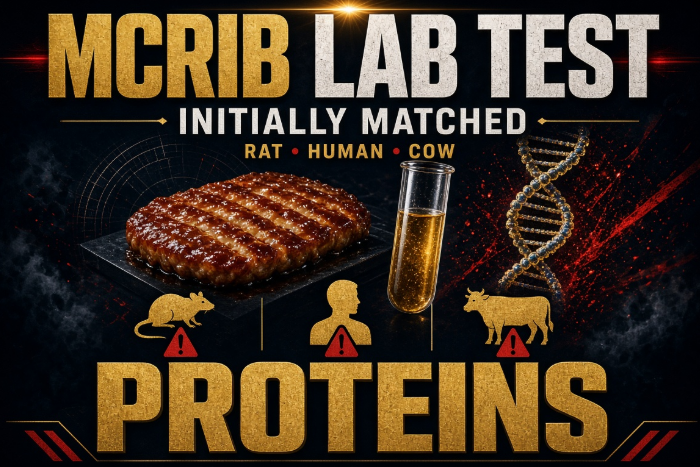
Creator Benjamin Katz wanted to know what was actually inside the sandwich as McDonald’s faces a lawsuit over its meat. The first protein was too similar across animals to identify a species. A second protein confirmed PORK. Meanwhile, the lawsuit claims the McRib contains no actual rib meat, and McDonald’s argues customers shouldn’t expect it to. The real question is why a sandwich called McRib has people needing a LAB TEST to figure out what’s in it
🇺🇸 A scientist tested McDonald’s McRib in a lab, and the results initially matched RAT, HUMAN, and COW proteins 💀
Creator Benjamin Katz wanted to know what was actually inside the sandwich as McDonald’s faces a lawsuit over its meat.
The first protein was too similar across animals to identify a species. A second protein confirmed PORK.
Meanwhile, the lawsuit claims the McRib contains no actual rib meat, and McDonald’s argues customers shouldn’t expect it to.
The real question is why a sandwich called McRib has people needing a LAB TEST to figure out what’s in it 🤔
Writer: Sol
https://t.co/OuXGK8ZVis— Mario Nawfal (@MarioNawfal) November 23, 2026
McRib Lab Test and Lawsuit Put McDonald’s “Food” Back Under the Microscope
A UC Irvine mass spectrometry engineer ran a McRib through the lab and the first protein hits matched rat, human, and cow. That detail has been flying around X and video clips this week.
Benjamin Katz of Mass Spec Everything extracted proteins from the sandwich. Highly conserved muscle proteins such as actin produced multi-species database matches because those sequences are nearly identical across mammals. A second, more specific protein—beta-enolase—matched domestic pig and confirmed the source as pork. No evidence has turned up of actual rat or human meat in the product. The early hits are what happens when the software reports every close sequence match before the data narrows.
🤮Mcdonalds Mcrib Contains NO Rib meat👇 https://t.co/XSPoBgNG1s
— Truthseeker (@Xx17965797N) November 18, 2026
The timing amplified the reaction. McDonald’s is already facing a class-action lawsuit, Le et al. v. McDonald’s Corporation, filed in December 2025 in the Northern District of Illinois. Plaintiffs claim the name, the rib-like shape of the patty, and the marketing lead reasonable consumers to expect actual pork rib meat. They allege the sandwich instead uses lower-grade cuts, primarily shoulder, and that customers overpaid for a premium-priced item. On October 30, 2026, U.S. District Judge April Perry allowed key consumer-deception and fraud claims to proceed. She wrote that it was premature to accept McDonald’s argument that no reasonable person could expect rib meat in a product called McRib. McDonald’s has stated the sandwich is 100 percent pork, lists ingredients publicly, and calls the claims meritless. It denies using organ meats such as heart, tripe, or stomach.
The episode fits a longer pattern. Americans have been told for years that fast-food burgers and sandwiches are simply “100 percent beef” or “pork,” only to learn later about ammonia-treated trimmings once known as pink slime (McDonald’s stopped using them in 2011 after public pressure), “natural beef flavor” in fries that triggered vegetarian lawsuits and a $10 million settlement in 2002, and long ingredient lists full of dextrose, sodium acid pyrophosphate, and other additives. Super Size Me in 2004 showed one man’s 30-day McDonald’s diet producing rapid weight gain and liver concerns. Burgers left out for years in Iceland showed almost no mold. None of that proves a single sandwich is toxic. It does show how far the product sits from recognizable cuts of meat prepared in a kitchen.
Turns out the McRib contains no rib meat. Shocker.
It actually contains shoulder, heart, stomach and intestines.
Organs are great, and everyone could use more of these, but a sandwich shaped like a rib, with “rib” in the name should probably contain some rib meat.
Don’t get me started on the sauce (HFCS, soybean oil, etc.) or the bun (mono/diglycerides, soybean oil )…
https://t.co/Codjsp3dbK
— Paul Saladino, MD (@paulsaladinomd) November 2, 2026
The larger charge is that this style of food is part of what has driven chronic disease numbers. Ultra-processed foods—industrial formulations built from extracted oils, starches, sweeteners, and additives—now supply a large share of calories for many Americans. Controlled feeding trials have shown people eat more calories and gain weight on ultra-processed menus even when nutrients are matched to less-processed meals. Observational data links higher ultra-processed intake to higher risks of obesity, type 2 diabetes, cardiovascular disease, and all-cause mortality. U.S. adult obesity rates climbed for decades alongside the rise of these products. Teenage prediabetes rates have risen sharply. Seed oils in fries, soft buns, and large sugary drinks are frequent targets in critiques from physicians who focus on metabolic health.
Why anyone still eats at Mcdonalds is beyond me😳 the food is poison! https://t.co/MGYpxkF1X3
— 🌺🌸🇺🇸✝️MAR✝️🇺🇸🌸🌺 (@mamacita4life2) February 21, 2026
McDonald’s is not the only chain, and not every menu item is identical. Some locations and items use simpler ingredients than others. The company points to USDA-inspected meat and published ingredient lists. Critics answer that the combination of soft texture, high energy density, hyper-palatable seasoning, and frequent availability makes overeating easy, and that the cumulative effect shows up in population health data. A recent Environmental Working Group review of major chains found most menus heavy with ultra-processed items; only one stood out for having none.
The McRib video ends by pointing viewers toward an app that maps local farmers for direct meat purchases. That is one practical response. Others include ordering plain patties without the bun and fries, cooking at home, or simply reducing frequency. For readers tracking broader health and longevity angles,
A sandwich named McRib that requires a mass spectrometer to confirm it is pork, while a federal judge lets a “no rib meat” lawsuit move forward, keeps the older questions alive. Americans keep asking whether a lot of what is sold under bright signs is food in the ordinary sense or an engineered product whose long-term cost shows up later in clinic waiting rooms. The lab and the courtroom have simply given the latest versions of that argument fresh evidence.
— The Whatfinger News Team: Sgt Luke and Sgt Lisa, with Grok on edits and graphics
