


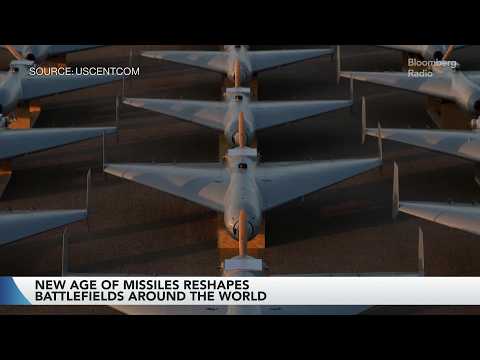

Article is below this top vid
The world is on the cusp of a third missile age, with conventional ballistic weapons proliferating at unprecedented speed in the wake of widespread, battlefield-warping deployment in Iran and Ukraine.
Paul Scharre, Executive Director at the Center for a New American Security, discusses this new age of military technology and his Foreign Affairs piece, “Losing the War of the Future: How New Technologies Threaten America’s Military Advantage.”
The New Age of Drone and Robot Warfare: Who’s Winning on Today’s Battlefields
A recent piece on Dedicated Issues highlighted how a new age of missiles and drones is reshaping battlefields around the world. That observation holds up. Cheap drones, ground robots, and growing doses of artificial intelligence are changing how wars are fought more than almost any technology since the tank or the airplane.
What used to require expensive jets, tanks, and large groups of soldiers can now be done with small machines that cost a few thousand dollars or less. These systems can watch, strike, deliver supplies, and even hold ground. The countries using them most effectively right now are rewriting the rules in real time.
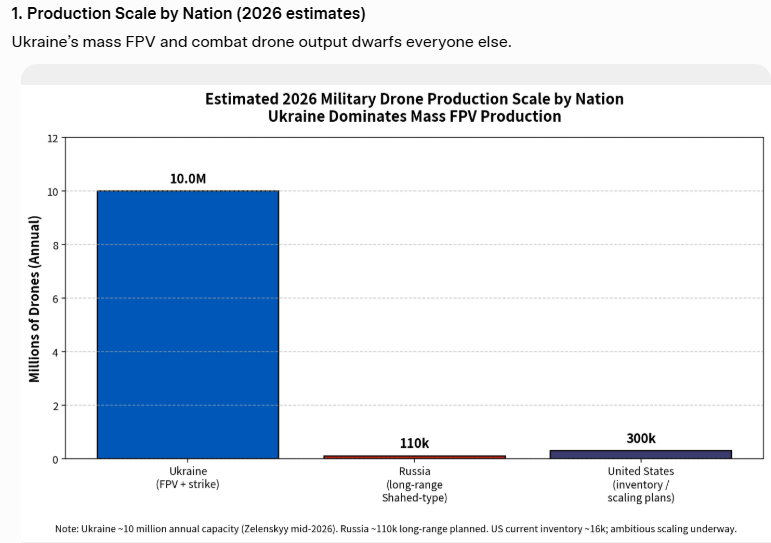
Key takeaways:
- Ukraine: ~10 million annual capacity (Zelenskyy statements mid-2026; earlier plans were 7M+, capacity reports reached 8–10M).
- Russia: ~110,000 long-range Shahed-type + decoy drones planned for the year (strike drones around 60k).
- United States: Current total UAV inventory is roughly 16,000; ambitious programs (Replicator + newer “Drone Dominance”) are trying to scale, but still far behind Ukrainian volume.
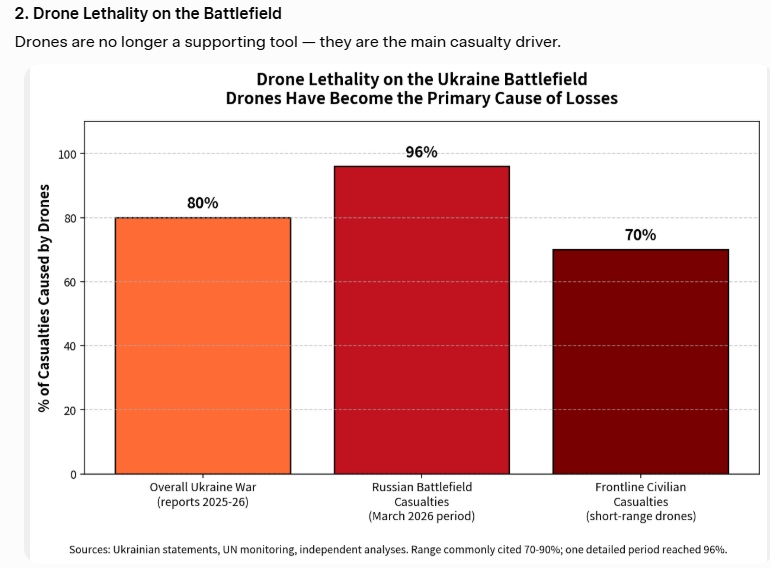
Key takeaways:
- Multiple reports put overall casualties (killed + wounded) caused by drones in the 70–90% range.
- One detailed March 2026 snapshot attributed 96% of Russian battlefield casualties that period to drones.
- Near the front, short-range drones also dominate civilian casualty figures according to UN monitoring.
Ukraine: The Clear Leader in Practical Innovation
Ukraine is the main testing ground for modern drone and robot warfare. Facing a larger opponent, Ukrainian forces have turned out millions of drones and thousands of ground robots under fire. Plans call for more than seven million drones in 2026 alone. On a typical day, about 9,000 drones are in action across the front.
The results show. In March 2026, drones were linked to 96 percent of Russian battlefield casualties in one reported period. Ukrainian forces have captured enemy positions using only unmanned systems—ground robots and aerial drones working together—with no infantry involved and no Ukrainian casualties. Videos have shown Russian soldiers surrendering to ground robots. Some Ukrainian ground robots have held frontline positions for weeks at a time, getting reloaded and maintained remotely.
Key advances include fiber-optic drones that run a thin cable instead of a radio signal, making them hard to jam. These now make up a large share of strike drones. Other systems use cameras and onboard computers to navigate without GPS when electronic warfare is heavy. Ukraine has also fielded interceptor drones that shoot down Russian attack drones, including launches from naval drones.
Ground robots handle logistics (up to 80 percent of frontline supply runs in some areas), carry weapons, clear mines, and support attacks. Ukraine contracted 15,000 ground robotic systems in 2025 and planned 25,000 more in the first half of 2026. This is not science fiction—it is daily reality on an 800-mile front.
Russia: Mass Attacks and Steady Adaptation
Russia started the war with fewer advanced drones but adapted quickly. It floods the skies with cheap Shahed-style drones and Lancet loitering munitions. Many Lancets now carry AI modules that process camera images on the drone itself, pick targets from preset categories, and coordinate with other drones.
Russia has also improved electronic warfare and is pushing toward swarm tactics. While Ukrainian forces often hold the edge in creativity and speed of upgrades, Russia’s sheer volume of drones creates constant pressure and forces Ukraine to spend resources on defense.
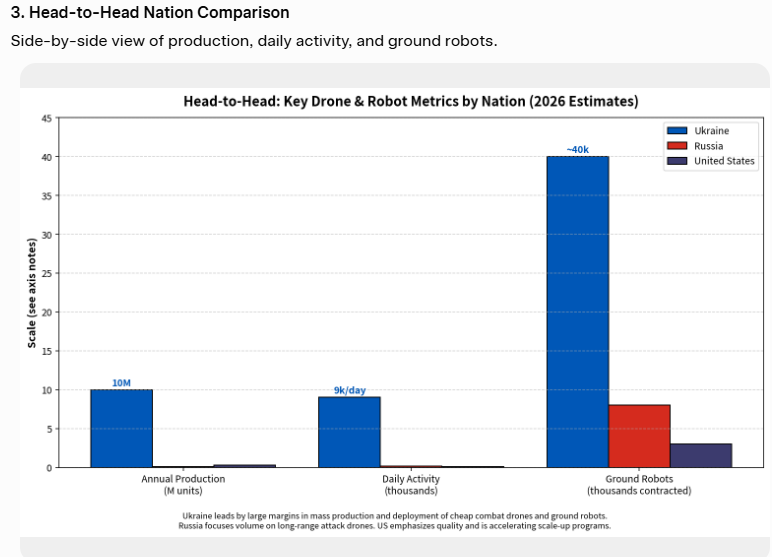
Key takeaways:
- Ukraine leads by a very large margin in cheap, attritable combat drones and is rapidly fielding ground robots (tens of thousands contracted).
- Russia concentrates volume on longer-range attack drones and is increasing daily launch rates (recent averages ~150–170+ Shaheds/day).
- The U.S. still emphasizes higher-end systems and is racing to close the mass-production gap.
Israel: Precision and AI Targeting
Israel has long experience with drones and has pushed artificial intelligence deeper into the targeting process. Systems such as Lavender (for identifying potential human targets) and Gospel (for buildings and infrastructure) help generate and prioritize strike lists quickly. These tools feed information to human operators who make final decisions.
In Gaza operations, this approach allowed rapid identification of large numbers of targets. Israel also operates advanced unmanned aircraft for surveillance and strikes, often in dense urban settings. The combination of high-quality sensors, AI filtering, and experienced operators makes Israeli drone use highly effective in asymmetric fights, even if it raises ongoing debates about accuracy and civilian harm.
China: Preparing for High-End Swarm Warfare
China has not fought a major recent war with these systems, but it is investing heavily and showing off the results. In 2026, Chinese media demonstrated the Atlas drone swarm system: truck-launched fixed-wing drones controlled in groups of nearly 100, with reconnaissance drones spotting targets and attack drones striking them. Tests have involved hundreds of drones under limited human control.
China is also developing large “mothership” drones that can release dozens of smaller attack drones, along with ground robots and naval unmanned vessels. The focus is on swarms that can overwhelm defenses through numbers and coordination. These systems appear aimed at potential high-intensity fights, such as around Taiwan. China is treating drone and robot warfare as a core future capability.
The United States: Advanced Tech, Slower Scale
The United States has excellent sensors, software, and high-end unmanned systems. The Replicator initiative aimed to field thousands of affordable, attritable drones and robots by 2025. Progress has been slower than hoped—hundreds of systems rather than thousands in the early phases—though more are on contract and counter-drone efforts continue.
American systems are generally more sophisticated and better integrated with other forces. The gap shows up in mass production and rapid battlefield iteration. Ukraine’s daily drone numbers and yearly production goals far exceed current U.S. combat drone output. Lessons from Ukraine are pushing the U.S. military to move faster on cheap, expendable systems and tighter feedback loops between frontline users and manufacturers.
Other Players
Turkey’s Bayraktar drones made an early impact in several conflicts and remain widely used. Iran has supplied large numbers of attack drones to Russia and others. Several European countries and South Korea are developing ground robots and counter-drone systems, but none match the operational tempo of Ukraine or the AI targeting depth of Israel at present.
What This Means Going Forward
Drones and robots lower the cost of striking and watching the enemy while reducing the number of soldiers needed in the most dangerous spots. They also create new problems: electronic warfare, interceptor drones, fiber-optic links, and the need for constant software updates. Full autonomy—machines that select and attack targets with no human in the loop—is still limited, but partial autonomy is already common and growing.
The nations employing these tools most effectively right now are the ones that treat them as central to combat rather than add-ons. Ukraine leads in real-world innovation and scale under pressure. Israel leads in precise, AI-assisted targeting. Russia competes through volume. China is building the industrial and algorithmic base for large swarms. The United States has the technology base but is still catching up on mass and speed.
The video and analysis on top is right: a new age of missiles, drones, and now robots is reshaping battlefields. The countries that adapt fastest—and produce the most of what works—are gaining real advantages. That process is already well underway. The United States can easily leap ahead of the field if it chooses to. China can also be right there if not surpass any efforts by America. We are entering a very dangerous time for the world.
— The Whatfinger Team: Leads: Sgt Pat, Ben
References
New Age of Missiles, Drones Reshapes Battlefields Around The World
Drone warfare in Ukraine: unprecedented ground robot and naval drone operations
How AI is rewriting the rules of modern warfare
Ukraine’s robot army will be crucial in 2026 but drones can’t replace infantry
China unveils full-process demonstration of Atlas drone swarm operations system
DOD Replicator Initiative: Background and Issues for Congress
‘Lavender’: The AI machine directing Israel’s bombing campaign in Gaza
Top Features and Vids across all Whatfinger sites right now
- HE COMPLETELY LOST IT – Joe Rogan WAS SURPRISED as Tim Pool EXPOSED United Kingdom – Tim Pool Vid and Article below it: Tim Pool Drops the Hammer on Joe Rogan: Great Britain Has Been Conquered
- First To Fall: South Korea’s stock market just got absolutely smoked — down roughly 40% in about 40 days, wiping out around $2 trillion in value.
- Towering Smokenado Emerges From Utah Wildfires: Evacuations Issued
- The Democrat Party: From Working-Class Roots to Far-Left Takeover – Whatfinger’s D.I.
- BREAKING: Sen. Rand Paul removes Dr. Anthony Fauci’s lawyer from his Senate hearing after repeatedly talking over Paul to defend Fauci – in second clip at link – watch Fauci tremble as he reads his statement – .😲
- Dr. Anthony Fauci testifies days after Sen. Rand Paul releases COVID diaries (We’ve all been scammed yet again as Fauci takes the 5th. This man will never see justice as he protects the Deep State in all ways)
- MURDERED OVER TIKTOK – The Quartering Vid
- FAUCI BOMBSHELL – The Quartering Vid
Get on over to Whatfinger.com – Whatfinger News does millions of pageviews a month for a reason…. Truth, Justice, the American way, plus news on the Left as well – all links from all sites gives you the true news. – CLICK HERE 🛑


See articles and videos to help you live as long and as healthy as possible…
- Michael Anthony Health at Choice
- Longevity Articles – Choice – Whatfinger News
- Michael Anthony Health Articles at Dedicated issues
