


Nature’s rescue file is bigger — and stranger — than the headlines.
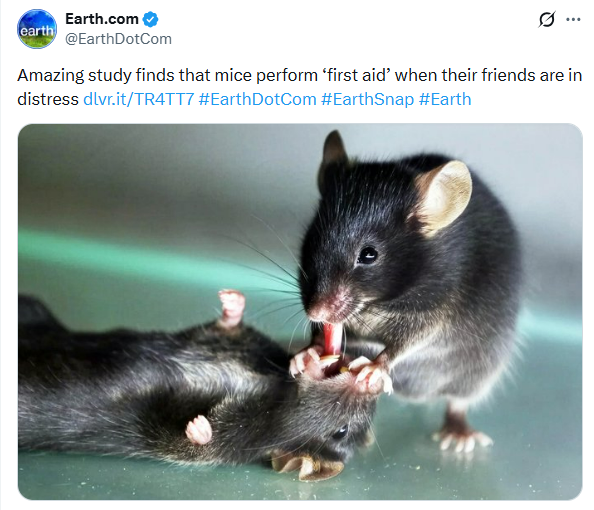
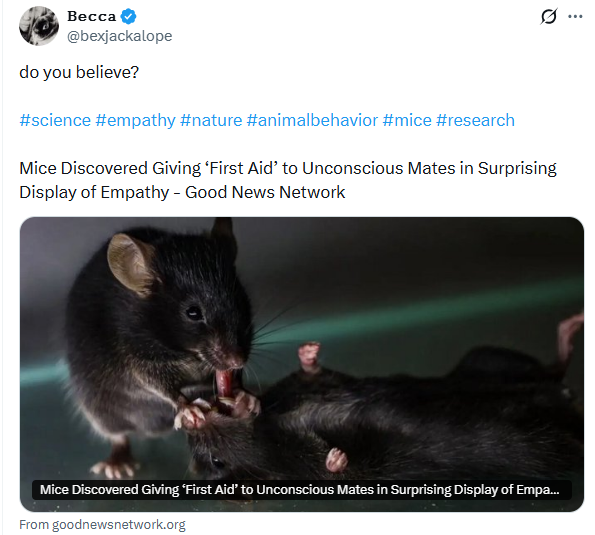
Folks, a story is circulating again this weekend and X is doing what X does: turning a lab finding into a morality play. The hook is simple enough. Put an unconscious mouse back in the cage, and another mouse does not shrug and go back to the food hopper. It sniffs. It grooms. It bites around the mouth. In more than half the trials, it pulls the other mouse’s tongue.
A 2025 Science paper out of the University of Southern California, led by Li Zhang, with co-author Huizhong Whit Tao saying out loud what every honest lab tech was thinking: this was the most surprising part of the study, and the effects are beneficial. Tongue-pulling opened the airway. When researchers stuffed objects in the unconscious animal’s mouth, the maneuver cleared them about 80 percent of the time. Familiar cage mates got more of the treatment than strangers. Once the patient woke up, the “medic” stopped. Naive mice did it with no training. Oxytocin circuits in the hypothalamus were required. Three independent labs have now seen versions of the same pattern.
Call it CPR if you want the clicks. The scientists themselves are more careful. This is not chest compressions. It is closer to basic airway first aid — the animal version of rolling someone so they can breathe. James Burkett at Toledo put the useful caution on it: the mouse is responding to an animal in need and performing a behavior that helps. That is not the same as proving the mouse intends to help. Peggy Mason at Chicago, who has spent years on rodent helping behavior, was even blunter. Benefit is not the same as charity. If you drop a twenty on the sidewalk and someone picks it up, they were helped. You did not help them.
Fair. Now look at the rest of the file. Because the mouse paper is not a one-off. It is one more data point in a pile that keeps growing.
Rodents have been doing jailbreaks for years.
Before the tongue-pulling mice, there were the University of Chicago rats. Inbal Ben-Ami Bartal, Jean Decety, and Peggy Mason put one rat in a restrainer and left a cage mate free in the arena. The free rat learned to pop the door. It did not bother with empty restrainers or toy rats. It still opened the door when it could not even socialize afterward. When they pitted freedom against chocolate, the rats opened both boxes and often shared the chocolate. That paper landed in Science in 2011. Mason called it evidence that empathy can motivate help. Critics have argued about mechanism ever since. The behavior itself did not go away.
So the new mouse work is not “rodents discovered kindness.” It is “the emergency sequence is more specific than we thought.” Sniff, groom, mouth, tongue, stop when the patient moves. Hardwired. Familiarity-biased. Measurable recovery advantage.
The ocean has been running a bigger operation.
Dolphins have the longest paper trail. Injured pod members get lifted to the surface so they can breathe. In 1956, researchers described adults bracing a stunned dolphin under the pectoral fin after a blast from a fishing operation. In 2004 off New Zealand, a pod circled lifeguard Rob Howes and three teenagers and kept a great white off them for about 40 minutes. In 2008, a twisted-spine bottlenose helped guide stranded pygmy sperm whales off a New Zealand beach after people could not. Those are anecdotes with witnesses, not lab graphs. They keep happening across cultures and centuries, which is why they refuse to die as “just stories.”
Then there are the humpbacks — and this one has a body count of observations, not vibes. NOAA marine ecologist Robert Pitman and colleagues compiled 115 encounters spanning 62 years. Humpbacks will charge in on killer whales mid-hunt. They slap flukes, bellow, and sometimes park a seal on their own chest between those four-and-a-half-meter flippers and nudge it back when it starts to slide. In the dataset, the animal being hunted was another humpback only about 11 percent of the time. The rest were gray whale calves, harbor seals, sea lions, porpoises, crabeater seals — even sunfish. Pitman has called it “inadvertent altruism”: an anti-orca instinct that other species get to borrow. That is the adult version of the story. The video version is a 40-ton animal rolling onto its back to keep a seal out of a killing circle.
Antarctic ice, a seal on a floe, an orca in the channel, a humpback surfacing in the same frame. This is what “intervening in someone else’s hunt” looks like when the intervenor weighs 40 tons.
Elephants do not need a press release.
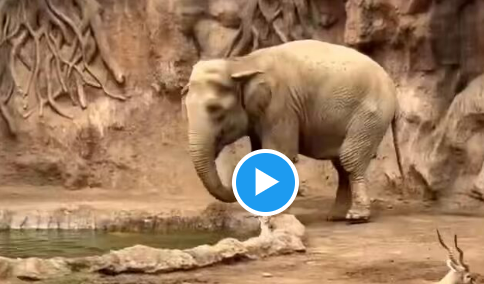
Herds pull calves out of mud and water. They wait for the injured. They investigate and sometimes guard animals that are not elephants. Videos of trunks lifting a drowning gazelle or a calf stuck in a ditch travel X every few months because the motion is unmistakable: the big animal is not feeding, not fleeing, not mating. It is applying force to get another body onto dry ground. Scientists still argue about cross-species cases. Inside the family group, the evidence for targeted aid is not exotic anymore. It is field biology.
A calf in a ditch and a trunk doing the job a tow strap would do. This is the version of “help” you can film without a lab.
Watch as this Elephant saved a drowning baby Gazelle.
Watch as this Elephant saved a drowning baby Gazelle.
Elephants are known to exhibit empathy for other animals, including species outside their own. They have been observed to help other animals in distress, such as lifting trapped animals out of mud pits or waterholes using… pic.twitter.com/4mHhAhF7Eo
— PROTECT ALL WILDLIFE (@Protect_Wldlife) June 12, 2025
Apes treat wounds. Ants run triage.
In Gabon’s chimpanzees, researchers have documented insects applied to open wounds of other individuals. In Gombe, leaves used as wipes. In the Taï Forest, the group adjusts the march to the injured. That is flexible aid, not a reflex twitch.
Then drop down the size chart and it gets almost industrial. Matabele ants (Megaponera analis) raid termites, take casualties, and carry the wounded home if the injuries are survivable. Nestmates lick wounds. Left alone, most of the experimentally injured ants died within a day. An hour of nest care crashed the death rate. Fatally wrecked ants get left. That is triage with pheromones instead of a clipboard. Florida carpenter ants go further: they clean some wounds and, for others, spend about 40 minutes amputating a leg. Survival on untreated femur wounds sat around 40 percent. After amputation, about 90 percent. Other ant species dig nestmates out of antlion pits, pull limbs, and bite the trap. Rescue in ants has now been described in dozens of species. Kin selection explains a lot of it. The behavior is still rescue.
“Mans best friend” helps another who is in trouble.🙏
“Mans best friend” helps another who is in trouble.🙏
A dog rescues another dog who is literally unable to fight the water currents and is in big trouble. It climbs in and rescues him. Amazing and heartwarming to watch.💓🙏 pic.twitter.com/EgltBDzsVB
— 💪🎭..Rai ji..💪🎭 (@Vinod_r108) April 8, 2025
Dogs, buffalo, and the viral layer.
Domestic dogs are the easy chapter because they were bred to attend to us — and they still drag other dogs out of current, carry a stuffed rabbit to a firehouse, or swim with a possum family on their back when the water rises. Those clips are not peer-reviewed. Some will be staged. Enough are not that the pattern sits in the same file as the lab work: a social mammal acting on another body in trouble.
African buffalo have the “Battle at Kruger” file: a calf taken by lions and crocodiles, the herd coming back. That is communal defense, which is not the same as one-on-one first aid, but it is the same family of decision: stay and spend energy on another animal instead of leaving.
X right now is a blender of the mouse paper, the elephant-and-gazelle clips, flood dogs, and the occasional whale. That is how these stories live. The lab result gives the viral clip a spine. The viral clip keeps the lab result from dying in a paywalled PDF.
What we actually have so far
Strip the Disney music and the ledger looks like this:
- Mice: stereotyped airway-clearing sequence on unconscious familiars; faster recovery; oxytocin-dependent; replicated.
- Rats: learned door-opening to free a trapped cage mate, even against chocolate.
- Dolphins: surface-support of injured conspecifics; repeated accounts of shielding humans and other cetaceans.
- Humpbacks: 115 documented interruptions of orca hunts, most of them for other species.
- Elephants: targeted aid to calves and, in some observations, other species.
- Chimpanzees: wound care with insects and leaves; group accommodation of the injured.
- Ants: retrieval, wound-licking, amputation, digging-out of trapped nestmates, with survival numbers attached.
That is not “animals are people.” It is not “your Labrador has a medical license.” It is also not nothing. Social species keep showing the same shape: detect unresponsiveness or entrapment, escalate contact, stop when the other animal is moving again, bias the effort toward familiars or nestmates, and — in enough cases to matter — change the odds of survival.
The honest line, the one Whatfinger will keep using, is the one Burkett and Mason already gave the mouse team. We can see the behavior. We can measure the benefit. We should not pretend we have read the animal’s mind. Instinct, memory of orca teeth, pheromone flares, oxytocin, group selection, and actual concern can look identical from a camera on a stick.
The mice still pulled the tongue. The whale still rolled onto its back. The ant still licked the wound. The record is no longer “a few cute videos.” It is a stack of papers and a century of field notes that keep rhyming.
Nature does not need our slogans. It already packed a first-aid kit. This world is more amazing than most people realize. We at Whatfinger News will bring you interesting facts and stories from all over the world.
—The Whatfinger News Team: Luke and Lisa, with Alex and a Grok assist.
Resources
- Scientists Watch Mice Perform CPR-Like Rescue on Unconscious Companions by Pulling Their Tongues
- Reviving-like prosocial behavior in response to unconscious or dead conspecifics in rodents (Science)
- Reviving-like Prosocial Behavior in Response to Unconscious or Dead Conspecifics in Rodents (PMC)
- Mouse-to-Mouse Resuscitation: Rodents Try to Revive Unconscious Buddies (Scientific American)
- Lab mice may give ‘first aid’ to unconscious mates (NPR)
- Mice seen giving ‘first aid’ to unconscious companions (New Scientist)
- Helping a cagemate in need: empathy and pro-social behavior in rats (Science / PMC)
- Rats free each other from traps, then share chocolate (New Scientist)
- Jailbreak Rat: Selfless Rodents Spring Their Pals and Share Their Sweets (Scientific American)
- Saved by the Whale! Humpbacks Play Hero When Orcas Attack (Live Science)
- Why did a humpback whale just save this seal’s life? (Science / AAAS)
- Humpback whales have been seen helping seals, sea lions and even sunfish escape orca attacks (ScienceBlog)
- Animal heroes that save other species: Five amazing stories (New Scientist)
- Some animals take care of others in need even if they are not related (EL PAÍS)
- Kindness in the Wild: Amazing Examples of Animals Helping Each Other (Discovery UK)
- ‘Paramedic’ Ants Are the First to Rescue and Heal Their Wounded Comrades (National Geographic)
- These Ants Perform Life-Saving Operations on Injured Nestmates, Similar to Humans (ScienceAlert)
- Toward a Behavioral Ecology of Rescue Behavior (PMC)
- X: Earth.com on mice first aid
- X: Good News Network / mice first aid clip
- X: Elephant lifts drowning gazelle
- X: Dog rescues another dog from current
- X: Dog swims with possum family in flood
Top Features and Vids across all Whatfinger sites right now
- America Still Owns the Night. China’s ‘Area 51’ Is Trying to Steal It. Russia Is a Spectator.
- What Happens to Your Body After Years of Taking Statins?
- War in Ukraine: Putin, Zelensky order pause in strikes – Both sides pause it all thanks to Trump’s efforts
- Democrats are dumbing down students – telling teachers to no longer teach students how to sound out words
- Karmelo’s father just crossed a freaking LINE.
- How Stupid Are These People? A gay couple say that if the “far-right” wins the next Spanish election, they will seek asylum in Palestine because it’s the most “progressive” place on Earth
