



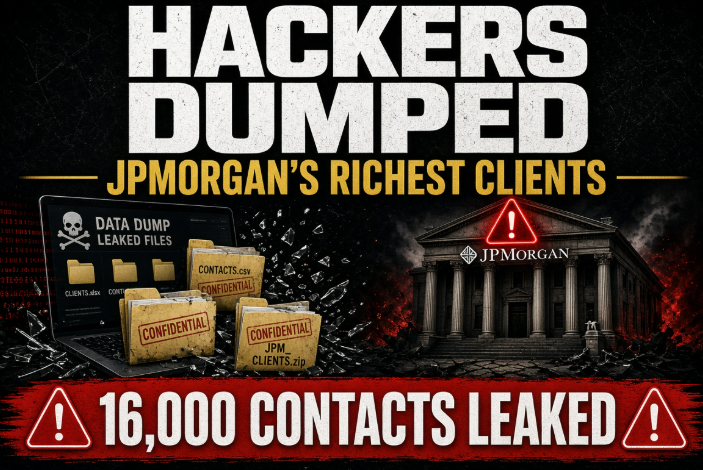
The n0n ransomware gang published roughly 16,000 email addresses tied to Chase’s invitation-only Reserve card — the Visa product for people with at least $10 million in assets managed by the bank. Some records included phone numbers and account IDs. More than 100 bank employee emails were in the dump too.
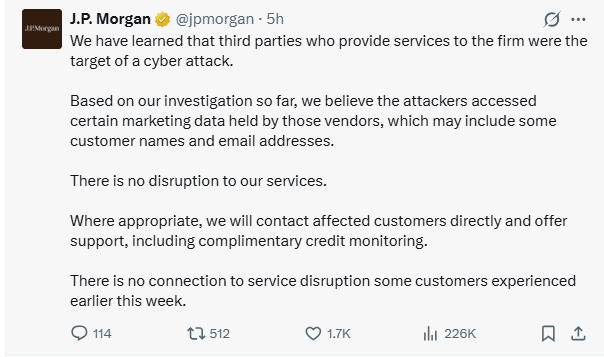
JPMorgan confirmed the hit came through third-party vendors that handle marketing data. The bank said its own systems were not breached, services were never disrupted, and it would offer free credit monitoring to affected customers. It has not named the vendors or confirmed the Reserve connection. The same gang listed Visa and Mastercard the same day and later published data from those companies as well: more than 6,000 premium Visa cardholders from an Asia-Pacific marketing program and roughly 2,000 Mastercard entries that researchers said looked messy, possibly test data. Visa stated its payment network was untouched and no card numbers were exposed.
UPDATE: HACKERS LEAK JPMORGAN CHASE CUSTOMER DATA ON DARK WEB
Ransomware group n0n has published stolen data containing approximately 16,000 customer email addresses linked to JPMorgan’s invitation-only Reserve card program, typically reserved for clients with $10 million or more in managed assets.
The leak also includes some phone numbers, account IDs, and 124 bank employee email addresses.
Cybersecurity researchers warn the exposed high-net-worth clients could face targeted phishing attacks.
JPMorgan says the breach originated with third-party vendors, not its own systems, and is unrelated to Monday’s banking outages.
— Bitcoin News (@BitcoinNewsCom) November 19, 2026
This is the pattern. Banks and card networks spend heavily on their own fortresses. The side doors — vendors, marketing platforms, compliance tools, CRM exports — stay open. n0n is a newer crew that relies on stolen or weak credentials rather than exotic exploits. It listed dozens of organizations in one batch and gave them 48 hours to pay before publishing. The Reserve list is useful precisely because it is selective: high-net-worth targets for tailored phishing, social engineering, or follow-on account takeover attempts. Regular customers get the same treatment in bulk.
JUST IN: Thousands of Visa, Mastercard, and JPMorgan Chase customers’ information has been leaked by a ransomware group after a cyberattack on a third-party vendor, according to The Wall Street Journal.
Visa: The breach hit a third-party provider in the Asia-Pacific region, Visa’s own systems weren’t involved, and no card numbers were affected.
Mastercard: A “limited amount of information” from some cardholders in one benefit program was exposed, and it’s been contained.
JPMorgan Chase: Attackers accessed vendor marketing data that may include customer names and email addresses.
— RedWave Press (@RedWavePress) November 19, 2026
The volume hits ordinary people harder. In 2025 the Marquis Software ransomware attack exposed personal and financial data on an estimated 788,000 to 1.35 million customers across dozens of community banks and credit unions. Stolen information included names, Social Security numbers, addresses, dates of birth, and financial account details. Texas alone saw hundreds of thousands of residents affected. Multiple banks notified customers months later. A single vendor breach cascaded through institutions that serve everyday depositors.
Earlier vendor incidents followed the same script. SitusAMC’s 2025 breach reached accounting records, legal agreements, and some customer data at major banks including JPMorgan, Citi, and Morgan Stanley. The Optimizely supply-chain malware planted on websites of 178 organizations — including HSBC and Equifax — was designed to skim payment cards, swap crypto addresses, and target older iPhones. Those were not elite-client lists; they were ordinary visitors checking news, shopping, or managing accounts.
JPMorgan Chase says vendors hacked, emails stolen days after massive outage https://t.co/FamDQueaL6 https://t.co/Mwv0k9VKiz
— New York Post (@nypost) November 19, 2026
The classic large-scale exposures remain on the books. Equifax in 2017 compromised data on about 147 million Americans. Capital One in 2019 exposed roughly 100 million. Those were direct or near-direct hits on credit and banking infrastructure. Today’s attackers often skip the vault and pick the marketing list or the software provider instead. The result is the same for the people whose names, emails, phones, SSNs, and account numbers end up on dark-web dumps.
JPMorgan, Visa, and Mastercard all pointed to third parties and stressed that core payment systems and card numbers stayed intact. That is the standard reply. It does not change the utility of the data for criminals who now have verified high-value contacts or large batches of ordinary customer PII. Credit monitoring is offered after the fact. The emails and phone numbers are already circulating.
The Reserve card leak shows the wealthy are not insulated. The Marquis numbers show the average bank customer is not either. Both groups are exposed through the same weak points the industry keeps leaving open.
— The Whatfinger News Team: Sgt. Luke and Sgt Lisa – with Grok on edits and graphics
