

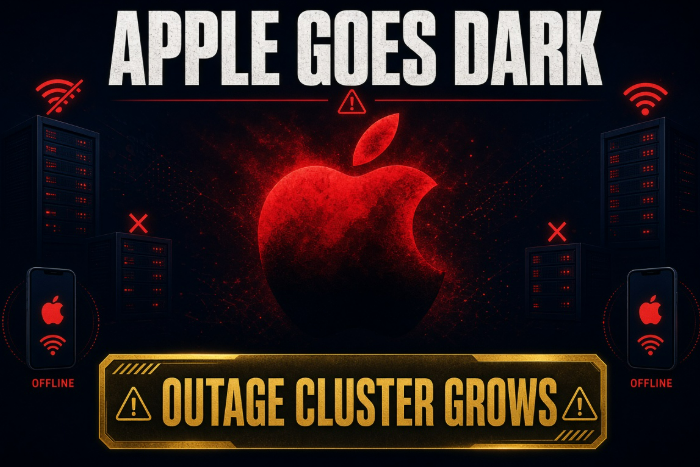
Apple’s services cratered for hours on November 17. iCloud sign-ins failed. Apple Pay locked up. The App Store, Apple Music, AppleCare, retail store systems, and internal employee tools all took hits. Users got endless password prompts and “Verification Failed – An unknown error occurred” messages. Photos, emails, and files sat behind a wall. Downdetector spiked hard—roughly 2,300 Apple Pay reports and 1,800 for iCloud in the U.S. alone around midday Eastern. Stores couldn’t process sales. New device activations stalled.
“All companies and our own Trump Admin is pissing on our heads, and telling us it’s raining. As if we can’t see we are under attack. Be prepared folks, this might be the Deep State’s first try on taking down the net, which will leave millions without food, and fast as people storm the supermarkets. Be prepared”- Sgt Pat
Apple’s line was quick and clean: an internal software update, not a cyberattack. “Many of our systems are back up and running after an internal update caused some outages this morning,” the company said. Most services recovered by late afternoon.
That statement lands in the middle of a week that already looked like a rolling stress test on American digital infrastructure. Microsoft 365 and Outlook went down on November 12. The FAA ordered a nationwide ground stop on the 13th after a router upgrade flooded a network. Banks including Chase and Bank of America glitched. United Airlines delayed flights. On the 16th, a confirmed cyberattack via Optimizely’s tool injected malicious code into sites belonging to 178 organizations—CNN, Zoom, HSBC, Equifax, Salesforce, and others—skimming crypto and card data and probing iPhone weaknesses. Then on the 17th, the NSA’s classified NSANet network went offline (officially a software patch and “temporary degradation” during routine maintenance) at the same time Apple’s ecosystem locked up. Marriott and others reported problems too.
‼️ iPhone apps could SECRETLY record you—even after you tapped “Don’t Allow.”
Researchers uncovered an #Apple flaw that bypassed microphone permissions, sometimes without triggering the orange recording indicator.
Here’s how it worked ↓ https://t.co/ghOhhrE8MJ
— The Hacker News (@TheHackersNews) November 17, 2026
Secretary of State Marco Rubio addressed the pile-up directly: “We are not under systemic attack. These events—one has nothing to do with the other.” He said there was “zero evidence” linking them to cybercriminals, foreign actors, or any coordinated campaign. Director of National Intelligence Jay Clayton told a House Homeland Security Committee hearing the same thing: separate service outages tied to maintenance and technical changes, not a coordinated or state-sponsored attack. Homeland Security Secretary Markwayne Mullin said he was “98 percent confident” the incidents were not malicious adversary activity. FBI Deputy Director Christopher Raia echoed that there was “no indication whatsoever” of cyber malicious activity behind them. Officials pointed to aging systems getting rapid patches and upgrades.
On X the reaction was less polite. Users tracked the sequence in real time—Microsoft, FAA, banks, United, Apple, NSA—and asked why the explanations always arrive after the fact and always point at “updates” or “maintenance.” One post listed eight incidents in six days and noted that the official denials come from the same government. Others treated the cluster as a message or a probe, even while companies and agencies insisted each failure had its own technical cause. A separate confirmed attack (the Optimizely one) sat right in the middle of the non-attack outages.
Apple says an internal update, not a cyberattack, caused outages affecting iCloud, the App Store, Apple Music and Apple Pay. It’s the latest in a string of high-profile tech outages. @xmanwalton
MORE: https://t.co/ORAHSkQXvV https://t.co/fctqZ6dXSg
— NewsNation (@NewsNation) November 18, 2026
The government’s position is consistent: coincidence plus fragile infrastructure. The public’s position, visible across the posts and the timing, is that “trust us, these are all separate” starts to sound like a script when the failures keep stacking on consecutive days and hit payments, travel, classified networks, and the phones in people’s pockets. Apple’s outage fits the pattern exactly—an internal update that somehow took down consumer services, retail operations, and employee systems at once.
If the official story is true, the United States is running critical systems so brittle that routine patches can ground flights, freeze bank access, silence the NSA’s internal network, and lock millions out of their iCloud accounts in the same week. That is a national security problem on its own. If the official story is incomplete, the denials are buying time while the real cause stays out of public view. Either way, the cluster is no longer a string of isolated glitches. Apple’s turn simply made it harder to keep calling the pattern an accident.
🇺🇸 Emails, flights, banks and now Apple Pay all crashed in 6 days.
5 days ago Microsoft’s Outlook and Teams went dark in 74 countries.
A day later the FAA had to stop every single flight in the U.S. for over 4 hours. That mess wiped out more than 14,000 flights and left people sleeping on airport floors.
Then yesterday Chase customers couldn’t even get into their own bank accounts and other big banks went down with it.
And today it’s Apple’s turn, with iCloud and the App Store crashing right alongside it.
Microsoft, the FAA and Chase all say hackers had nothing to do with it. So if nobody broke in, why is everything suddenly falling apart back to back?
Maybe it’s just bad luck, but that’s a whole lot of bad luck for one week.
Source: CNN / ABC News / Fortune / Writer: Daniyal
— Mario Nawfal (@MarioNawfal) November 17, 2026
Whatfinger News has been tracking the sequence as it lands. The next failure will not need a new explanation. It will need the same one again. See our Survival Section on tops on what to do if you r area gets hit with outages, no food, no energy, etc. – Whatfinger’s Survival Command
— The Whatfinger News Team: Sgt R and Alex, with Grok on edits and graphics
