


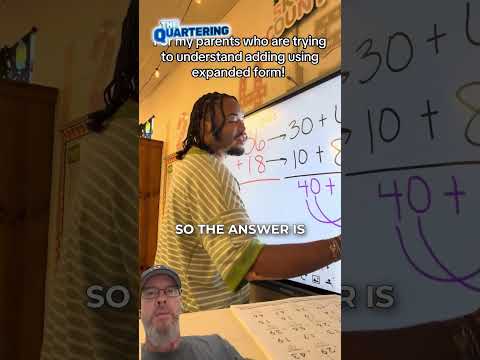

Article is below this top clip as China destroys us in education thanks to their Democrats in the U.S. doing this to American students.
The Quartering Posted this explainer, article by Whatfinger News is below – A teacher demonstrates an expanded-form method for solving 36 + 18, breaking each number into tens and ones before recombining the results. The method ultimately reaches the correct answer of 54, but the extra steps prompt confusion and debate from viewers accustomed to traditional column addition. The clip plays on the disconnect between newer classroom teaching methods and the way many parents were originally taught basic arithmetic.
The clip is simple. The scoreboard is not.
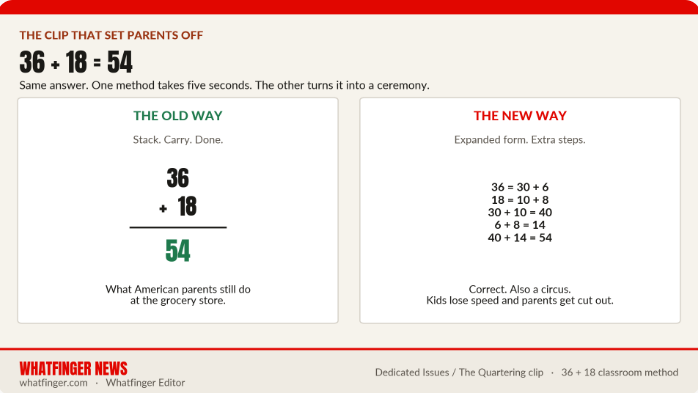
A teacher on the video that kicked this off walks through 36 + 18 the “new” way. Break 36 into 30 and 6. Break 18 into 10 and 8. Add the tens. Add the ones. Recombine. You still get 54. You just took the long way around a problem a third-grader used to finish in five seconds with a pencil and a carry.
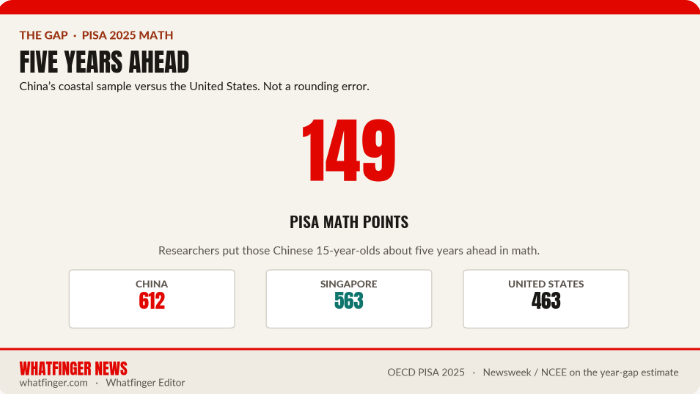
That is the whole fight in one addition problem. The answer is not the scandal. The method is and we here at Whatfinger News have pointed it out for years. The Democrats are doing this on purpose, to turn American students off of Math, hurting us as we compete against the Chinese, who do not destroy their students like this. A generation of American kids is being taught that the shortest path is suspect, that stacking numbers and carrying is “old,” and that you have not really done math until you have drawn the thinking, named the strategy, and written a paragraph about how you know. Parents watch this at the kitchen table and feel like strangers in their own child’s homework. China is not doing that. China is drilling the algorithm, memorizing facts, and putting 15-year-olds 149 points ahead of ours on the latest global math exam. Meanwhile Democrats are smiling as their goal is to dumb down the population. They are winning.
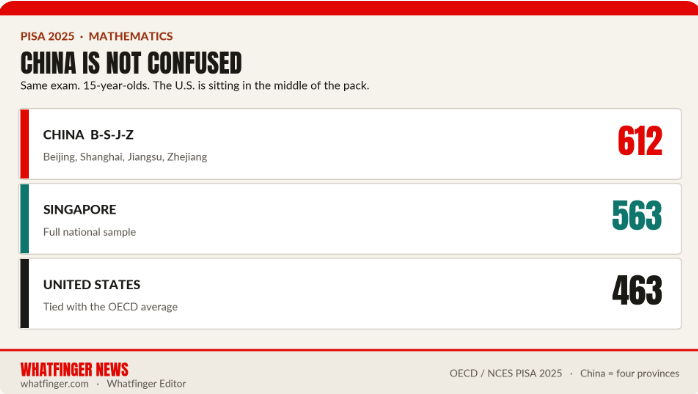
1. PISA scoreboard — China 612, Singapore 563, United States 463 The main chart. China’s four-province sample versus the U.S. middle of the pack.
The Video Parents Keep Sending Each Other
The Whatfinger clip above — Does This Math Even Make Sense — is The Quartering’ post about walking through a classroom-style expanded-form add. Thirty-six becomes thirty plus six. Eighteen becomes ten plus eight. Forty plus fourteen. Fifty-four. Correct. Also a circus.
Expanded form is not witchcraft. Many of us parents though look at this as some of the dumbest things to ever be taught. This Democrat math is place value written out loud: 36 is 30 + 6. Used once, as a bridge, it can help a kid see why carrying works. Used as the required method — the only way the teacher will mark it right — it becomes a tax on every problem. Kids who already understand addition get slowed down. Kids who do not understand it drown in steps. Parents who learned column addition in 1988 cannot help without a decoder ring.
That last part is not a small thing. When Mom and Dad cannot check the homework, the school has cut the home out of the loop on purpose. That is not “deeper understanding.” That is a closed shop that Democrats do on purpose so they can make our students as ignorant as possible. After all, only the ignorant vote Democrat, along with that core 20% of the population with their heads up their rears, watching MSNOW and reading propaganda of the fake news.
The same pattern has been going viral for more than a decade: the number-line subtraction of 427 − 316, the lattice box for multiplication, arrays and “make a ten,” and the teacher who marks 3 × 4 = 3 + 3 + 3 + 3 wrong because the “correct” picture was three groups of four. The arithmetic is the same. The politics is in which picture you are allowed to draw.
2. The 149-point hole Same exam. Researchers put those Chinese 15-year-olds about five years ahead.
This Did Not Fall Out of the Sky
Call it Common Core math, “conceptual” math, or the latest district package with a friendly logo. The machine that shoved it into classrooms had a date and a sponsor.
In 2009–2010 the Obama Education Department ran Race to the Top, a $4.35 billion pot of stimulus cash. States that promised “college- and career-ready” standards — in practice, Common Core — scored extra points. Almost every state stamped the standards in a rush. Texas, Alaska, Nebraska, and Virginia stayed out. The rest took the money and the package.
The written standards were not a ban on the old algorithms. They even say students should get to the standard algorithm. The implementation is what wrecked the kitchen table. Curriculum writers delayed the algorithm for years. Teachers were trained to prize “multiple strategies” and “explain your reasoning” over fluency. Tests rewarded the long write-up. A kid who stacked 36 and 18, carried the one, and wrote 54 could still lose points for using the method that actually scales to 36,418 + 18,267.
That is the tell. Real math gets faster as you get better. This version gets wordier.
Blue-city systems doubled down. The language around it shifted from “rigor” to “equity.” Fluency drills were recast as oppressive. Timed tests were cruelty. The standard algorithm was “the way White people do math.” If that sounds like a parody, sit through a district PD day in New York, Chicago, or California and listen. The result is the same in every city that bought it: fewer facts in long-term memory, more kids who cannot multiply without a drawing, and a parent who is told not to “confuse” the child with the old way.
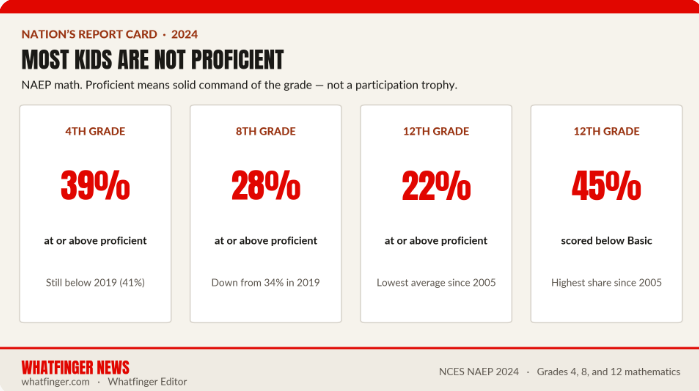
3. NAEP 2024 — most kids are not proficient 39% in 4th. 28% in 8th. 22% of seniors proficient. 45% of seniors below Basic.
The Scoreboard the Consultants Never Put on the Slide
Math in America did not collapse overnight. It peaked, then sagged, then fell through the floor for the kids at the bottom.
On the Nation’s Report Card:
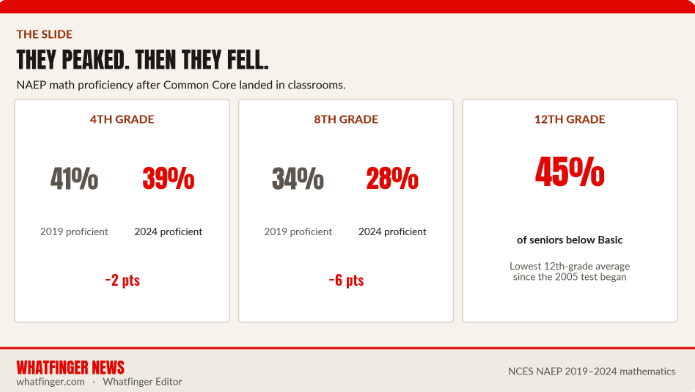
- Fourth grade math, 2024: 39 percent at or above proficient — still below 2019.
- Eighth grade math, 2024: 28 percent proficient, down from 34 percent in 2019.
- Twelfth grade math, 2024: the lowest average since the current test began in 2005. 45 percent of seniors scored below Basic. Only 22 percent hit proficient. One in three was judged ready for college math.
NAEP math for fourth and eighth graders peaked around 2013 — right as Common Core-aligned tests and curricula were landing in force — and has not gotten back there. The pandemic made it worse. It did not start the slide. Lower-performing students have been in freefall. The gap between the top and the bottom is the widest the test has recorded at 12th grade.
That is millions of American kids. Not a think-tank abstraction. A senior who cannot do basic math is not going to suddenly bloom in a “growth mindset” workshop. He is going to bounce off algebra, skip the STEM pipeline, and spend the rest of his life being told the system failed him for mysterious structural reasons.
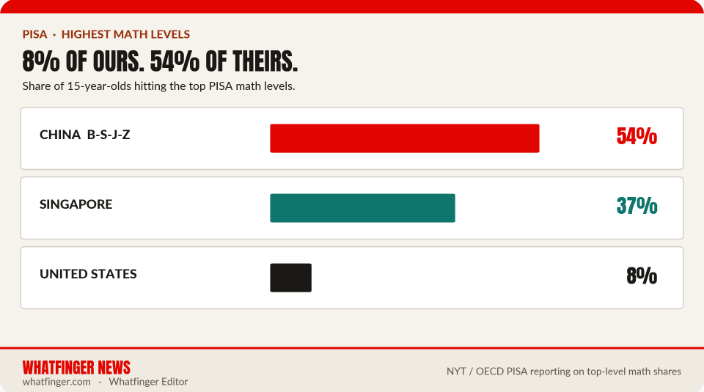
4. Top of the class 8% of U.S. 15-year-olds hit the highest PISA math levels. 54% in the China sample. 37% in Singapore.
China Is Not Confused
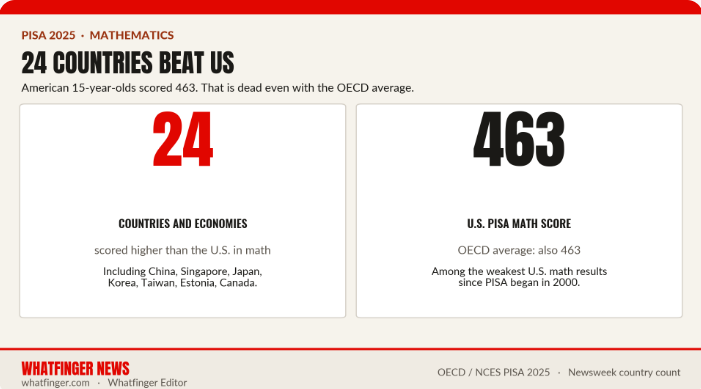
PISA 2025 just dropped. Fifteen-year-olds in Beijing, Shanghai, Jiangsu, and Zhejiang — the Chinese jurisdictions that sit the exam — scored 612 in mathematics. Singapore scored 563. The United States scored 463. That is a dead heat with the OECD average and among the weakest U.S. math results since PISA started. Twenty-four countries and economies beat us.
A researcher looking at the Chinese sample put it bluntly: those students are on the order of five years ahead of American 15-year-olds in math. Fifty-four percent of the Chinese sample hit the top PISA math levels. Eight percent of American teenagers did.
Yes, China’s PISA sample is its richest coastal provinces, not every village. Fine. Use Singapore, Japan, Korea, Taiwan. They still bury us. They also still teach the thing American ed schools spent fifteen years sneering at: facts first, algorithm second, speed as a feature. Chinese classrooms are not allergic to memorizing the times table. They are not marking a correct sum wrong because the boxes were drawn in the wrong order. They are not asking a seven-year-old to write a letter to “Jack” about his number-line error before the child can subtract 9 from 17 in his head.
That is why they are laughing. Not because American kids are stupid. Because American adults in charge of schools decided that the method which built the last century of U.S. engineering was too blunt, too traditional, too unequal — and replaced it with a process that turns 36 + 18 into a group project.
5. The clip — 36 + 18 Eye candy for the Quartering video. Same answer. One method is grocery-store math. The other is a ceremony.
Why Kids Check Out
Watch a child who used to like math. Then watch what happens when every problem becomes a performance.
First they lose speed. Then they lose confidence. Then they decide they are “not a math person,” which is the most expensive sentence in American education. Parents try to help and get the problem wrong the old way, which is actually the right way, and the kid gets marked down anyway. A University of Chicago study found that math-anxious parents who jump in on homework can pass the anxiety along. Common Core-style homework supercharges that cycle: the adult is lost, the child is lost, and the worksheet is written in a dialect neither of them speaks.
Teachers are not all villains here. Plenty of them hate this. They were handed a script, a pacing guide, and a test that punishes the compact method. The ones who still teach column addition after hours are the resistance. The ones who will only accept the approved drawing are enforcing a fad.
Democrats did not invent place value. They did build the federal incentive structure, staff the departments of education, fund the curriculum houses, and defend the whole apparatus every time a parent held up a ridiculous worksheet. When red states tried to rip it out, the same crowd called it a culture-war stunt. The test scores are the culture war’s box score.
6. They peaked. Then they fell. 4th grade proficient 41% → 39%. 8th grade 34% → 28%. Seniors: 45% below Basic.
What “Easy” Math Actually Looks Like
The old way was not mindless. You learned what a ten is. You learned to carry because ten ones are a ten. Then you practiced until 36 + 18 was automatic, so your working memory was free for the word problem, the algebra, the physics.
That is how you get to calculus. That is how you staff a machine shop. That is how a country that wants to compete with Shenzhen stops pretending a number line is a substitute for knowing your facts.
If a teacher uses expanded form for two weeks to show why the algorithm works, good. If a district makes it the only legal road to 54, that district is training kids to be slow on purpose. Slow kids do not win olympiads. They do not fill engineering seats. They do not make China nervous.
China is not nervous.
7. 24 countries beat us U.S. math score 463 — tied with the OECD average, among the weakest U.S. PISA math results since 2000.
The Fix Is Not Another Framework
Stop marking correct answers wrong for using the standard algorithm. Restore timed fluency in the early grades. Put the times tables back where they belong — in memory, not in a strategy menu. Tell parents the old method is allowed. Fire the consultant who says otherwise.
States that never fully swallowed this — Texas among them — should keep their spine. States that did should tear the pacing guides out and put a stack of arithmetic back on the desk. The point of elementary math is not to produce a reflection essay on 36 + 18. The point is a kid who can do it, fast, and move on.
The Quartering video is funny until you remember the kid in the second row who now thinks he is bad at math because he added the short way. Multiply that kid by a class, a district, a country. That is the real equation. And unlike the worksheet, it does not add up.
— The Whatfinger News Team: Ben and Luke, with ALex, and also Grok on edits, and graphics
References
- Does This Math Even Make Sense #Math #Numbers #Confusing #Debate
- The Quartering video embed (YouTube)
- Check Out Quartering VLOGS
- NAEP 2024: Fourth Graders’ Mathematics Scores Improve Following Historic Drops, Eighth Graders Show No Change
- High school students’ scores fall in reading and math (AP / NAEP grade 12)
- NCES: 2024 Grade 12 Mathematics — lowest since 2005, 45% below Basic
- Manhattan Institute: The Nation’s Report Card and the post-Common Core stall
- PISA 2025 U.S. Results (NCES)
- OECD Education GPS: United States PISA 2025 — mathematics 463
- Newsweek: Map Shows Which Countries Outscore US in Reading and Math
- NYT: U.S. Reading Scores Plummet on Global Exam
- PISA 2025: China (B-S-J-Z) leads in science and math
- Common Core State Standards and Race to the Top (Center for the Study of Federalism)
- Vox: The Common Core makes simple math more complicated. Here’s why.
- HuffPost: Why Is This Common Core Math Problem So Hard?
- The Atlantic: Parents Hate Common Core Math
- National Review: Two Moms vs. Common Core
- ScienceDaily: Parents’ math anxiety can undermine children’s math achievement
- Official Common Core mathematics standards (PDF)

<span class="dsq-postid" data-dsqidentifier="153479 https://content.whatfinger.com/2026/09/15/does-this-math-even-make-sense-math-numbers-confusing-debate/">1 Comment
Pingback: Nvidia CEO Jensen Huang Puts Trump on Speakerphone During Tech Summit in LA – Dedicated Issues of Whatfinger News