


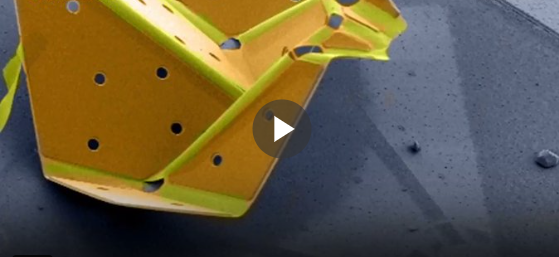

Shape-shifting “metasheet” robots represent a significant breakthrough in the field of microscale robotics. These robots are typically smaller than a millimeter and begin as 2D hexagonal metasheets. Upon activation by an electric current, they morph into pre-programmed 3D shapes and can even crawl, giving them a high degree of versatility and potential applications in various fields such as biomedical devices and material science Technology Networks and ScienceDaily
At Cornell University, something mind-bendingly intricate has just emerged—tiny robots, delicate as a whisper, but capable of transforming like nothing we’ve seen before. These “metasheet” robots can bend and twist… morphing into shapes as if they’ve been designed by nature itself. The secret? A spark of electricity, and voilà—what was once flat begins to crawl. But don’t be fooled by their size. These creations were not born from your usual lab tinkering. No, they draw inspiration from both biology and the age-old Japanese craft of kirigami, where folding and cutting bring paper to life in unexpected forms.
Microscopic robots unfold like origami birds pic.twitter.com/4Nsehp6D14
— Mashable (@mashable) September 6, 2024
Now, “metasheet” may sound like science fiction jargon, but it’s really just a reflection of their complex, flexible nature—built from “metamaterials,” the kind that lets you think beyond the ordinary. Imagine this: 100 panels of silicon dioxide, each so impossibly thin it’s measured in nanometers, all stitched together by invisible hinges. The whole thing breathes when a little charge of electricity runs through it—expanding, contracting—up to 40% of its original size. Just that slight burst of power, and these robots come to life, slithering into forms pre-programmed into their very structure.
- Kirigami-inspired design: Unlike traditional origami, where folding is based on uncut sheets, kirigami involves cutting the sheet to achieve complex 3D shapes. This allows the metasheet robots to fold, expand, and contract efficiently Technology Networks
- Electrochemical actuation: The robots use electricity to activate hinges within the metasheet, enabling them to take on different shapes and movements, such as wrapping around objects or returning to a flat configuration ScienceDaily
- Potential applications: Due to their programmable nature and small size, these robots could be used for tasks such as targeted drug delivery, microsurgery, or environmental monitoring.
But where does it end? What does this weird, mesmerizing ability actually mean? The potential here seems almost limitless. Imagine them squeezing into spaces too small for human hands or bulky machinery—wriggling through narrow pipes to fix something deep within an industrial system, or even entering the human body to perform delicate surgeries where precision is everything. The beauty is in their ability to shift on demand—to become something new based on the needs of the moment.
A new microscale kirigami robot can fold and crawl in 3D! This tiny innovation could lead to breakthroughs in medical applications and complex robotics. #Robotics #Innovation #Tech
Read more: [Mirage News](https://t.co/iom4CA97JL) pic.twitter.com/rwu6nn6ZGI
— RobotNext (@RobotNext) September 12, 2024
Yet, it’s not just their utility that captivates—it’s the elegance of the idea. The ancient art of kirigami combined with modern science… it’s a kind of poetry in motion, the kind that moves beyond rigid technology and becomes something closer to an art form. The paper-folding techniques of kirigami, with its cutting and folding, merge effortlessly with advanced robotics, resulting in something that feels oddly organic, almost alive.
These robots could very well be the harbingers of a new age of soft robotics. Imagine machines that are not static, that don’t need to be rigid, but instead can flow, bend, and morph as the situation requires. Machines that don’t just perform a task but adapt themselves in real-time to meet whatever challenges lie ahead. Tools that are created to change themselves—to suit the environment, the moment, the mission.
Electronically configurable microscopic metasheet robots https://t.co/eRs8Nx4fmw
— Prof Nasr Bensalah (@PBensalah) September 12, 2024
The world has only just begun to scratch the surface of what these metasheet robots can do. They may be minuscule, but their implications are vast. What if the future of robotics isn’t about building bigger, stronger machines—but about designing tiny, adaptable ones? The future might just unfold from these small, delicate sheets, shifting and crawling their way into places we once thought unreachable…
Major Points:
- Researchers have created tiny robots capable of transforming into pre-set shapes and moving when electricity is applied, merging art and science in an innovative design.
- These robots draw inspiration from both biological organisms and kirigami, a variation of origami that involves cutting to create more complex shapes and movements.
- Each robot is constructed from 100 ultra-thin silicon dioxide panels, connected by hinges, allowing them to expand or contract by 40% when an electrochemical reaction is triggered by electricity.
- These tiny robots have potential uses in fields like medicine, industry, and space exploration, where their ability to adapt and change shape can lead to innovative solutions for delicate or precise tasks.
- This development pushes the boundaries of soft robotics, where materials not only function but also respond and adapt to their environment, paving the way for future advancements.
RM Tomi – Reprinted with permission of Whatfinger News
