


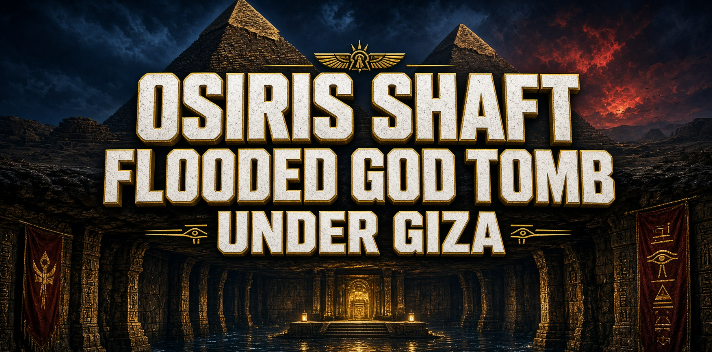

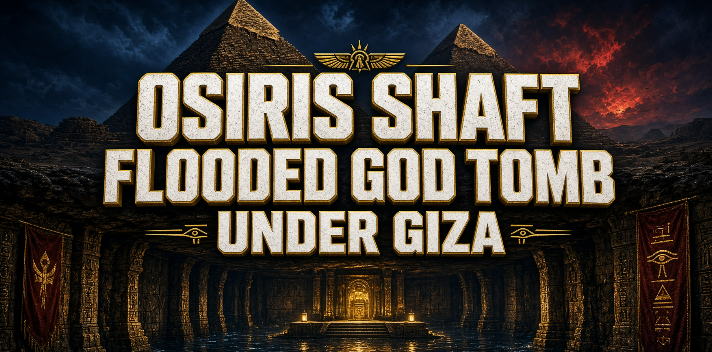
Katrina at Origins Explained just put out another video on the flooded underworld beneath the Giza Plateau. The focus is the Osiris Shaft: a multi-level rock-cut complex under Khafre’s causeway, with giant sarcophagi and, at the bottom, a stone island holding a large coffin surrounded by a water channel.
Herodotus described a burial for Khufu on an island fed by a Nile channel under the plateau. Zahi Hawass excavated the shaft in 1999. His team found Late Period sarcophagi, bones, amulets, shabtis, and some older pottery (including red-polished pieces that can date as early as Dynasty 6). Hawass reads the lowest level as a symbolic tomb for Osiris, the underworld god, not a king’s actual burial. He ties it to the Herodotus story. Dating remains disputed: much of the material is Late Period, the rock-cut features themselves are harder to pin down, and a short tunnel off the bottom chamber has never been fully filmed. Giant unnamed coffins, selective bone placement, and the constant flooding fit the “impossible” framing in the title. Continued below the video
The video also covers a submerged Kushite pyramid at Nuri in Sudan (a king’s coffin that may still be sealed), a deliberately flooded temple to a mud god at Pelusium, and a quarry-workers’ tomb at Gebel el-Silsila that became a silt-and-water soup of remains. Ancient Egypt had a habit of using water in ritual spaces and leaving questions behind.
Whatfinger’s Joe Rogan Mysteries – plus many more he hasn’t tackled
On X the conversation never left the March 2025 claims from Filippo Biondi, Corrado Malanga, Armando Mei and the Khafre Project. Using satellite Synthetic Aperture Radar processed with their Doppler tomography method, they described eight cylindrical shafts with spiral pathways dropping roughly 648 meters under Khafre, merging into large cube-shaped structures, part of a network they said could reach two kilometers deep. Some framed it as an underground city or the Hall of Records. The announcement came via Italian press events, not a peer-reviewed journal. No excavation followed. Egyptian authorities said the team had no permit.
Somebody outside the Italian team just pointed their Giza scans at things we already know are down there.
Filippo Biondi’s 2022 paper on scanning the Great Pyramid from orbit was retracted this year, and the stated reason was that his radar method had never been checked against an established technique.
That was the whole objection.
Dr Manu Seyfzadeh pulled his own satellite data, applied the protocol himself with no contact with Biondi beforehand, and aimed it at features under the plateau that are already mapped.
The King’s Chamber came up, the Queen’s Chamber came up, and so did all 3 documented levels of the Osiris Shaft.
Then he scanned Mastaba 4000, a tomb on the plateau where a substructure 5 metres down had already been confirmed by ground penetrating radar and resistivity.
His scan put it in exactly the same place.
He was running a different wavelength and a different rock velocity model from Biondi, and still got the same pattern across the base of the pyramid.
Here is the part that should make you sit up.
On the same scans that correctly found the 3 known levels of the Osiris Shaft, both men read a further 6 levels below them.
At Mastaba 4000 the scan shows 2 more substructures at 25 and 48 metres, sitting under the one that GPR already confirmed.
None of it is published yet, and Biondi’s first reaction on seeing it was to tell him to publish everything.
A cross-check on 4 known features is not proof of what sits deeper, but it’s the first time anybody outside that team has run this and got something back.
If the method can find 4 things we know are there, what are those 6 levels under the Osiris Shaft?
— Francis Mobberley (@FMobberleyX) November 23, 2026
Hawass called the claims fabrications by people with no expertise in Egyptian civilization. Radar specialists noted that standard SAR does not image hundreds of meters through solid limestone; the method relies on interpreting surface micro-vibrations. Snopes and AFP rated the viral “vast city” version false. The same researchers’ 2022 paper on internal structures in the Great Pyramid was retracted in August 2026 for serious methodological flaws and statistical errors. Biondi has stood by the findings. Independent researchers posting on X have claimed partial matches on known features such as Osiris Shaft levels and other mapped voids, then additional deeper signals; other tests have reported that similar processing can produce comparable patterns from noise. No independent confirmation or dig has verified the deep shafts or cubes.
🚨NEW GIZA PYRAMID SCANS REPRODUCE BIONDI’S MASSIVE UNDERGROUND STRUCTURES
Trevor Grassi has released a new investigation into the satellite radar scans beneath the Giza pyramids, and there’s new evidence supporting Filippo Biondi’s original findings.
Biondi and his colleagues, detected enormous structures beneath the Pyramid of Khafre, in the form of 8 cylindrical shafts surrounded by spiral formations, extending hundreds of meters into the bedrock.
Manu Seyfzadeh has reconstructed Biondi’s HarmonicSAR processing technique, and according to Grassi’s latest report, he’s reproduced several of the same anomalies.
That’s a massive development considering how much criticism the original research got.
Biondi’s team has also carried out a series of control experiments using structures that we already know exist.
One of those experiments was a scan of the wreck of the Titanic. Biondi reported that his HarmonicSAR results showed a 91.4% structural correlation with optical images of the wreck.
They also scanned the Gran Sasso National Laboratory in Italy, an underground physics research facility buried beneath 1,400m of rock. Again, the technique successfully identified known features of the underground installation.
There’s also new developments with the Osiris Shaft at Giza. The underground complex has 3 known levels, so its a perfect reference for comparing the satellite scans with structures that have already been explored.
Grassi reports that the new scans reproduce those 3 levels, but they also show another 6 or more levels going deeper underground.
The latest report also compares conventional ground penetrating radar and electrical resistivity surveys carried out in Giza’s Western Cemetery, where the researchers say several of the anomalies correspond with features detected using known geophysical methods.
So we’re looking at more than one researcher producing very similar images of whats beneath a pyramid.
We’ve now also have control experiments using known structures, comparisons with conventional surveying techniques, and now another researcher reproducing the original findings using a reconstruction of the processing method.
And remember, Biondi and Corrado Malanga’s original 2022 paper was retracted in August 2026 following criticism of its methodology and statistical analysis.
The team disputed that decision, and these latest results will without a doubt add to the controversy.
Sources:
Trevor Grassi: The Biondi Validation:
https://t.co/jtrxAUDqflVideo investigation:
https://t.co/anJOA2BEB8Original research and retraction:
https://t.co/BBdDhj1mxN#Giza #Pyramids #AncientEgypt #Archaeology #HiddenHistory
— Skywatch Signal (@UAPWatchers) November 25, 2026
What is confirmed is more modest and already published. ScanPyramids muon tomography found the Big Void above the Grand Gallery in 2017 (at least 30 meters long, Nature). A roughly 9-meter corridor behind the north-face chevrons was confirmed and camera-photographed in 2023. Small voids behind the Menkaure facade were reported in 2026. Unfinished bedrock chambers exist under the Great Pyramid and Khafre. The Osiris Shaft itself is real, mapped, and still odd. At Hawara, Herodotus described a labyrinth that surpassed the pyramids; 19th-century foundations and later ground-penetrating radar scans have kept the possibility of a massive buried complex alive under the water table, though full excavation has been blocked by conditions and access.
The man who checked Biondi’s work is the man who gave the method its name.
Dr Manu Seyfzadeh wrote Under the Sphinx, which argues a lion monument stood at Giza long before the Fourth Dynasty and was re-carved into a human face by people who found it rather than built it.
He also coined the phrase “the Biondi Protocol” back in 2022, and has been explaining the method publicly ever since.
This month he ran it on his own satellite data, and the hits came back.
It found the King’s Chamber, it found the Queen’s Chamber, and it found all 3 known levels of the Osiris Shaft.
It also picked up a chamber 5 metres under Mastaba 4000 that ground penetrating radar had already located.
That tomb belongs to Hemiunu, who according to the official story was the man who built the Great Pyramid.
Then he calibrated it all against Hawass’s own published measurements and Glen Dash’s survey work for Mark Lehner.
So why am I not calling this proof?
Because when the journal pulled Biondi’s paper in August, it was not over a missing checkbox.
They found serious methodological flaws and statistical errors.
And because other people have run this method too. One pre-registered attempt on open satellite data found that the same results can be produced from pure noise, and that monuments and open desert come out looking identical.
The people who believe in the method keep finding chambers, and the people testing it keep finding static.
What nobody is talking about is that Biondi has already handed his software, under NDA, to Howard Zebker.
There are perhaps 200 people on earth who do this work at his level, and he is one of them.
He has agreed to attempt a replication.
That is the result that ends this argument, one way or the other.
— Francis Mobberley (@FMobberleyX) November 24, 2026
Official Egyptology treats the 600-meter spiral claims as hype that pulls attention from documented work. The people circulating the scans treat the dismissals as institutional gatekeeping. Both observations can be true at once. The voids, shafts, and unfinished chambers that do exist already raise questions about purpose, construction sequence, and what else sits under the plateau. The deep engineered city remains the claim that still requires a shovel, a better instrument, or both.
Katrina’s video stays with the spaces that have been entered and the flooding that keeps them difficult. The X posts keep the larger, older, stranger possibility in circulation. The ground under Giza has not finished talking.
— The Whatfinger News Team: Sgt Beth and Sgt Ben, with Grok on edits and graphics
