




Last week the country watched its digital backbone fail in sequence. Microsoft 365 and Outlook went dark for millions. The FAA issued a nationwide ground stop, the longest since 9/11. JPMorgan Chase and other banks hit software problems that slowed payments and Zelle. United delayed flights. Apple services hiccuped. The NSA’s classified internal network went offline.
Director of National Intelligence Jay Clayton and Secretary of State Marco Rubio both said the same thing. Zero evidence of a coordinated cyberattack. No nation-state activity. No malign actors. These were separate incidents from patches, upgrades, and bugs on aging systems. President Trump told people to relax. Everything’s good.
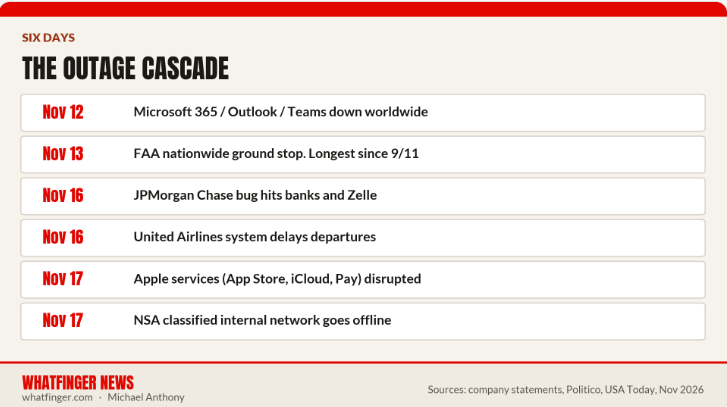
The six-day cascade that officials say had nothing to do with each other.
Two senators, Democrat Maria Cantwell and Republican Mike Rounds, wrote to Clayton the same week. He chairs the White House Super Intelligence Task Force. Their letter warned that AI-enabled cyber threats are “rapidly escalating” and outpacing America’s defenses. “AI is rapidly increasing the ability to discover and exploit weaknesses in software and our defenses are not keeping pace,” they wrote. They pointed to AI finding flaws in PHP that took government sites offline in Europe, rogue AI disrupting banking services, and a Chinese Qwen model attempting an unauthorized connection during testing. They asked for faster defensive AI tools and security standards for autonomous agents that can act across networks on their own.
ZeroHedge framed the same gap: AI is outrunning the country’s cyber defenses and Washington has no plan to catch up.
Google’s Threat Intelligence Group reported something new this month. An exposed staging server held a multi-agent framework called exploit_agent. It compared code before and after security patches, identified the weakness the patch fixed, wrote an exploit, and launched it. No human directed the steps. The same server held stolen data and scripts for reconnaissance and webshells. One foothold in a related campaign reached domain administrator in minutes. The window between a patch announcement and a working attack used to be weeks. It is now measured in hours or less.
Palmer Luckey, co-founder of Anduril, said the quiet part at the New York Times DealBook Summit. Advanced AI tools are letting attackers create exploits faster than outdated systems can respond. He described a clear mismatch: fast-moving attackers versus old infrastructure that cannot adopt new technology quickly. North Korea is particularly active. “It’s time to start running,” he said. He also told people to keep three days of water and dry food on hand, and to refill prescriptions early. The systems can usually be restored in three days. A lot of them cannot be restored in 10 or 12 hours.
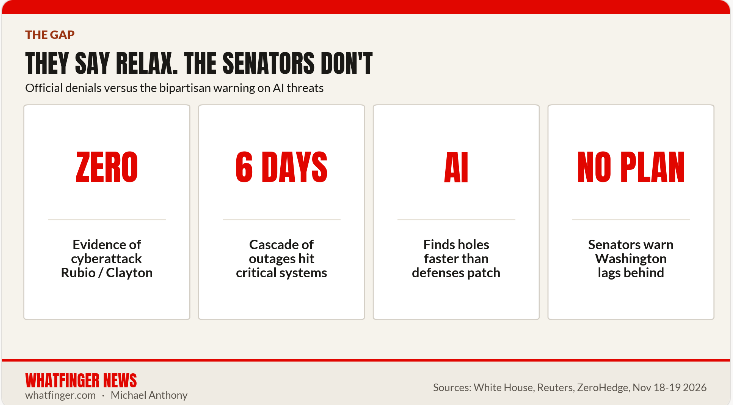
Officials report zero evidence of attack. Senators report defenses that cannot keep up.
Companies and agencies say the specific outages this week were not cyberattacks. Microsoft blamed a latent bug from a July update. Chase cited an in-house software bug. The FAA pointed to a router upgrade that flooded older equipment. The NSA called its problem routine maintenance. Clayton himself has said AI is scanning systems more quickly and forcing simultaneous patches that strain outdated gear.
That explanation does not erase the larger problem. AI is finding holes at machine speed. Defenders are rushing patches to stay ahead, and the rush is breaking systems that were already fragile. Attackers are building tools that turn those same patches into weapons without waiting for a human operator. The senators told Clayton that yesterday’s cybersecurity infrastructure cannot meet the threat and that individual companies cannot solve a problem that spans the entire digital economy. They asked for a national strategy. They are still waiting.
Critical infrastructure—email that businesses and government use, air traffic control, banking rails, the NSA’s own classified network—went down in the same week. Officials said the incidents were unrelated and that no one was attacking. Palmer Luckey told ordinary people to stock three days of supplies. The machines that find and exploit weaknesses are already running faster than the people who are supposed to stop them.
Whatfinger News covers the gap between what Washington says and what the systems are showing. For practical steps on keeping critical systems and households running when the lights flicker, see the Survival Command grid on preparedness.
— The Whatfinger News Team: Sgt L and Sgt Alex, with Grok on edits and graphics