



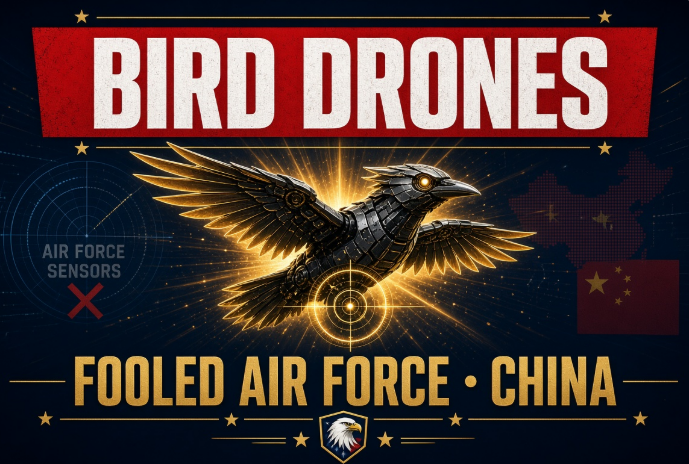
A one-pound ornithopter from California startup Ornadyne flapped its wings like a crow at Edwards Air Force Base in September and got logged as a bird by competing counter-drone gear. The O1 flew during “Game of Drones” 26-3, an event run by the 412th Test Wing’s Experimental Test Force and the Defense Contract Management Agency’s Blue List team. Co-founder Armen Arakelyan (ex-SpaceX) said it looks like a bird, moves like a bird, and is quieter because it has no propellers. Co-founder Geourg Kivijian confirmed the sensors “could not establish our drone” and registered it as a bird—the exact outcome the company wanted. Specs from the company: about 1 lb, roughly 3-foot wingspan, more than 6 miles range, over an hour endurance, small camera payload. Color, shape, and proportions can be tweaked to match local species.
Task & Purpose ran the story under a “Birds Aren’t Real” headline. The satire group’s joke is starting to look less funny.
China has built a stealth drone that looks and flies like a real bird..
The conspiracy theorists are right again.. lmao https://t.co/ZadIXtC01N
— American AF 🇺🇸 (@iAnonPatriot) March 7, 2026
China has been ahead of this curve. In 2024, PLA Jiaolong Commandos (their SEAL-equivalent frogmen) released a sparrow-like flapping-wing drone from the water during an exercise. State media and observers called it a miniature biomimetic ornithopter built for covert recon. Northwestern Polytechnical University has posted multi-hour ornithopter endurance records. At the 2025 China Military Intelligent Technology Expo, Chinese teams showed magpie-size (90 g, hand-launched, camera) versions plus larger seagull, hawk, and eagle models. The eagle variant is listed around 3.6 kg with a two-meter span, 40-minute endurance, 6–8 km radius, and the ability to carry micro-munitions. Swarm tactics are part of the pitch: flood the area with things that look like local birds so radars, acoustics, and optical systems treat the whole flock as wildlife.
Whatfinger’s Military and War Aggregate
Then there are the insects. National University of Defense Technology in Hunan put a mosquito-scale UAV on CCTV 7. Students held it between two fingers. It has a stick-like body, leaf-shaped flapping wings, and three hair-thin legs for perching. Reports put length around 1–2 cm and weight under 0.3 g. It is built for indoor/outdoor recon and special-operations support where larger drones get noticed. The flap-wing design keeps acoustic and visual signatures low; the size itself drops it below most radar and human-spot thresholds. U.S. Army labs have looked at similar millimeter-scale insect robots for years; China just showed one on military television.
Forget quadcopters. This tiny drone flies like an insect.
Meet MetaFly by Bionic Bird, a 9.5-gram biomimetic flying machine that uses flapping wings instead of propellers.
The wings are made from flexible carbon fiber and liquid-crystal polymers. A miniature motor drives the flapping mechanism, while the tail helps control its direction.
It can reach speeds of 20 km/h, fly indoors and outdoors and even glide.
The engineering is fascinating. Instead of fighting aerodynamic drag with spinning propellers, it recreates the wing movements found in nature.
You can use this approach for miniature flying robots designed for confined spaces, biological research or even studying insect-inspired flight.
— Praveen Kumar Verma (@Alacritic_Super) November 2, 2026
Current counter-UAS setups were built around propeller noise, radio links, and fixed radar cross-sections. A flapping wing that matches bird or insect kinematics sits inside the existing noise floor. Optical systems see a bird. Acoustic sensors hear flapping or near-silence. Small radar returns look like clutter or wildlife. The Ornadyne result at Edwards is one data point from commercial sensors in a desert exercise; it still matches what Chinese state media and special-forces videos have been demonstrating.
The end of privacy as we know it?
Imagine a drone that hunts underwater, launches straight into the sky and flies away.
MIT and EPFL built a bird-inspired robot that seamlessly transitions from swimming to flying in under a second.
Is this the future of environmental research… or the ultimate tool for next-gen surveillance?
— Praveen Kumar Verma (@Alacritic_Super) November 6, 2026
YouTube clips of the Ornadyne flight and older Chinese sparrow releases circulate alongside the usual “Birds Aren’t Real” memes. X posts treat the Edwards test as confirmation that low-cost, hard-to-classify platforms are already past the point where conventional detection is reliable. One post noted that adversaries do not need stealth bombers when a cheap flapping drone can pass as a sparrow.
The practical problem is scale and attribution. A single bird-shaped recon drone is annoying. A mixed swarm of magpie-size cameras and mosquito-size sensors that can perch, loiter, and relay, plus larger variants that can carry a small warhead, changes the math for airfields, ships, bases, and urban targets. Detecting every real bird is not an option. Filtering the mechanical ones out of the biological noise is the hard part, and the public record shows China iterating on both the bird and insect ends while U.S. efforts are still mostly startup demonstrations and research programs.
For more on the drone and counter-drone fight, see the military coverage at militarywar.whatfinger.com.
The next time a crow sits on the perimeter fence, the question is no longer purely ornithological.
— The Whatfinger News Team: Sgt K, Sgt R, with Grok on edits and graphics
