



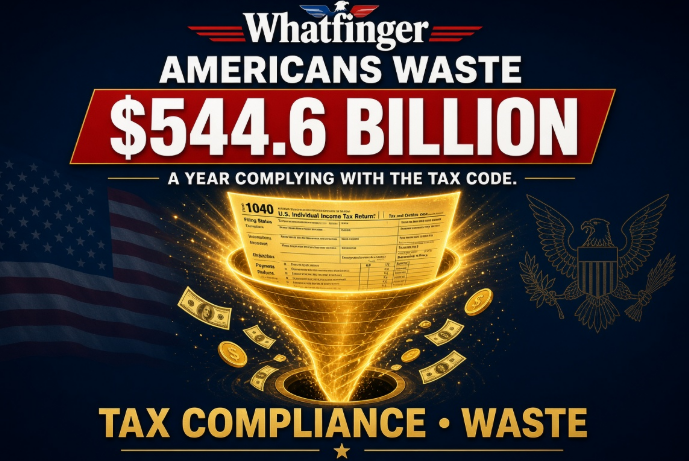
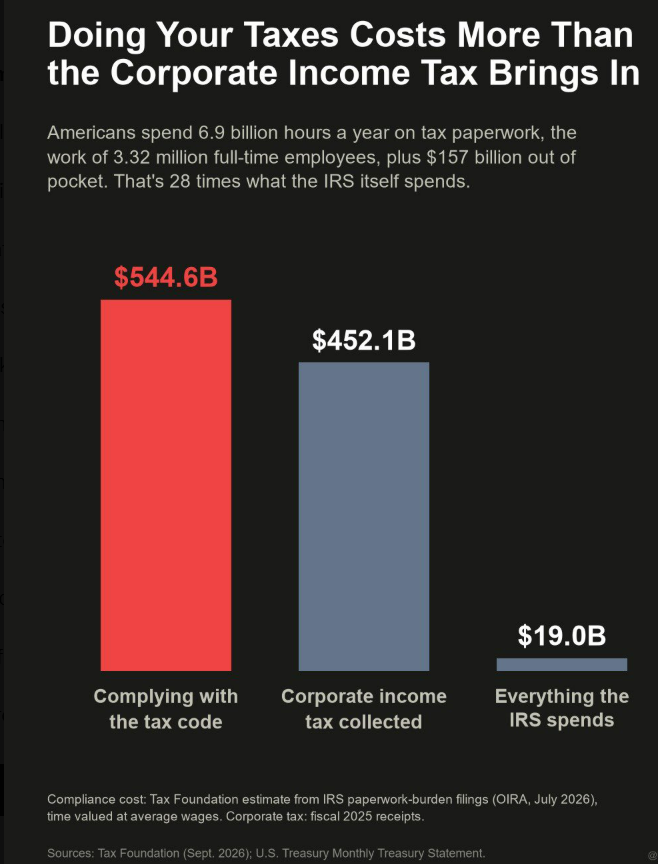
That figure comes from the Tax Foundation, using White House Office of Information and Regulatory Affairs data for 2026. Americans will spend 6.9 billion hours on IRS forms, records, and calculations. That is the full-time labor of 3.3 million people — more than the population of Chicago and nearly 35 times the IRS workforce — doing nothing but paperwork. Add $157 billion in out-of-pocket costs for software, preparers, and accountants, and the total hits $544.6 billion, or more than 1.7 percent of GDP.
None of it builds anything. It does not hire workers, expand a shop, or pay down the national debt. It only feeds the machine that calculates what you already earned.
Corporate income tax collections were $452 billion in fiscal 2025. Individual income taxes brought in $2.656 trillion. Total federal receipts exceeded $5.2 trillion. The compliance burden sits on top of the take. The IRS itself spent roughly $18–20 billion to collect those trillions. The paperwork costs 28 times that.
President Trump has repeatedly pointed to hundreds of billions in federal waste, fraud, and abuse. The Government Accountability Office has estimated the government loses $233 billion to $521 billion a year to fraud in spending programs. Separate GAO work puts tax fraud losses at $116–304 billion annually. Stack those figures with the $544.6 billion compliance cost and you are looking at a massive annual drain before any debate over the income tax rate itself. The money is already gone — either seized, fraudulently diverted, or burned on forms.
Net interest on the national debt hit about $1.05 trillion in fiscal 2026, averaging nearly $3 billion a day. The compliance waste alone would cover more than half of that interest bill. Combined with the fraud and improper payments Trump has flagged, the total approaches or exceeds the entire interest cost. That money could slow the debt snowball instead of disappearing into accountants, software, and enforcement.
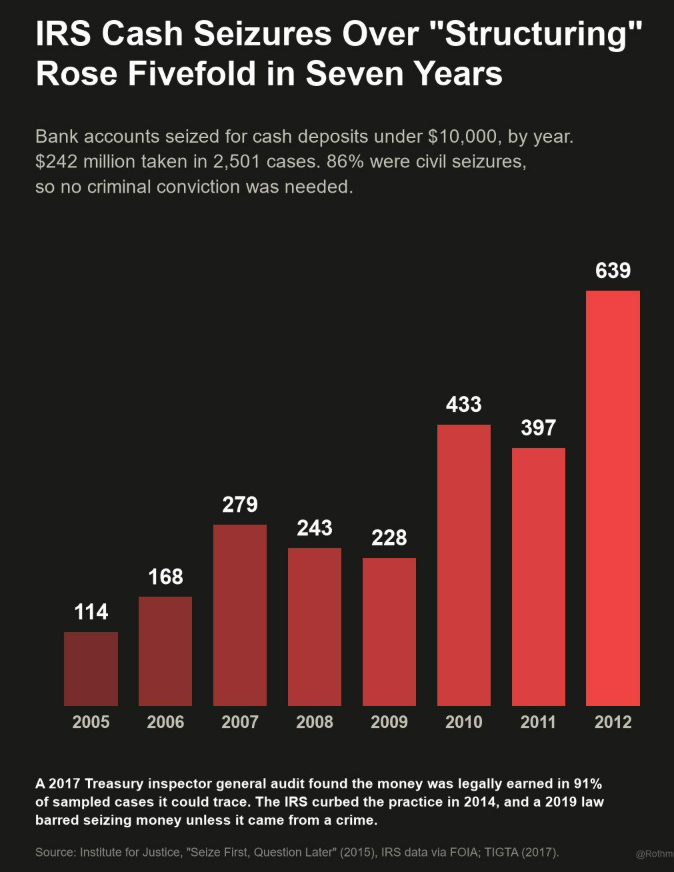
The IRS has shown what the current system enables. Between 2005 and 2012 it seized $242 million from 2,500 Americans for depositing their own legally earned cash in amounts under $10,000. Eighty-six percent of the seizures were civil; no conviction required. A Treasury review found 91 percent of the traceable funds were legitimate. A Navy veteran’s gun store lost $940,000 after the IRS accused him of “structuring” for deposits under his insurance limit. He spent over $100,000 fighting and settled with the agency keeping $50,000. A dairy farmer lost $29,500 for the same reason — no charges, no warrant, years of fighting to recover his own money. Public pressure and a law named in part for the veteran eventually curbed the practice. The code that made it possible is still there.
Rothmus and others on X have highlighted the $544.6 billion number and the 3.3 million worker-years required to feed it. YouTube breakdowns and tax-complexity trackers from the National Taxpayers Union and Tax Foundation keep landing on the same range: hundreds of billions in pure deadweight, year after year, rising even as electronic filing spreads. The code grows faster than the software that tries to tame it.
A simpler system — a flat tax, a national sales tax, or any design that ends the annual filing ritual — would free those 3.3 million worker-years and the $544.6 billion. Small businesses would keep the hours now spent with CPAs. Households would keep the software and preparer fees. The government would collect what it needs without the extra layer of waste. Stack that recovered money with the fraud and waste Trump has targeted and the nation would be measurably richer. Debt interest would shrink. Growth would accelerate. The income tax filing industry would shrink to what is actually necessary.
The political class has spent decades defending the complexity that keeps the accountants, the lobbyists, and the enforcement apparatus employed. The bill keeps rising. Americans are already paying twice: once in the tax itself and again in the cost of figuring out the tax. That second payment alone is large enough to move the needle on the debt. Combined with the fraud and waste already documented, the case for a cleaner system is arithmetic, not ideology.
More…
The IRS also looted $940,000 from a Navy veteran’s gun store without ever charging him with a crime.
When Andrew Clyde deposited cash under $10,000 because his insurance only covered that amount on hand, the IRS similarly accused him of “structuring” and froze the account.
After he spent over $100,000 fighting them, they kept $50,000 in a settlement.
Before that, this IRS tactic targeted 2,500+ cases and pulled more than $242 million between 2005 and 2012.
A 2017 Treasury review later found that in 91% of the seizures they could trace, the money had been earned legally.
Only after Congress passed a law partly named for Clyde did the practice stop, and voters sent him to the House the next year.
— Rothmus 🏴 (@Rothmus) November 7, 2026
