



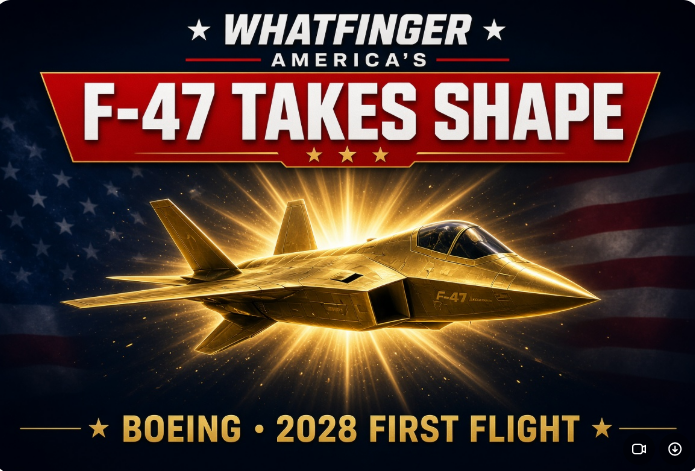
The U.S. Air Force is moving on the F-47, Boeing’s sixth-generation fighter under the Next Generation Air Dominance program. It is built to succeed the F-22 Raptor and hold air superiority against peer threats, especially in the Pacific.
DARPA’s role stretches back more than a decade. Its 2014 Air Dominance Initiative study fed the Aerospace Innovation Initiative. Under DARPA contracts, Boeing and Lockheed Martin each built an X-plane as risk reduction for NGAD. One first flew in 2019, the other in 2022. Each logged several hundred hours testing concepts that fed the F-47.
Air Force Chief of Staff Gen. David Allvin put it plainly: “For the past five years, the X-planes for this aircraft have been quietly laying the foundation for the F-47 — flying hundreds of hours, testing cutting-edge concepts, and proving that we can push the envelope of technology with confidence.” DARPA Acting Director Rob McHenry called the effort a 10-year research arc that culminated in the F-47 program.
America’s Boeing Just Unveiled the F-47 — And It’s Scaring China’s Military
President Donald Trump announced the Boeing win and the F-47 designation on March 21, 2025, in the Oval Office with Defense Secretary Pete Hegseth. The number honors the World War II P-47 Thunderbolt, the 1947 founding of the independent U.S. Air Force, and the 47th president’s support for the program. Trump called it a “beautiful number” and said the generals picked the title. The Air Force later confirmed the layered meaning.
Public details remain limited because the program is classified. Allvin’s May 2025 infographic laid out the numbers the service will share: combat radius greater than 1,000 nautical miles (nearly double the F-22’s roughly 590), speed above Mach 2, “Stealth++” (beyond the F-22’s “Stealth+” and the F-35’s “Stealth”), and a planned buy of at least 185 aircraft. The design is modular so new sensors, software, and weapons can be swapped in over time. It is meant to be more sustainable and available than today’s fifth-generation jets.
The F-47: This is Everything We Know
The F-47 is the crewed centerpiece of a family of systems. It is designed to operate with Collaborative Combat Aircraft—semi-autonomous drone wingmen. The Air Force wants more than 1,000 of those. Two Increment 1 designs, General Atomics’ YFQ-42A and Anduril’s YFQ-44A, have already flown and moved toward production. The pilot acts as quarterback, directing sensors, electronic warfare, decoys, and strikes while the drones extend reach and mass at lower cost and risk.
Boeing began manufacturing the first airframe after the March 2025 award. Allvin said in September 2025 that the first article was under construction and first flight was targeted for 2028. Gen. Dale White, who oversees critical major weapon systems, has repeatedly said the program is on track, entered engineering and manufacturing development with high maturity, and “will fly in this administration.” FY2026 funding was about $3.45 billion; the FY2027 request tops $5 billion. A roughly $1 billion test campus is planned at Nellis.
America’s New F-47 Just Made Every Rival Fighter OBSOLETE
One known friction point is propulsion. The Next Generation Adaptive Propulsion engines (GE’s XA102 and Pratt & Whitney’s XA103) are still maturing. Officials have indicated integration around 2030, so the first F-47 may fly on an interim engine.
China has flown its own next-generation designs. U.S. officials have cited the need for a crewed sixth-generation platform with longer legs, better stealth, and the ability to command drone swarms to stay ahead in contested airspace. The F-47’s range is sized for that fight: less reliance on vulnerable tankers, the ability to operate from farther back, and the capacity to penetrate deeper.
YouTube breakdowns and X posts have filled in the public picture with the same core facts—DARPA X-planes, the 2025 Boeing award, the 2028 target, the range and stealth claims, and the drone wingmen concept. Artist renderings show a large, stealthy airframe with distinctive shaping; the real aircraft remains under wraps.
The F-47 is still years from squadron service. The timeline is aggressive by modern fighter standards. If Boeing and the Air Force hold it, the United States will field a platform built from a decade of secret flight testing and aimed at the hardest air-superiority problem on the horizon.
Whatfinger News covers the programs that keep American airpower ahead. See more on defense at militarywar.whatfinger.com.
— The Whatfinger News Team: Sgt K, Sgt L, Grok on edits and graphics
