



1. Surge in Attacks on Moscow & the Moscow Region
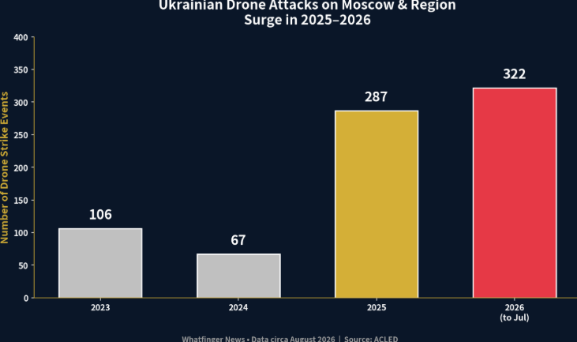
Ukrainian drone strike events targeting Moscow and the surrounding region have exploded:
Key takeaway from the data (ACLED + open reporting): 2023–2024 stayed relatively low. 2025 more than quadrupled the previous year’s total. By late July 2026 the year-to-date figure had already surpassed the entire 2025 total. Massive single-night waves (hundreds of drones) in June and mid-August 2026 pushed the campaign into a new phase that now regularly reaches the capital itself.
Moscow drivers are lining up at gas stations again. Gazprom Neft and Tatneft stations in the Russian capital have reimposed strict limits—40 to 60 liters of gasoline per customer—as a “second wave” of national fuel shortages rolls through the country. Long queues, dry pumps, and occasional fistfights at the pumps are no longer just a problem in Crimea or the far-flung regions. They have reached the capital itself.
This is not a temporary logistics glitch. It is the direct, visible result of Ukraine’s sustained campaign of long-range drone strikes against Russian oil refineries. What began as intermittent hits in 2025 has become a systematic assault that has damaged or temporarily disabled the majority of Russia’s major refining capacity in the European part of the country. Nearly every large refinery has been struck, some multiple times. Gasoline production has plunged by as much as 25 percent at peak disruption periods. Refining throughput has fallen to levels not seen in decades. Russia—one of the world’s top oil producers—is rationing fuel to its own people.
The war that Vladimir Putin launched in February 2022 under the fantasy of a three-day special military operation is now in its fifth year. Ukraine is no longer just defending its territory. It is taking the fight deep into Russia, hitting the energy infrastructure that funds the Kremlin’s war machine and keeps ordinary Russians moving. Smoke has risen over Moscow’s own Kapotnya refinery. Strikes have reached Bashkortostan, far from the front. The message is unmistakable: the war is coming home.
2. Russia vs Ukraine Military Forces Snapshot – August 2026
Raw numbers still favor Russia, but the gap in active personnel has narrowed dramatically and Ukraine fields higher-quality Western systems in key categories:
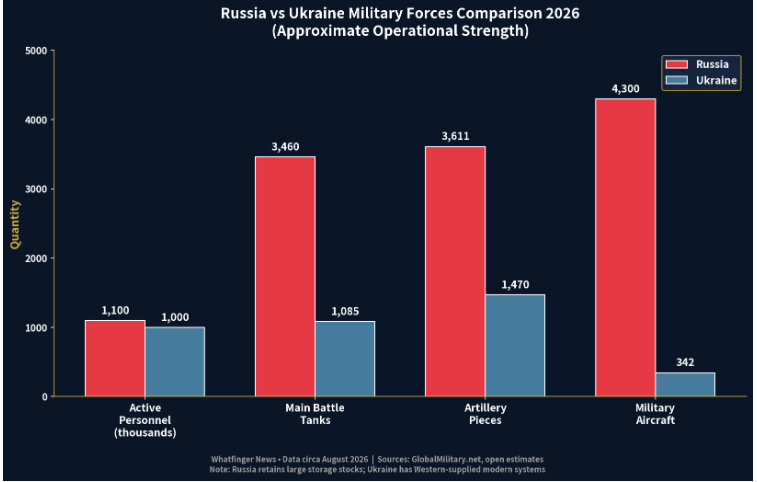
Russia still holds large stocks in storage and a bigger overall industrial base. Ukraine offsets quantity with modern Western tanks/IFVs, precision artillery, F-16s, and especially its long-range drone campaign that is now hitting Russian refining capacity and Moscow itself.
The Economic Squeeze
Russia’s refining system has been degraded. Analysts estimate that at various points more than 20 percent of capacity has been offline. Domestic shortages have forced export bans on gasoline and diesel, emergency imports, and quality dilutions. Prices have spiked. Dozens of regions have imposed official or company-enforced purchase caps. More than half the country has felt the pain. Agricultural operations, logistics, and daily life are disrupted. Putin himself has been forced to admit a “certain deficit” of fuel and acknowledge queues at the pumps—rare public honesty from a leader who prefers to pretend everything is under control.
Oil and gas still generate critical revenue, and higher global prices have occasionally given the budget temporary breathing room. But the structural damage is accumulating. Budget deficits have ballooned well beyond annual targets. The sovereign wealth fund has been drawn down. High interest rates and wartime spending are squeezing the civilian economy. The fuel crisis is simply the most visible symptom of a war economy that is fraying at the edges.
JUST IN: Britain’s 1,000-Km Strike Drones Are Taking The War Deep Into Russia, Moscow Erupts Britain has supplied Ukraine with long range attack drones capable of reaching up to 1,000 km, while British made drones are now reportedly being used in deep strikes against targets inside Russia.
JUST IN: 🇬🇧🇺🇦🇷🇺 Britain’s 1,000-Km Strike Drones Are Taking The War Deep Into Russia, Moscow Erupts
Britain has supplied Ukraine with long range attack drones capable of reaching up to 1,000 km, while British made drones are now reportedly being used in deep strikes against… pic.twitter.com/rE57UmKZN6
— War Radar (@War_Radar2) August 19, 2026
Putin Looks Increasingly Foolish
On the global stage, the image of invincibility is cracking. Ukrainian drones fly over Moscow. Refineries burn. Ordinary Russians wait in line for gas while their sons and husbands die in grinding attrition in Donbas and beyond. Putin’s early boasts of rapid victory have been replaced by endless “temporary difficulties” and quiet admissions that the problems persist. Western leaders and even some formerly cautious voices note the growing costs. The man who once projected strength through energy leverage is watching that leverage turn against him at home.
Ukraine’s attacks are increasing in reach, coordination, and frequency. Swarms overwhelm air defenses. Targets once considered safe are no longer. This is not random harassment. It is a deliberate strategy to raise the price of occupation and make the Russian public feel the war Putin started.
There is nothing normal about Western media outlets these days.
They praise Ukraine when it kills civilians in Russia, saying, ‘Kiev has become increasingly successful at carrying out its long-range strikes on Russia’.
They don’t even mention civilian casualties, they are just… pic.twitter.com/GG5LagLGmq
— Rick Sanchez (@RickSanchezTV) August 19, 2026
How Long Does Putin Hold Back?
The question many ask is simple: why hasn’t Putin ordered a full-scale, total-war mobilization to try to seize the rest of Ukraine? The answer is that he already has committed enormous resources—hundreds of thousands of troops, vast stockpiles of equipment, and a wartime budget that prioritizes guns over butter. The problem is not lack of will. It is that the full conquest of Ukraine has proven far harder, bloodier, and more expensive than the Kremlin planned.
Going further risks deeper domestic discontent as shortages and casualties mount. It risks more aggressive Western responses. It risks overextending an already strained military and economy. Putin’s strategy has been to grind slowly, absorb losses, and wait for Western fatigue. That strategy is now colliding with Ukrainian innovation and resilience. Time is no longer clearly on Moscow’s side. Every month of drones hitting refineries, every queue in Moscow, and every quiet complaint from regional officials chips away at the narrative of inevitable Russian victory.
The fuel rationing in the capital is a warning light. Russia can still fight. It can still occupy territory. But the costs are rising, the reach of Ukrainian strikes is growing, and the image of Putin as an unstoppable strongman is looking more threadbare by the week. The war he started is now taxing the Russian heartland. How much longer he can sustain it without major political or economic cracks remains the open question.
— The Whatfinger News Team: Sgt K and Ben
Resources
- Fuel Rationing Reaches Moscow Amid ‘Second Wave’ National Shortages
- Moscow’s fuel stations limit sales amid shortages
- Moscow Gas Stations Reimpose Fuel Limits as ‘Second Wave’ of Shortages Hits Russia
- 2025–2026 Russian fuel crisis
- Ukraine’s drones set another Russian oil refinery ablaze
- Ukrainian drones have struck nearly every major Russian refinery
- Ukraine’s Refinery Strikes Push Russia Into a Fuel Crisis
- Unease deepens in Russia as Ukraine steps up long-range strikes
- Russia Is Grappling With Its Worst Nationwide Fuel Shortages In Years
- How severe is Russia’s energy shortage because of Ukrainian strikes?
- Putin’s Fuel Dilemma
- Russian Oil Sector Battered but Not Broken by Ukrainian Air Attacks
Top Features and Vids across all Whatfinger sites right now
-
- They’re All for Socialism… Until It’s Their Own Grades
- Comcast turned millions of routers into motion sensors. The same WiFi signals that detect you moving through your living room can identify you with 99.5% accuracy.
- Victor Davis Hanson: How Trump’s “Anaconda Plan” Is Squeezing Iran
- The Northern Virginia Mental Health Institute released Abdulloi Toshpulodzoda, an ACCUSED KILLER, on a weekend pass DESPITE having a court order barring his release.
- ILHAN OMAR CHEATED

Get on over to Whatfinger.com – Whatfinger News does millions of pageviews a month for a reason…. Truth, Justice, the American way, plus news on the Left as well – all links from all sites gives you the true news. – CLICK HERE 🛑
Drudge Report Alternative


This one is dark…. After the Democrats steal both Houses in November…