



Farmed Fish Is Not the Health Food They Sold You
By Michael Anthony, Health Writer, Whatfinger News
The grocery-store salmon fillet looking “heart-healthy” under the lights is not the same fish your parents were told to eat. New research tied to USDA food-composition work shows farmed Atlantic salmon has lost a large share of the long-chain omega-3s that made it famous. The drop is not a rounding error. It is the predictable result of feeding a carnivore soy, canola, and other land crops because the ocean cannot keep up with industrial pens. In other words, we are being deprived of nutrition while these poor animals are tortured.
That finding landed this week and immediately circulated on X: farmed salmon is fattier, cheaper, and still marketed with old nutrition numbers. The marketing did not update when the feed did.
The numbers, not the slogan
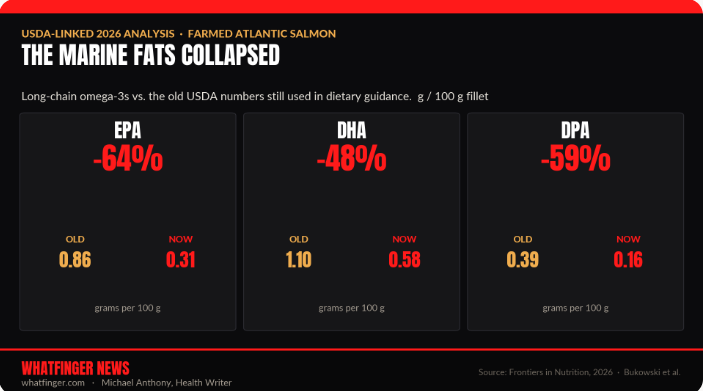
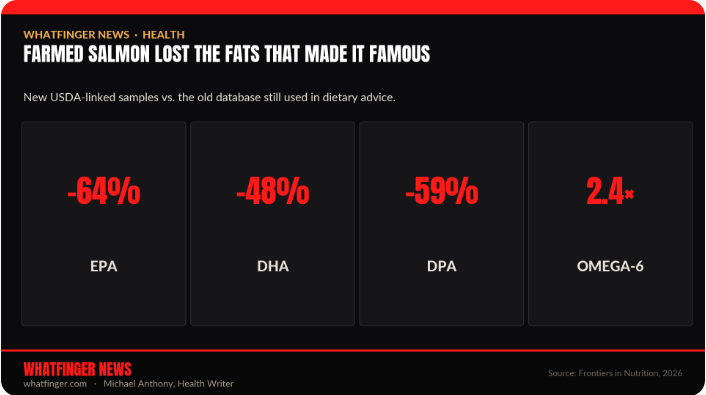
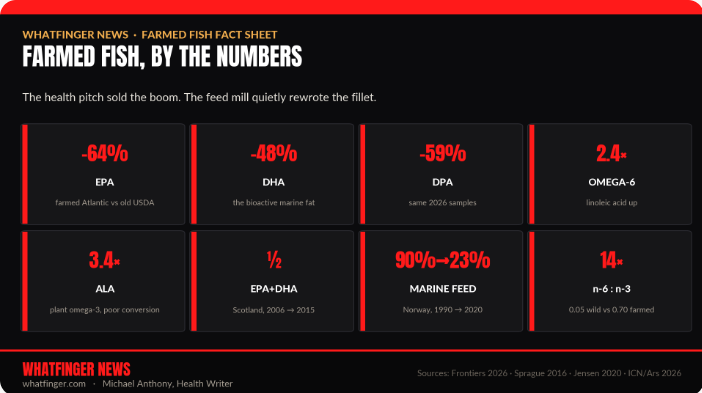
A 2026 Frontiers in Nutrition analysis compared new individual-sample data on retail farmed Atlantic salmon with the older USDA Standard Reference values still used in dietary guidance. The long-chain marine fats that actually matter for the brain and heart fell hard:
- EPA dropped about 64 percent (0.862 g/100 g down to 0.312 g/100 g)
- DHA dropped about 48 percent (1.100 g/100 g down to 0.577 g/100 g)
- DPA dropped about 59 percent
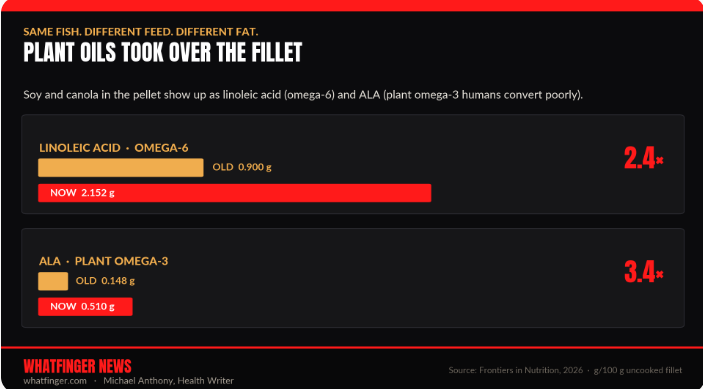
Plant fats went the other way. Linoleic acid (an omega-6) rose 2.4-fold. Alpha-linolenic acid (ALA, a short-chain plant omega-3 humans convert poorly) rose 3.4-fold. Total n-3 PUFA only slipped modestly. The composition changed: less EPA and DHA, more cheap vegetable oil.
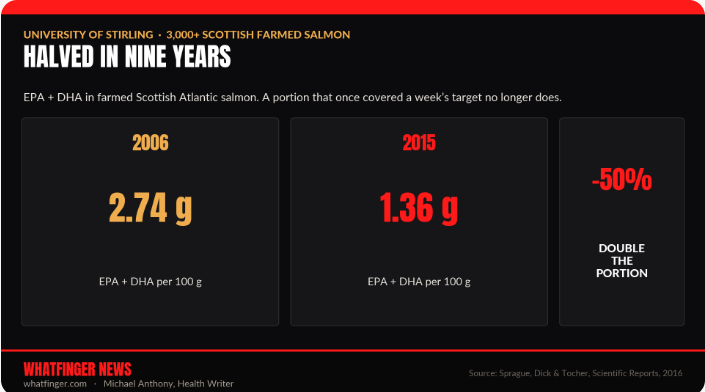
That is not a one-off. In 2016, University of Stirling researchers measured more than 3,000 Scottish farmed salmon from 2006 to 2015. EPA + DHA in the flesh fell from about 2.74 g per 100 g to 1.36 g per 100 g. A portion that once covered a week’s recommended intake no longer did. They said you would need roughly double the serving to get the same marine omega-3s. BBC covered it at the time. The industry kept growing.
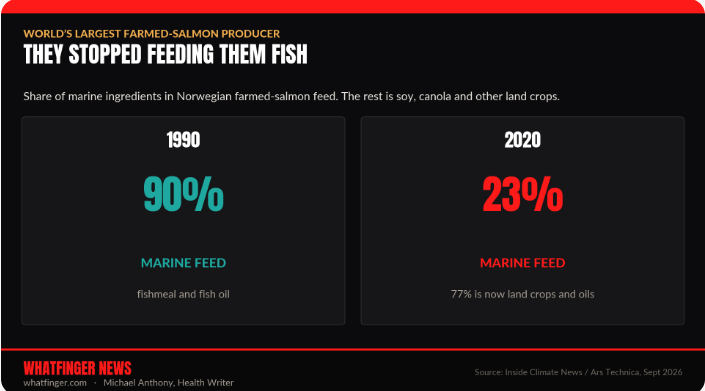
Norway, the world’s largest producer, cut marine ingredients in feed from about 90 percent in 1990 to about 23 percent by 2020. The rest is terrestrial: soy, canola, other oils and meals. You are not eating a fish that ate krill and forage fish. You are eating a fish that ate the same industrial crops that already flood the rest of the food supply. We are being poisoned by design, for profit.
Fat quantity is not fat quality
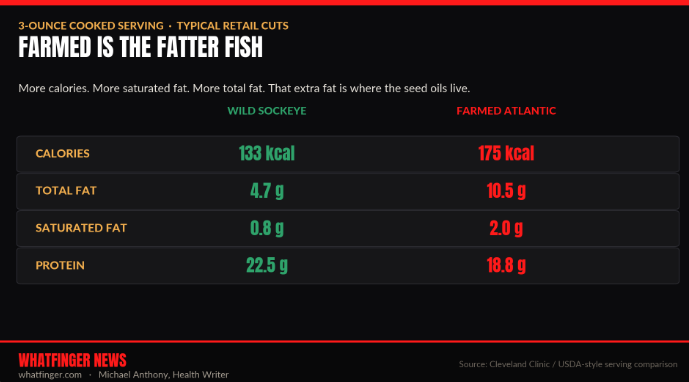
Farmed Atlantic salmon is typically two to three times fatter than wild Pacific salmon. More fat means more total omega-3 grams on some labels. That is the industry’s favorite talking point, and it is incomplete.
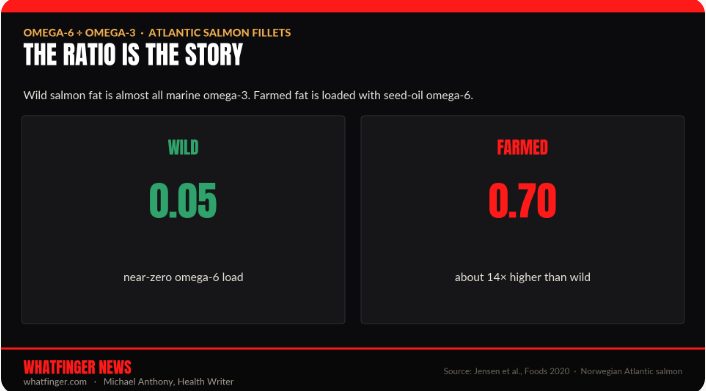
Wild salmon fat is dominated by marine long-chain omega-3s. Farmed salmon fat is padded with oleic acid, linoleic acid, and ALA. The omega-6 to omega-3 ratio in wild Atlantic salmon has been measured around 0.05. In farmed fish it has been measured around 0.7 — an order of magnitude worse.
ALA is not EPA or DHA. Human conversion is limited. If you bought salmon for the bioactive marine fats, the farmed product is a weaker delivery system than the old databases claim. USDA and American Heart Association guidance still leans on those older figures. The new paper’s authors said the sample was not large enough to force a guideline change and called for a broader study. The agency declined interviews. The labels did not wait.
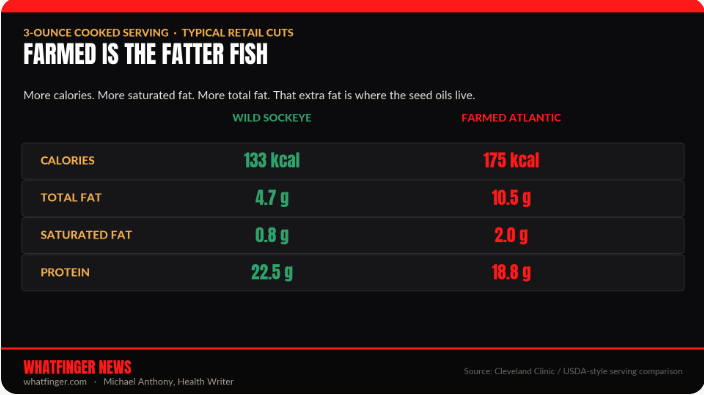
Wild sockeye is leaner. Per ounce it can carry less total EPA + DHA than a fatty farmed fillet even after the decline. Per gram of fat, and in the ratio of inflammatory to anti-inflammatory fats, wild still wins. Calories and saturated fat also run higher in the farmed fish. If you are eating salmon as a lean protein, farmed is the worse bargain.
It is not just salmon
Tilapia is the textbook example of what happens when you farm an omnivore on grain-heavy feed. Multiple analyses show farmed tilapia with elevated linoleic acid and a poor n-6:n-3 ratio compared with wild fish of the same species. Some older work found the inflammatory fatty-acid profile of farmed tilapia less favorable than people assume when they “eat fish for omega-3s.” Diet can be adjusted; the cheap commercial diet usually is not. In other words avoid Tilapia unless you can get wild caught only.
Farmed catfish and other pond species follow the same pattern: higher total fat, more plant-derived 18-carbon fats, less of the long-chain marine fats unless the feed is deliberately fortified — which costs money.
Farmed shrimp is a different problem stacked on the same industrial logic. A large share of U.S. shrimp is imported and farm-raised. Studies have found higher prevalence of antibiotic-resistance genes in the gut communities of imported farm-raised shrimp versus U.S. wild-caught shrimp. Residues and pond chemicals show up in testing programs with depressing regularity in some producing countries. Consumer Reports and academic papers have documented bacteria, residues, and poor conditions in parts of the trade. Wild shrimp is not magic, but it is not raised in the same chemical bath.
Filter-feeding shellfish (oysters, mussels, clams) are a partial exception: many are farmed in open water on plankton, not pellets. That is not the fish most people mean when they buy “farmed salmon” or “farmed tilapia.”
Contaminants, dye, and the pen
Older landmark work (Hites et al., 2004; Environmental Working Group testing) found farmed salmon higher in PCBs and related persistent organic pollutants than wild salmon, because the fishmeal and fish oil used then concentrated those compounds. Some later Norwegian comparisons found higher dioxins, dl-PCBs, mercury, and arsenic in wild fish than in farmed — still below EU limits in the samples tested. Geography and feed matter. The honest summary is mixed, not “farmed is clean.” Fat stores toxins. Farmed fish has more fat.
Farmed salmon is not pink by nature on a plant-heavy diet. Producers add astaxanthin — often synthetic — so the fillet looks like wild fish. That is cosmetic, not nutrition.
Crowded net pens create sea lice, disease pressure, and waste. Antibiotic use has fallen in Norway and among some Global Salmon Initiative members. Chile, a major exporter, has a worse record. Pathogens and parasites do not stay politely inside the pen. That is an environmental fact with a food-safety shadow.
Farmed salmon production tripled between 2000 and 2020. Aquaculture is the fastest-growing animal-food system on the planet. The nutritional pitch that sold the boom — cheap EPA and DHA for the masses — is the part that eroded as marine feed ran short and soy filled the gap. Trading overfished forage fish for South American soy is not a free lunch. It is a different set of costs, some of them on your plate.
What to do instead of pretending the label is current
If you want the fats people actually cite in the heart and brain literature, prioritize wild oily fish that still eat a marine diet: Alaskan sockeye, coho, and king when you can get them; sardines, anchovies, mackerel, herring. Those small fish are also lower on the contaminant ladder than long-lived predators.
If budget is the issue, canned wild salmon and sardines beat a cheap farmed fillet on fat quality more often than the circulars admit. Algae-based EPA/DHA exists if you refuse fish. Flax and chia give you ALA. They do not give you the same molecule the salmon studies were about.
Do not treat “farmed” as automatically safe or automatically poisonous. Treat it as a different product: higher fat, shifted fatty-acid profile, variable residue risk, and nutrition numbers that lag the feed mill. The new USDA-linked data and the 2016 Stirling data say the same thing a decade apart. The fish changed. The advice did not.
That is the fact pattern. Eat accordingly. Save your life and prevent the problems of eating anything that is not natural.
—Michael Anthony, Health Writer
See Health Articles and Videos to help you live as long and as healthy as possible, without the Big Pharma BS and scams to hook you into their drugs.
- Michael Anthony Health at Choice
- Longevity Articles – Choice – Whatfinger News
- Michael Anthony Health Articles at Dedicated issues
- BMI + Healthy Weight Range Calculator
Resources
- Farmed salmon may not be as nutritious as it once was, new research suggests — Ars Technica / Inside Climate News
- Foundation Foods reveals significant changes in farmed Atlantic salmon relative to Standard Reference Legacy data — Frontiers in Nutrition (2026)
- Impact of sustainable feeds on omega-3 long-chain fatty acid levels in farmed Atlantic salmon, 2006–2015 — Scientific Reports (Sprague et al., 2016)
- Omega-3 oils in farmed salmon ‘halve in five years’ — BBC News
- An Update on the Content of Fatty Acids, Dioxins, PCBs and Heavy Metals in Farmed, Escaped and Wild Atlantic Salmon — Foods / MDPI (Jensen et al., 2020)
- Wild Salmon vs. Farmed Salmon: Is One Healthier? — Cleveland Clinic
- First-Ever U.S. Tests of Farmed Salmon Show High Levels of Cancer-Causing PCBs — Environmental Working Group
- Antibiotic-resistant bacteria and gut microbiome communities associated with wild-caught shrimp from the United States versus imported farm-raised retail shrimp — Scientific Reports
- Aquaculture is depleting the oceans: A farmed salmon can consume more than six times its weight in wild fish — El País
- Farmed vs Wild Fish: A Scientist’s Honest Comparison — Prof. Dr. Zayde Ayvaz
Top Features and Vids across all Whatfinger sites right now
- Farmed Fish Is Not the Health Food They Sold You
- Steve Inman Clips – Knuckle Sandwich Compilation, Animals Gone Wild III
- America Still Owns the Night. China’s ‘Area 51’ Is Trying to Steal It. Russia Is a Spectator.
- What Happens to Your Body After Years of Taking Statins?
- War in Ukraine: Putin, Zelensky order pause in strikes – Both sides pause it all thanks to Trump’s efforts
- Democrats are dumbing down students – telling teachers to no longer teach students how to sound out words
- Karmelo’s father just crossed a freaking LINE.
- How Stupid Are These People? A gay couple say that if the “far-right” wins the next Spanish election, they will seek asylum in Palestine because it’s the most “progressive” place on Earth

<span class="dsq-postid" data-dsqidentifier="151890 https://dedicatedissues.com/?p=151890">2 Comments
Pingback: Dyson Put a Camera in Your Mouth and Called It Oral Care – Dedicated Issues of Whatfinger News
Pingback: Michigan ROBS Western Michigan?! | Big Ten Officials EXPOSED In Clock SCANDAL! – Dedicated Issues of Whatfinger News