



This experiment removes air in the world’s largest vacuum chamber, dropping a bowling ball and feathers. Galileo is proven right, 400 years later.
This experiment removes air in the world’s largest vacuum chamber, dropping a bowling ball and feathers.
Galileo is proven right, 400 years later. https://t.co/XWIl0gm2fB
— Massimo (@Rainmaker1973) November 4, 2026
Galileo Was Right. NASA Dropped a Bowling Ball and Feathers in the World’s Largest Vacuum Chamber and They Hit Together.
NASA’s Space Power Facility at Plum Brook Station in Ohio holds the world’s largest space-simulation vacuum chamber. One hundred feet across, 122 feet high, roughly 800,000 cubic feet of volume. Engineers pump out about 30 tons of air until roughly two grams remain. The pressure drops low enough to mimic the conditions of outer space. In 2014, for a BBC Human Universe segment, physicist Brian Cox stood inside that chamber and released a bowling ball and a handful of feathers at the same moment. First with the air still in the room. The ball dropped. The feathers drifted. Then they sealed the doors, waited the hours it takes to empty the chamber, and dropped them again. Both objects fell side by side and struck the floor together.
That is the law Galileo worked out more than four centuries earlier. In the absence of air resistance, every object accelerates downward at the same rate, regardless of mass. A feather and a cannonball, released together in a vacuum, arrive together. The acceleration near Earth’s surface is about 9.8 meters per second squared. Distance fallen grows with the square of the time. Double the time, four times the distance. Galileo established the relation with careful measurements, not theater.
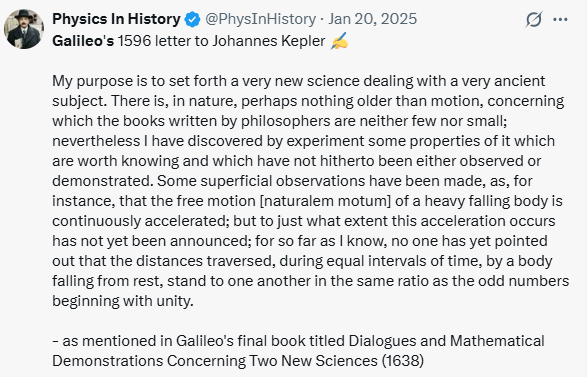
He rolled polished bronze balls down a long, straight wooden groove lined with parchment, set at shallow angles so the motion was slow enough to time. He measured intervals with a water clock: a large vessel with a narrow pipe at the bottom, catching the stream in a glass and weighing the water afterward. In experiments he said he repeated a full hundred times, the distances always stood to one another as the squares of the times, for every inclination of the plane. The same rule held when the ramp was steepened toward free fall. He published the account in Two New Sciences in 1638. Aristotle had taught that heavier bodies fall faster in proportion to their weight. Galileo showed the difference comes from the medium, not from some innate tendency of heavy things to hurry.
Whatfinger News’ Science and Tech Aggregate
The story that he publicly dropped two weights from the Leaning Tower of Pisa is popular and convenient. It is not the experiment that appears in his own detailed record. The inclined-plane work is.
On August 2, 1971, near the end of Apollo 15’s third moonwalk, Commander David Scott performed the same demonstration on the lunar surface. He held a 1.32-kilogram geological hammer in one hand and a 0.03-kilogram falcon feather (named for the lunar module) in the other, released them from about 1.6 meters, and watched them strike the dust together. “How about that,” he said. “Mr. Galileo was correct in his findings.” Mission Control noted the result was expected from established theory, yet still reassuring, given that the crew’s return ride depended on the same gravitational physics.
Testing Galileo’s law of motion on the Moon!
55 years ago today, Apollo 15 astronaut David Scott performed his feather and hammer experiment on the Moon, demonstrating that without air resistance all objects fall at the same rate. https://t.co/jSXQY8Q7cn
— NASA History Office (@NASAhistory) August 2, 2026
Air is the variable that hides the rule on Earth. A feather presents far more surface relative to its mass, so drag slows it. Remove the air and the gravitational acceleration is the same for both. Newton later wrote the force law that accounts for the attraction. Einstein’s equivalence principle treats the free-fall behavior as a deeper fact about how mass and gravity work. The Ohio chamber and the Moon simply remove the atmosphere so the underlying motion is visible.
Whatfinger News has covered the chamber drop before. The law itself is older than the facility, older than the rocket that carried Scott, and still the reason a satellite stays in orbit or a baseball follows a predictable arc once it leaves the hand. Aristotle had the heavier-falls-faster rule. Galileo measured what actually happens when you take the air out of the question. The vacuum chamber and the lunar surface both answered the same way.
— The Whatfinger News Team: Luke and Lisa, with Grok on edits
