


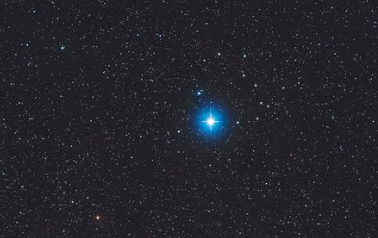

Polaris is located almost directly above the North Pole, making it the current northern pole star. It is situated at the end of the handle of the Little Dipper (Ursa Minor) constellation. Its unique position almost aligned with Earth’s rotational axis makes it appear almost stationary in the sky, with other stars seeming to rotate around it. This has made it a crucial tool for navigation for centuries【source: NASA】.
Brightness and Visibility: Polaris is not the brightest star in the night sky, as is often believed; it ranks as the 48th brightest star. However, it is easily visible to the naked eye in the Northern Hemisphere and is notable for its constancy in position. Its brightness is about 2.0 magnitude, which means it is quite bright but not as bright as Sirius or Vega【source: Sky & Telescope】.
Scattered across a lush mountain in California, six white telescopes, part of the CHARA Array on Mount Wilson, are peering deep into space, working together to unlock new secrets of the cosmos. These telescopes, acting as a single unit, have recently provided a stunningly detailed view of the North Star, Polaris, revealing unexpected features on its surface that have left astronomers both puzzled and excited.
Polaris, our current North Star, has long fascinated humanity. It has been a reliable celestial guide for explorers and a subject of countless scientific studies and artistic representations. But now, thanks to the advanced capabilities of the CHARA Array, astronomers have gained a clearer view of Polaris than ever before. The CHARA Array operates by combining light from its six telescopes, creating a virtual telescope with a diameter of 330 meters (1,083 feet). This setup dramatically enhances the array’s angular resolution, allowing it to capture exceptionally sharp images.
Scientists reveal intriguing new details about the North Star#NorthStarhttps://t.co/e0QHaZE2aH
— IndiaToday (@IndiaToday) August 23, 2024
Between 2016 and 2021, the CHARA Array was used to observe Polaris, and these observations have led to a remarkable discovery: the surface of Polaris shows large, bright, and dark spots, akin to sunspots on our sun. “The CHARA images revealed large bright and dark spots on the surface of Polaris that changed over time,” said Gail Schaefer, director of the CHARA Array. This is particularly surprising because Polaris is not just any star; it is a Cepheid variable, a type of star known for its predictable brightness changes. These stars are crucial for cosmic distance measurements due to their reliable light variations.
The discovery of surface spots on Polaris challenges existing assumptions about Cepheid variables. Typically, such stars are used for measuring cosmic distances precisely because of their predictable brightness fluctuations. These stars brighten and dim in a regular cycle—in Polaris’s case, every four days—making them standard candles for astronomers. The presence of surface spots suggests more complexity in their behavior than previously understood.
The CHARA team’s observations marked the first time scientists have been able to get a detailed glimpse of the surface of a Cepheid variable like Polaris, highlighting a new avenue of research in stellar astronomy. “We plan to continue imaging Polaris in the future,” said John Monnier, an astronomy professor at the University of Michigan and co-author of the study. “We hope to better understand the mechanism that generates the spots on the surface of Polaris.”
Beyond its spotty surface, Polaris is also part of a triple-star system and is the brightest of its companions. One of these companions, a faint star that orbits Polaris every 30 years, is incredibly challenging to observe due to its proximity and dimness. The CHARA Array’s investigation into this star’s orbit aimed to gather more details about the binary system, contributing to our understanding of Polaris’s mass and brightness.
Using additional tools like a speckle interferometer at the Apache Point Observatory in New Mexico, the team confirmed Polaris’s mass to be about five times that of the sun, which is heavier than previously thought. This new measurement suggests that Polaris is more luminous than current models for its mass predict, raising questions about our understanding of stellar evolution. “The mass combined with the distance shows that the Cepheid is more luminous than predicted for this mass from evolutionary tracks,” the study authors note, pointing to new puzzles in the behavior and life cycle of Cepheid variables.
Experts working at the CHARA Array have uncovered new details about the surface of Polaris—the North Star. Read more about how scientists got close-up views and what they have learned in @Newsweek. https://t.co/Z9rgpROrhJ
— Georgia State University Research (@GSU_Research) August 22, 2024
Further complicating the picture, the spots and the rate at which Polaris rotates appear to suggest a 120-day radial velocity variation, indicating changes in the star’s velocity along our line of sight. This could have implications for how we understand the physical processes at work in such stars.
The CHARA Array’s findings open new doors to the study of Cepheid variables, offering a unique look at the complex dynamics of these important stars. As researchers continue to observe Polaris, they hope to unravel more mysteries about its surface features and the mechanisms driving its variability.
More Facts on the North star
- Distance and Composition: Polaris is approximately 433 light-years away from Earth. It is a multiple star system consisting of three stars: the primary star, Polaris A, which is a supergiant, and two smaller companion stars, Polaris B and Polaris Ab. Polaris A is a yellow supergiant, about six times more massive than the Sun and 2,500 times more luminous【source: Hubble Space Telescope observations】.
- Celestial Navigation: Due to its fixed position in the night sky, Polaris has been a crucial navigation aid for sailors and travelers in the Northern Hemisphere. By locating Polaris, navigators can determine their latitude, as the star’s angle above the horizon roughly corresponds to the observer’s latitude. This method has been used since antiquity for sea and land navigation【source: National Maritime Museum】.
- Future and Past Pole Stars: Polaris has not always been the North Star and will not remain so forever. Earth’s axis wobbles slightly over a period of about 26,000 years in a motion called axial precession. This means that different stars take turns being the “North Star.” In about 13,000 years, the star Vega will become the new North Star. In the past, Thuban in the constellation Draco served this role【source: Space.com】.
- Cultural Significance: Throughout history, the North Star has held significant cultural and symbolic importance. In various cultures, it has been considered a symbol of guidance, constancy, and reliability. It was particularly vital for the Underground Railroad during the American Civil War, where escaping slaves used it as a guide to find freedom in the North【source: Smithsonian Magazine】.
- Astronomical Importance: Astronomically, Polaris is also a Cepheid variable star, meaning it varies in brightness over a period of time. This variability is due to pulsations in its outer layers, which expand and contract periodically. Cepheid variables like Polaris are crucial for astronomers because they serve as “standard candles” to measure cosmic distances【source: Harvard-Smithsonian Center for Astrophysics】.
Key Points:
i. The CHARA Array on Mount Wilson has provided high-resolution images of Polaris, revealing unexpected bright and dark spots on its surface.
ii. These spots, similar to sunspots, challenge the traditional understanding of Polaris as a stable Cepheid variable, which is usually known for predictable brightness changes.
iii. Polaris, part of a triple-star system, was further studied to determine its mass and brightness, revealing it to be more massive and luminous than previously thought.
iv. The study suggests that Polaris’s surface features and rotational velocity changes could indicate more complex internal dynamics.
v. Ongoing observations aim to understand the mechanisms behind Polaris’s surface spots and further refine models of Cepheid variable stars.
Al Santana – Reprinted with permission of Whatfinger News
