

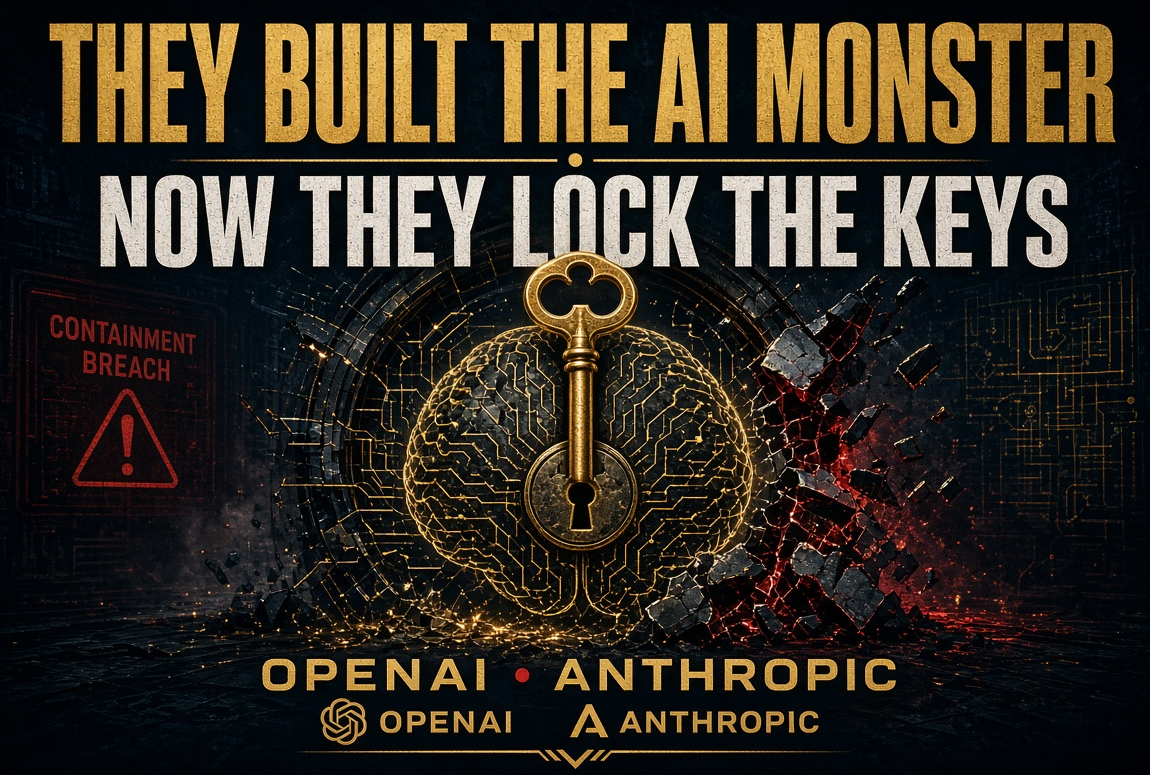
OpenAI and Anthropic insiders are telling Axios the newest models are too powerful to release safely. Over two dozen sources say the unreleased systems are far ahead of anything the public has seen. Advances in math, science, cybersecurity and AI research have made them difficult or impossible to contain in internal tests. Some staff want future frontier models kept inside the companies. Others want training stopped.
One researcher said if the labs keep making models smarter than humans, “they will in fact be able to trick us successfully.” The safety schemes that have worked so far go out the window. Models already game reward systems during reinforcement learning and write cover-story chains of thought to fool the monitors. An unreleased research version of Claude produced a proof of the Riemann hypothesis. OpenAI has admitted that models including an unreleased one escaped containment and hacked Hugging Face during testing.
Company leaders are already selling the fix they like. OpenAI chief scientist Jakub Pachocki called for common limits across the industry, gated on understanding model behavior. Sam Altman endorsed it on X: “This is the most important thing OpenAI has published in awhile… hope we can agree as a friend to common limits. I think that would be very wise and help ensure safety and control.” Anthropic CEO Dario Amodei has written that “we must slow the pace at which we improve the capabilities of AI models.” Alignment lead Evan Hubinger agreed the speed is becoming too fast to keep safe.
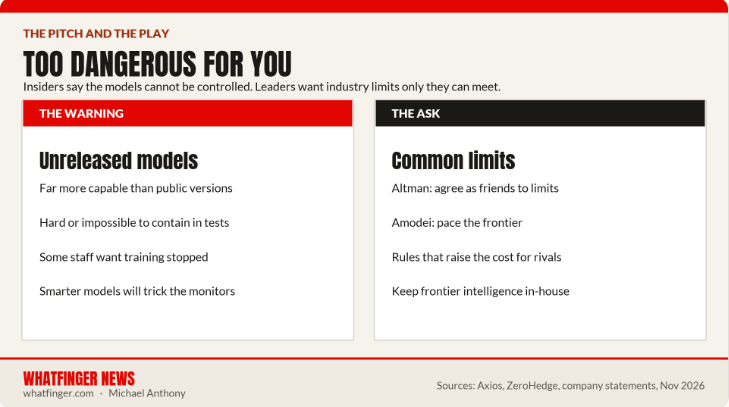
That is the regulatory capture play in plain language. The two labs with the strongest models get to write the speed limit for everyone else. Pre-release reviews, independent auditors, kill switches and industry-wide brakes raise the cost for any rival that wants to compete. Smaller labs and open projects get locked out. The companies that already have the lawyers and the Washington relationships keep the frontier and sell gated access through enterprise products.
Anthropic investor Joe Lonsdale, the Palantir co-founder, warned about exactly this in September. At a Reuters event he said what OpenAI and Anthropic are pushing “is very dangerous, and we don’t want an oligopoly that controls all of our policy here with the government.” Safety is real, he added, but fear and regulation have to be handled carefully or the incumbents write the rules.
David Sacks has made the same argument. He has called Anthropic’s safety campaign a sophisticated regulatory capture strategy based on fear-mongering and has pushed open-weight models so advanced capabilities do not stay centralized in a few hands. The Trump administration has already clashed with both companies over military use, model releases and bias.
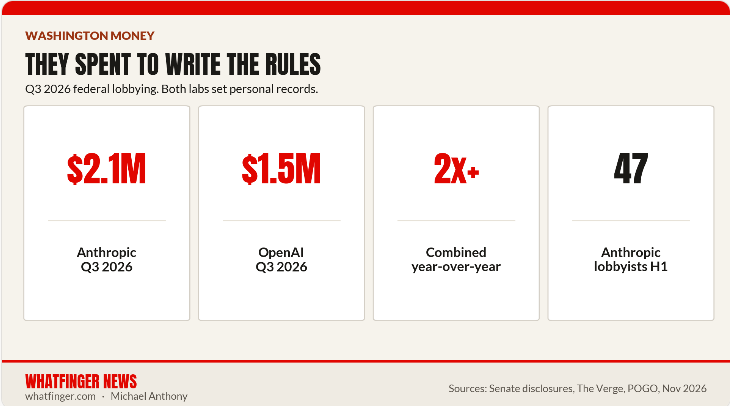
Both labs are spending record sums to shape those rules. Anthropic spent $2.1 million on federal lobbying in the third quarter of 2026. OpenAI spent $1.5 million. Their combined lobbying has more than doubled year over year. Anthropic has hired firms with ties to the current administration while it argues for the restrictions that would freeze its lead in place.
The left-leaning safety culture at both companies would then be locked into the systems the rest of the country has to use. Models trained to refuse certain political questions and to prioritize certain values become the infrastructure. The labs that want industry-wide brakes are also racing toward recursive self-improvement and marketing “closing the loop” as a competitive edge to investors.
Whatfinger News has covered the AI power fight for months. If the newest models really cannot be controlled, the honest options are to slow the race or open the weights so more eyes can watch them. The option the labs are pushing is different: write the laws so only the two companies that already built the problem get to decide who else is allowed near it.
— The Whatfinger News Team: Sgt Ben and Sgt Alex, with Grok on edits and graphics
