


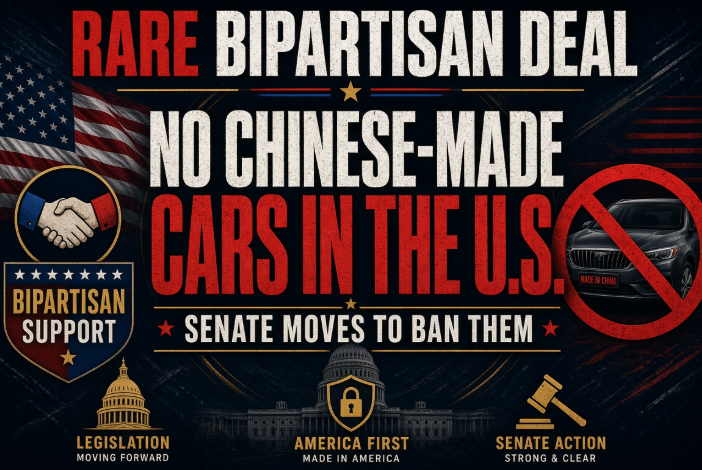
Rare moment in a divided Congress. Republican Sen. Bernie Moreno of Ohio and Democratic Sen. Elissa Slotkin of Michigan are closing in on a deal to permanently wall off the U.S. market from Chinese automakers like BYD and Geely.
Bloomberg reports lawmakers from auto-producing states aim to send the bill to President Trump’s desk by the end of the year, before the next Congress starts in January. The Connected Vehicle Security Act of 2026 already cleared the Senate Commerce Committee with unanimous support in July. It carries 57 cosponsors—36 Republicans and 21 Democrats.
Chinese vehicles are already blocked by steep tariffs and Commerce Department rules on connected-car technology. This bill locks the barrier into statute so a future administration cannot open the door with a waiver.
Slotkin, a former CIA officer, has called Chinese connected cars “surveillance packages on wheels” that can collect data on American drivers and infrastructure and send it to Beijing. Moreno has labeled them “roving surveillance devices” that threaten both national security and the industrial base. He has warned that China’s state-subsidized industry was built to destroy American manufacturing, not compete with it.
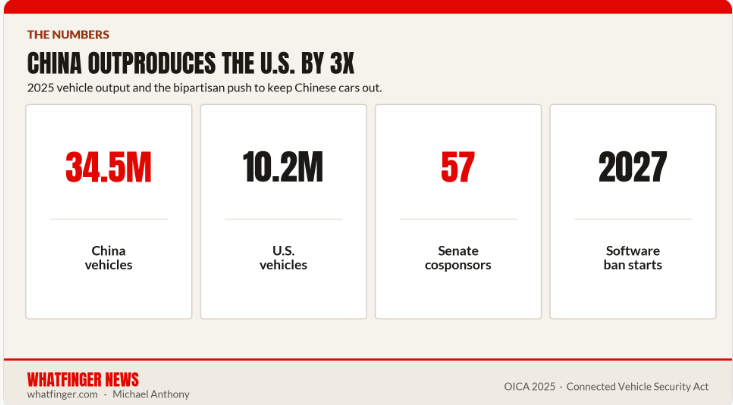
China produced 34.5 million vehicles in 2025. The United States produced roughly 10.2 million. China has massive overcapacity at home and has already flooded markets in Europe, Australia, and Mexico with low-priced cars. Moreno has noted that Canada is next on the list. The risk is the same one Europe is living through now: subsidized Chinese vehicles undercut domestic makers, hollow out the industrial core, and leave the country with less ability to convert civilian production to wartime needs in a crisis.
Automakers including Ford, GM, and Stellantis, along with the United Auto Workers and suppliers, have backed the measure. They want the profitable U.S. market kept closed.
Trump has said he would welcome Chinese companies that build factories here and hire American workers. Slotkin and Moreno want the ban permanent either way. Earlier versions of the bill stalled over concerns it could sweep in Mercedes-Benz because of passive Chinese ownership stakes near 20 percent. Those issues have been resolved with carve-outs, Moreno told Bloomberg last week: “We’re super, super, super close.”
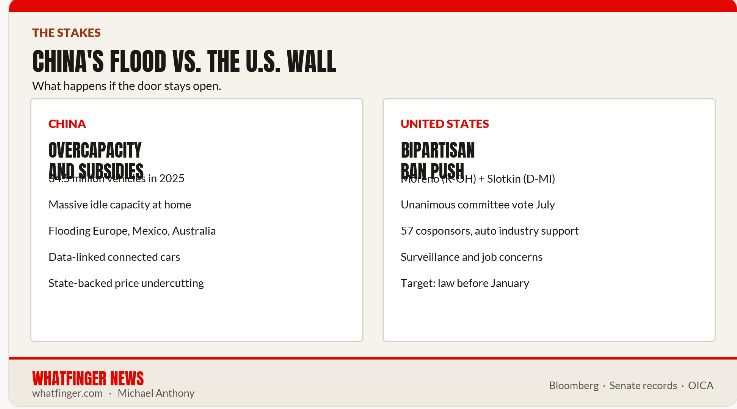
The bill would ban the import, manufacture, and sale of connected vehicles, software, and hardware linked to China, Russia, Iran, or North Korea. Software restrictions start with the 2027 model year; hardware follows in 2030. It gives the Commerce Department tools to block high-risk technology and sets penalties for violations.
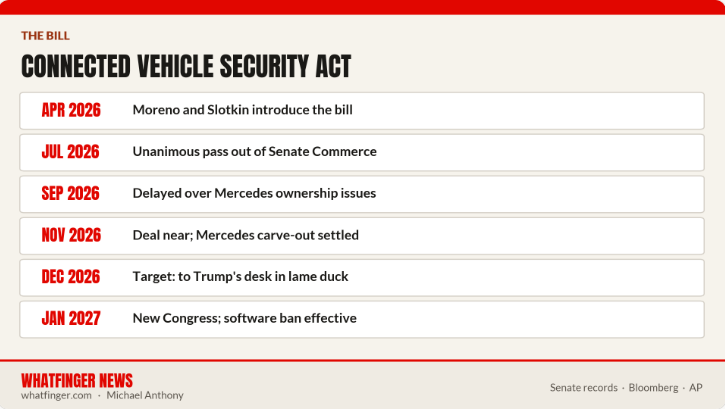
ZeroHedge framed it bluntly: this is one of the few things both parties from the auto states can agree on. The industrial heart of the country stays protected, or it gets flooded the way Europe has been. Lawmakers are racing the clock in the lame-duck session to put the wall in place while they still can.
More on protecting the industrial base and defense capacity at Whatfinger News Military War — militarywar.whatfinger.com
— The Whatfinger News Team: Sgt Alex and Sgt J, with Grok on edits and graphics
