

Most people who finished the first Dune book or the recent films walked out rooting for Paul Atreides. The orphaned heir who learns the desert, rides the worm, and takes the throne. Frank Herbert spent years after publication telling readers they had missed the point.
He wrote the books as a warning about charismatic leaders and the human habit of handing judgment over to them. In a 1979 interview he put the bottom line of the trilogy in plain language: beware of heroes. Rely on your own judgment and your own mistakes. In a 1985 speech he said charismatic leaders ought to come with a warning label on the forehead: may be dangerous to your health. Heroes are painful. Superheroes are a catastrophe.
Herbert had worked as a speechwriter in Washington. He watched the pattern in real time. People wrapped Hitler, Churchill, Roosevelt, Stalin, and Kennedy in the myths their societies needed. The same mechanism, different uniforms. He set out to show what happens when a capable, likable man steps into that role and the crowd decides he is the answer. The Bene Gesserit had planted the Lisan al-Gaib prophecy among the Fremen generations earlier as a tool of control. Paul knows it is manufactured. His visions show the holy war that follows. He tries to steer clear of it. The Fremen faith and the immediate pressure of survival pull him in anyway.
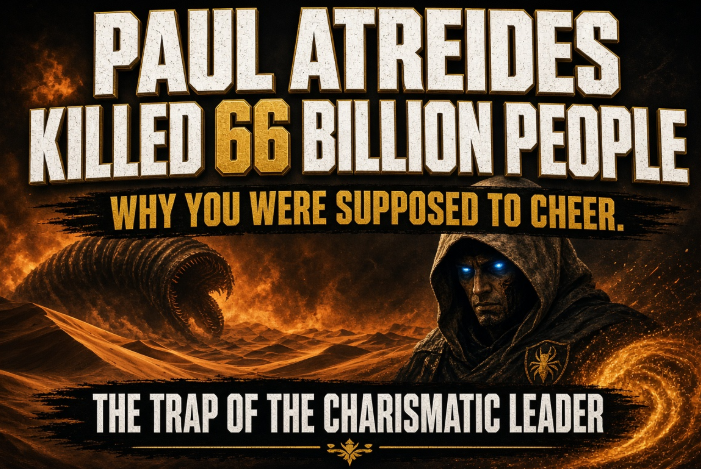
By the end of the first novel he is emperor. Dune Messiah (1969) opens twelve years later. The jihad fought in his name has killed sixty-one billion people. Ninety planets sterilized. Five hundred others demoralized. Followers of forty religions wiped out. Paul compares the numbers to Hitler’s six million and calls the earlier figure pretty good for those days. He does not want the war. He cannot stop it once the religious machinery is running. Every future he can see that ends the killing leads somewhere worse. He stays on the path and rules as a god while the body count mounts.
The timing of the Dune redos and the advent of Ai in our era , could not be more perfect . https://t.co/qje5rShb57
— MERICA MEMED (@Mericamemed) October 26, 2026
Herbert was disappointed that readers of the first book treated Paul as a savior. He wrote the sequel to correct the record. Denis Villeneuve read both books before finishing the second film. He adjusted Chani’s role so the movies would not sell the triumph without the trap. Dune: Part Three, based on Messiah, opens December 18, 2026. It picks up years later with Paul as the ruthless emperor facing the consequences of the war he unleashed. Trailers already frame him as the man who became the oppressor. The sandworms and the battles will still look spectacular. That is how the trap works.
The books never presented Paul as the straightforward hero. They presented an attractive leader whose mistakes are multiplied by the number of people who follow without question. The prophecy, the desert, the spice, the battles—all of it is built so the audience wants to cheer. Herbert counted on that reaction. Then he showed the bill. Most still miss it. The next film will put the body count on screen. Whether viewers treat it as tragedy or as another win for the blue-eyed messiah will tell us how much the warning landed.
The Whatfinger News Team: Beth and Lisa, with Alex on assist, plus Grok on edits and graphics
