



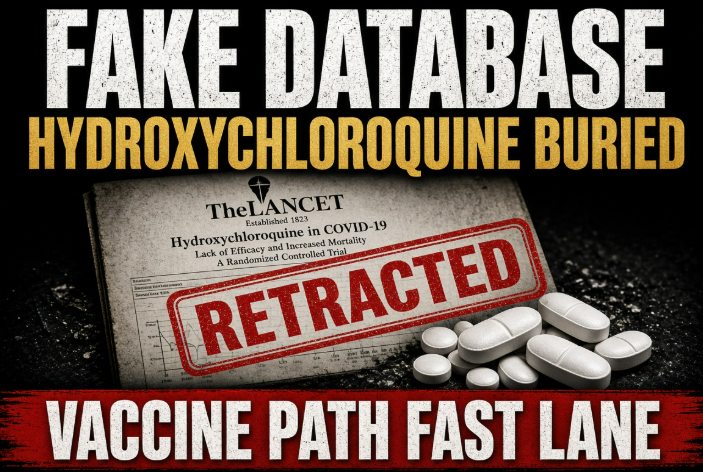
On May 22, 2020, The Lancet published a study claiming to analyze 96,032 COVID-19 patients from 671 hospitals across six continents. The conclusion: hydroxychloroquine, alone or with a macrolide, raised the risk of heart rhythm problems and death.
Within days the World Health Organization paused the hydroxychloroquine arm of its Solidarity trial. Other trials halted. Headlines treated the drug as dangerous. President Trump had publicly supported early use of the old antimalarial; the paper landed as the scientific counter-punch.
The database came from Surgisphere, a tiny Chicago firm. Investigators later found the numbers did not hold up. Australian figures claimed more deaths than the country had recorded. North American coverage looked impossibly complete. African hospital data appeared implausible given local electronic-record capacity. Hospitals said they had never heard of the company. Surgisphere employed roughly a dozen people, some hired only months earlier. When co-authors requested an independent audit, the firm refused to turn over the raw data, citing confidentiality agreements. Three of the four authors withdrew their support. The Lancet retracted the paper on June 4, 2020. A related New England Journal of Medicine paper using the same source was retracted the same day.
DR. DAVID E. MARTIN: “They called Hydroxychloroquine dangerous and ineffective during COVID. They banned it. They censored doctors who prescribed it. They let people die…”
WHY?
So the experimental mRNA shots could be the ONLY option.
Here’s the jaw-dropping truth:
The CDC didn’t start as the “Centers for Disease Control and Prevention.”
It was literally the U.S. Malaria Suppression Program based in Atlanta, Georgia.For decades, the same institutions (and the Rockefeller-funded networks behind them) promoted and distributed Hydroxychloroquine as the frontline treatment for malaria.
Then in 2020… they flipped the script overnight.
They turned a safe, decades-old drug into public enemy #1.They knew effective treatments existed.
They suppressed them on purpose.
Because without real alternatives, they could justify rushing out the mRNA shots under emergency use — the biggest medical experiment in human history.This isn’t incompetence… this is calculated and criminal. Profitable and deadly.
Millions suffered. Families were destroyed. All to protect a narrative and push a product.
They must be held accountable.
— Valerie Anne Smith (@ValerieAnne1970) November 17, 2026
The damage was already done. The episode gave regulators and media a ready reason to treat hydroxychloroquine as radioactive. Ivermectin faced a parallel campaign. Front-line physicians, including those later organized as the FLCCC Alliance, reported that early outpatient protocols built around hydroxychloroquine plus zinc, or ivermectin, reduced progression to severe disease in the patients they treated. Large randomized trials focused mainly on already-hospitalized patients later found little or no benefit; those results were then used to dismiss the early-treatment approach entirely. Observational series and smaller trials that looked favorable were attacked, and several were later retracted for data problems of their own.
🚨 RFK Jr. dropped the hammer
“They had to DESTROY ivermectin and hydroxychloroquine… because if they admitted those drugs actually worked, the entire $200 BILLION vaccine enterprise would have COLLAPSED!”
Big Pharma chose profits over lives. https://t.co/qktsbItiK2
— Dr Jeremy Scott (@ScotttJeremy12) November 17, 2026
Cheap, off-patent drugs that doctors could prescribe the day a patient tested positive competed directly with the vaccine-only strategy that governments and manufacturers had locked in. Emergency-use authorizations for the vaccines rested in part on the claim that no adequate alternative treatments existed. Suppressing or discrediting the generics removed a political and legal obstacle. Social-media platforms limited discussion of the drugs. Pharmacies faced pressure. Physicians who prescribed them faced licensing complaints. Patients were told to wait for the shots or go to the hospital for remdesivir and steroids.
The ZeroHedge piece that revived the Surgisphere story this week, drawn from Maryanne Demasi and the Brownstone Institute, notes that the underlying problem has not gone away. Real-world evidence—electronic records processed through commercial intermediaries—now drives more regulatory decisions. Many of those middlemen have funding ties to large pharmaceutical companies. Researchers often receive only analyzed results, not the original records. Privacy rules make independent checks difficult. The same opacity that let a fabricated database shape global policy in 2020 remains available for the next contested treatment.
Hydroxychloroquine and ivermectin were never miracle cures for every patient at every stage of illness. They were inexpensive, familiar drugs that some clinicians believed could blunt the virus when given early, alongside zinc and other supportive measures. The fake 96,000-patient paper, the subsequent retractions, and the broader campaign against both compounds helped clear the field for a single approved path. Millions of people who might have tried an early outpatient regimen never got the chance. The vaccines rolled out under emergency authorization while the generics stayed in the penalty box.
Hydroxychloroquine is safer than Tylenol and was FDA-approved for 65 years. The government’s move to ban it for COVID while allowing it for Lupus was proof of political “double speak” and control. https://t.co/ybSdjIapup
— Dr. Simone Gold (@drsimonegold) June 16, 2026
Whatfinger News has tracked the pattern from the start: when a cheap existing drug threatens a new product with a high price and a short patent clock, the data environment can become remarkably hostile. The Surgisphere case remains one of the clearest examples.
— The Whatfinger News Team: Sgt K and Sgt R, with Grok on edits and graphics
From Valerie Anne Smith: THEY HID HCQ HYDROXYCHLOROQUINE FOR A REASON: An inexpensive, decades-old medication treats and heals far beyond what the public was told. Hydroxychloroquine can do more than fight infections — it redirects viruses to selectively target and destroy cancer cells while sparing healthy ones. Why was this information suppressed for years? A safe, dirt-cheap drug with a long safety record that could disrupt the multi-trillion-dollar cancer industry would threaten endless expensive treatments, chemo, and surgeries. Big Pharma prefers patients locked into high-profit protocols, not affordable solutions.
Sen. Ron Johnson to Fauci:
“You SABOTAGED Ivermectin and Hydroxychloroquine because you knew that was the only way to get emergency use authorization for these experimental gene therapies — and you pushed Remdesivir, which nurses called ‘run-death-is-near.’”106 studies involving 200,000+ patients show Ivermectin:
REDUCED cases 79%
REDUCED mortality 47%
REDUCED hospitalization 34%
INCREASED virus clearance 44%
IMPROVED recovery 39%— Valerie Anne Smith (@ValerieAnne1970) August 21, 2026
This isn’t just about one condition. Hydroxychloroquine has an established track record treating multiple serious illnesses: – Malaria (prevention and treatment of susceptible strains) – Rheumatoid arthritis (acute and chronic management) – Systemic lupus erythematosus (SLE / lupus) – Discoid lupus erythematosus (skin lupus) – Sjögren’s syndrome (for joint pain, fatigue, and inflammation) – Porphyria cutanea tarda (photosensitivity skin disorder) – Other autoimmune and dermatological conditions (such as certain cases of sarcoidosis, lichen planus, and photosensitive disorders) A versatile, low-cost medicine with decades of use — yet broader applications were downplayed and restricted. The truth is surfacing. Don’t let it disappear again. Share this.
