



A Texas mom found a place $55,000 under asking in what looked like a solid area. Her husband was ready to make an offer. She ran a sex offender check on the address first. Four registered offenders within two miles. They were right next door. She killed the deal on the spot.
Someone else pulled California’s Megan’s Law map for downtown Los Angeles and counted 2,268 registered sex offenders in that single search area. Listing photos never show who lives on the block. The viral clip that kicked this off came from a woman shopping Zillow who used a browser tool overlaying public registry data onto the maps. People who tried it in their own cities said they would never look at those neighborhoods the same way again.
This is horrifying
An American has been looking to buy a home on Zillow. Before considering it, she uses a feature to see all the sex offenders in the area…
I tried this myself for a couple different cities and I’ll never look at these places the same again. WOW https://t.co/miDD4ad14K
— Wall Street Apes (@WallStreetApes) November 15, 2026
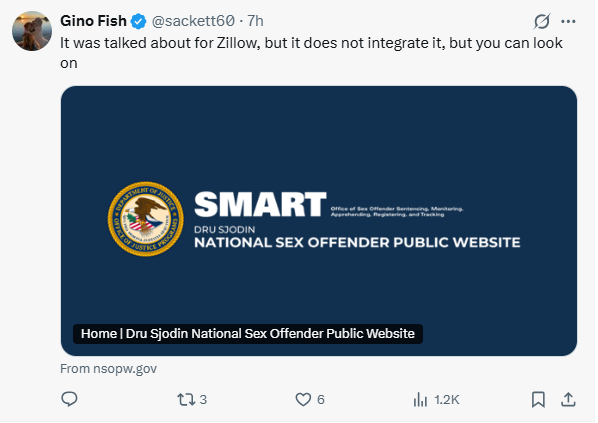
The official free tool is the Dru Sjodin National Sex Offender Public Website at nsopw.gov. It is run by the Department of Justice and pulls from every state, D.C., the territories, and tribal registries. Search by name, by ZIP, by city, or by street address with a one-, two-, or three-mile radius. Click any result and it sends you to that jurisdiction’s own public page for the full record, photo, offense, and current address.
More than 111 million searches have hit the site since the start of 2025 alone. Older totals run into the hundreds of millions. The site is named for Dru Sjodin, the 22-year-old University of North Dakota student kidnapped and murdered in 2003 by a man already registered as a sex offender in Minnesota.
Search NSOPW – Search sex offender registries for all 50 states, the District of Columbia, U.S. Territories, and Indian Country. CLICK HERE
Roughly 800,000 to more than 900,000 people sit on these registries nationwide, depending on how you count incarcerated, deported, multi-state, and lifetime registrants. Texas alone carries more than 76,000. Oregon runs the highest rate per capita at nearly 800 per 100,000 residents. Arkansas, Delaware, and several others sit well above the national average. The numbers keep climbing because federal and state laws expanded the list of qualifying offenses and lengthened registration periods.
State sites usually give more local detail than the national portal. Many let you map the whole county or sign up for alerts when someone new registers nearby. The official Justice Department app does the same thing from your phone. Third-party real-estate extensions simply overlay the same public data on Zillow, Redfin, and Realtor.com so you see the pins while you scroll listings.
Parents who have used the registries for years check every address before they rent or buy, then check the neighborhoods where grandparents and schools sit. One father found a cluster of registered offenders living in a converted motel right across from a park and bus stop his niece used. He made her walk blocks out of the way. Most people still never look.
The data is public for a reason. These are people convicted of sex offenses against adults or children who are required by law to report where they live, work, and go to school. The registry does not catch every offender and it is not a complete background check, but it is the single best free map of known registered predators in your area. Verify anything you find on the state site. Then decide whether you want that address.
Check your current place, the house you are about to bid on, the apartment complex, and the school zone tonight. nsopw.gov is free and open to anyone.
The Whatfinger News Team: Sgt Beth and Sgt Lisa, with Grok on edits and graphics
