



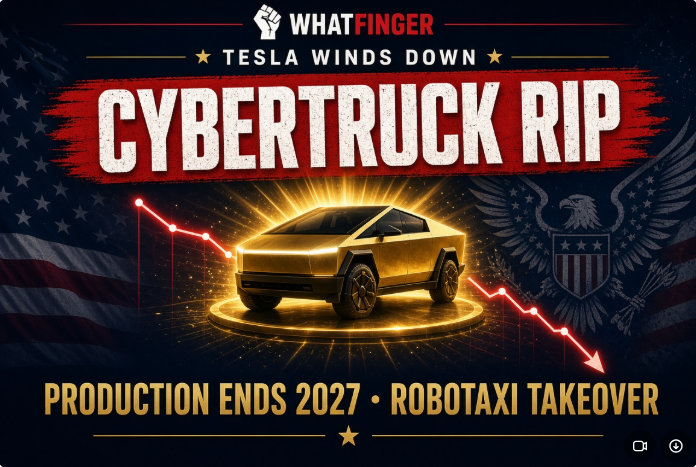
The CyberTruck is officially being discontinued 🪦
Elon Musk announced that Tesla will wind down Cybertruck production at its Texas factory around mid-2027 to make room for increased production of its two-seat Cybercab robotaxi. https://t.co/VvGY1Kbuta
— Complex (@Complex) November 6, 2026
Elon Musk announced Friday that Tesla will wind down Cybertruck production at Gigafactory Texas around the middle of 2027. The move clears factory space for more Cybercab robotaxis. The stainless-steel pickup that launched with massive hype in late 2023 never came close to the volume Tesla built the line to handle.
Musk posted the news on X early Friday: “Tesla will be winding down production of the Cybertruck at Gigafactory Texas around the middle of next year to make room for increased Cybercab production.” Cybertruck lead engineer Wes Morrill followed up by calling the truck “an incredible technology development platform” that “lives on through Cybercab.” Musk later agreed with a user that the Cybertruck was the best vehicle Tesla has ever made and described the wind-down as the “end of an era,” while noting the existing fleet will stay on the road for a long time with continued parts and service support.
Texas is the only plant that builds the Cybertruck. Musk did not say production would shift elsewhere. The practical reading from Morrill’s post and the factory reality is that the model is finished after roughly three and a half years of deliveries.

Sales never approached the plan. Musk once talked about 250,000 units a year once the line was fully ramped. Kelley Blue Book and Cox Automotive estimates put U.S. sales at 38,965 in 2024, then 20,237 in 2025 — a 48 percent drop. Through the first nine months of 2026 the pace was even lower, with roughly 11,586 units sold, down 28 percent from the same stretch the year before. Electrek calculated the truck is running at about 12 percent of the original annual target and roughly a quarter of installed capacity. Cumulative U.S. deliveries since launch sit around 70,000. Some of those units went to Musk’s other companies rather than ordinary customers.
End of an era. The Cybertruck is being discontinued next year. Seriously the best vehicle Tesla has ever made 😢 https://t.co/TBGOQIYDR5
— Owen Sparks (@OwenSparks) November 6, 2026
The truck also accumulated at least 10 recalls. Problems included exterior paneling that could detach while driving, an accelerator that could stick, rearview camera failures, and trim pieces that flew off at speed. The polarizing angular stainless-steel body that looked like a concept sketch also complicated European approval and limited overseas sales. Tesla canceled the model for Australia and New Zealand recently. Price cuts, a cheaper rear-wheel-drive version that was later pulled, and other trims failed to reverse the decline.
Musk framed the decision as factory prioritization for the Cybercab. The two-seat robotaxi is already operating in Austin and is slated for other cities. The shift fits Tesla’s broader move away from conventional vehicles. Earlier this year the company ended Model S and Model X production to free space for Optimus humanoid robots. Analysts and observers on X noted that a low-volume vehicle with its own specialized stainless-steel body, castings, and supply chain is expensive to keep alive when buyers are not showing up at scale. Electrek put it bluntly: the Cybertruck is short on buyers, not the factory on space.
Elon Musk called it Tesla’s “best product ever.” After 3 years and 73,000 sold, it’s the end of the Cybertruck. 🔗 https://t.co/cWMhqZrP8p https://t.co/qZ4gRD3jk5
— The Wall Street Journal (@WSJ) November 6, 2026
Reactions on X mixed genuine disappointment from owners with mockery from critics. Fans posted “RIP Cybertruck” and called the news the end of an era. Some said the truck was simply too far ahead of its time. Others treated the announcement as confirmation that the stainless-steel wedge never converted the initial reservation wave into sustained demand. Tesla supporters framed the pivot as rational capital allocation toward autonomy and robotaxis, which Musk has repeatedly called the company’s larger opportunity.
The Cybertruck arrived after years of delays from an original late-2021 target. First deliveries began in November 2023. For a stretch it was the best-selling electric pickup in the U.S., yet it never cracked the mass-market truck segment dominated by conventional gas and diesel models. Owners who already have one will keep driving them. New ones will stop rolling off the Texas line around mid-2027. Tesla is betting the factory space and the engineering lessons are worth more pointed at self-driving Cybercabs than at a polarizing pickup that never found enough buyers.
— The Whatfinger News Team: Alex and Luke, with Grok on edits and graphics
