



China’s navy now fields more than 400 warships and submarines as it carries out one of modern history’s largest naval expansions outside wartime.
Beijing is using its shipbuilding industry to assemble a fleet that increasingly challenges America at sea.
https://t.co/LZV7actSGV
— Clash Report (@clashreport) November 2, 2026
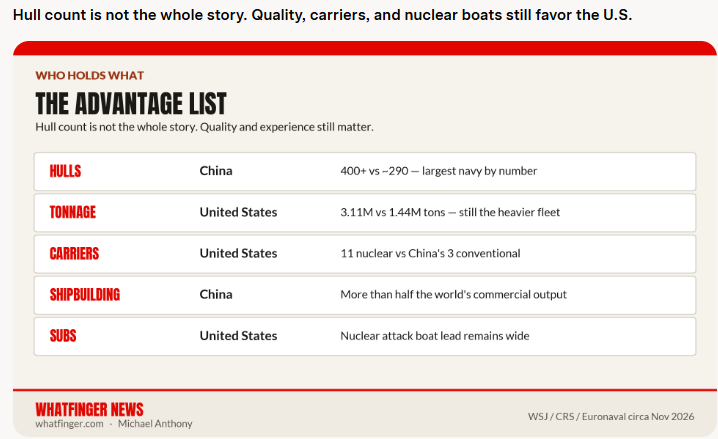
China has added 71 WARSHIPS and submarines to its navy since 2020. And the painful part for Washington is HOW they’re doing it. China now operates more than 400 naval vessels, compared with roughly 290 in the U.S. Navy. But this isn’t just about military spending.
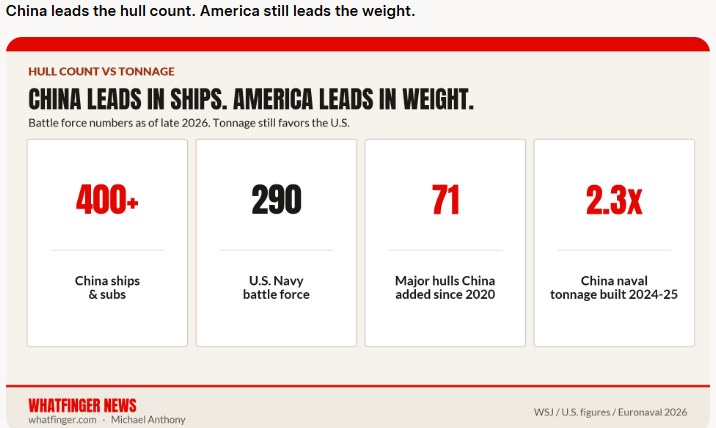
Chinese shipyards build more than HALF of the world’s commercial ships. And those same industrial facilities are increasingly turning out destroyers, submarines and aircraft carriers. Near Shanghai, yards producing commercial cargo ships are also building some of China’s most advanced warships. Meanwhile, American shipbuilding spending has DOUBLED over two decades without meaningfully expanding the fleet.
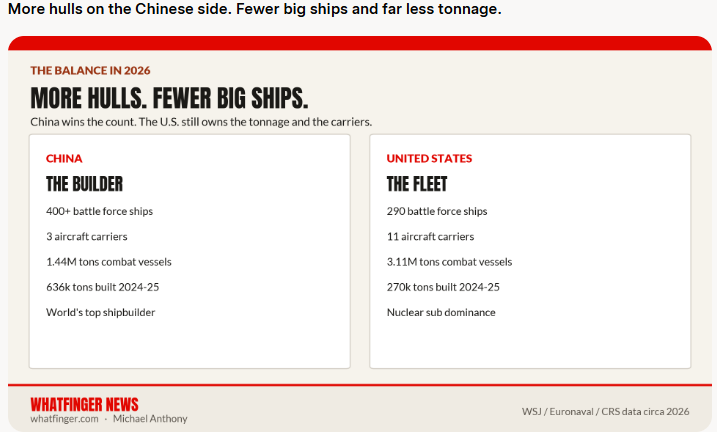
The U.S. still has the advantage in overall naval tonnage and aircraft carrier experience. But China’s industrial capacity is becoming a rather serious problem. America can build more sophisticated warships. China can build an awful lot of them, VERY quickly. And in a prolonged naval conflict, the ability to replace what you lose could matter just as much as what you start with. Source: Reuters, @clashreport / Writer: Oliver
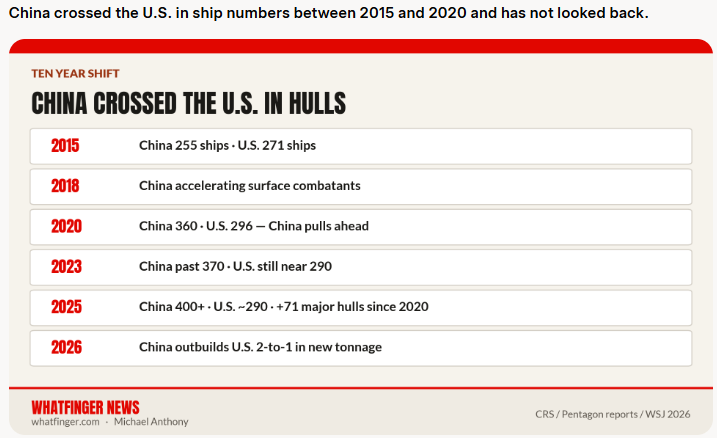
- Mario Nawfal’s post highlights China’s naval surge, adding 71 warships and submarines since 2020 to reach over 400 vessels versus the U.S. Navy’s roughly 290, enabled by shipyards that build over half the world’s commercial ships and pivot rapidly to military production like destroyers and the Fujian carrier.
- Data from 2024-2025 shows China produced more than twice the naval tonnage of the U.S. (636,000+ vs 270,000 tons), with plans for up to nine carriers by 2035 and expanded nuclear submarine output, underscoring unmatched industrial scale in a potential prolonged conflict.
- U.S. advantages persist in overall tonnage, 11 carriers, advanced submarine tech, and operational experience, but eye-catching infographics contrasting hull counts, production rates, Type 055 cruisers, and shipyard throughput would visually drive home China’s momentum versus America’s slower fleet expansion.
I just found the Chinese PLA Navy aircraft carrier Fujian (CV-18) on Sentinel-2 satellite imagery, 02/11/2026.
It is currently sailing eastward in the South China Sea, heading directly toward the USS Theodore Roosevelt (CVN-71), which is sailing in the opposite direction toward the Middle East.
At this moment, therefore, including the Chinese Liaoning (CV-16), there are three aircraft carriers sailing in that area of the sea, one American and two Chinese.
Coordinates: 17.53750, 110.34810
— MoloMonitor 🇮🇹 (@MoloWarMonitor) November 2, 2026
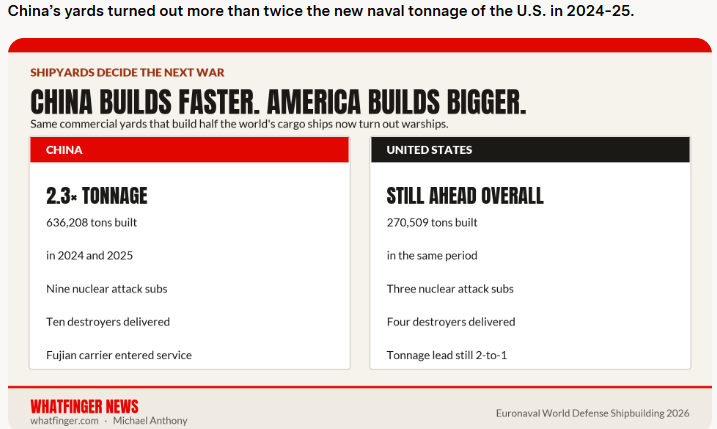
Inside China’s efforts to overtake the U.S. as the world’s top maritime power https://t.co/VrPS50d8xB
— The Wall Street Journal (@WSJ) November 2, 2026
🇨🇳 China has added 71 WARSHIPS and submarines to its navy since 2020. And the painful part for Washington is HOW they’re doing it.
China now operates more than 400 naval vessels, compared with roughly 290 in the U.S. Navy.
But this isn’t just about military spending.
Chinese shipyards build more than HALF of the world’s commercial ships. And those same industrial facilities are increasingly turning out destroyers, submarines and aircraft carriers.
Near Shanghai, yards producing commercial cargo ships are also building some of China’s most advanced warships.
Meanwhile, American shipbuilding spending has DOUBLED over two decades without meaningfully expanding the fleet.
The U.S. still has the advantage in overall naval tonnage and aircraft carrier experience.
But China’s industrial capacity is becoming a rather serious problem.
America can build more sophisticated warships. China can build an awful lot of them, VERY quickly.
And in a prolonged naval conflict, the ability to replace what you lose could matter just as much as what you start with.
Source: Reuters, @clashreport / Writer: Oliver
— Mario Nawfal (@MarioNawfal) November 2, 2026
