



On the night of August 17–18, Israeli jets hit the Abu al-Duhur military airbase in northwest Syria—runways, facilities, a site near Aleppo that Israeli officials say Turkey was preparing to use. Prime Minister Benjamin Netanyahu’s follow-up was one word, in English: “Don’t.”
That was not a tweet aimed at Damascus. It was a warning to NATO member Turkey: do not move south. Do not plant radar, air defenses, or troops closer to Israel. Israel says it will strike again if Ankara tries. The question hanging over the region is whether that red line can produce a war between Israel and a NATO ally. Turkey’s leader, who were affectionately call The Sultan of Turkey, here at Whatfinger News, seems intent on challenging Israel. But does he have the balls to move south as he planned? Article continues below this vid from ILTV
The strike and the message
Israel’s Prime Minister’s Office said Syria was on the verge of breaking a security “status quo” by allowing Turkish forces at the base. Jerusalem says it had warned Damascus repeatedly. Syria “chose to ignore these warnings.” Netanyahu later put it more bluntly: Israel will not tolerate a Turkish military buildup “that descends south because it threatens us.” The first warning, he said, was not heard. The airstrike was how Israel “made sure they understood it more clearly.”
Defense Minister Israel Katz went straight at President Recep Tayyip Erdoğan on X, accusing him of dragging Turkey into “dangerous adventures in Syria” and warning that Israel will not let any actor threaten its security. Israeli officials later said intelligence pointed to radar, air-defense systems, and Turkish commandos at the site—assets that could squeeze the Israeli Air Force’s freedom of action over Syria and toward Iran. The base sits well south of Turkey’s existing footprint in northern Syria and less than 200 miles from Israel.
Israeli Ambassador to the U.S. Yechiel Leiter called it a crossed red line, not a hunt for war: “We are not seeking escalation or war with either Turkey or Syria. But a red line was crossed.” He noted the imbalance Israel sees on the ground: a thin Israeli security zone in the south versus what Jerusalem describes as a much larger Turkish presence in the north.
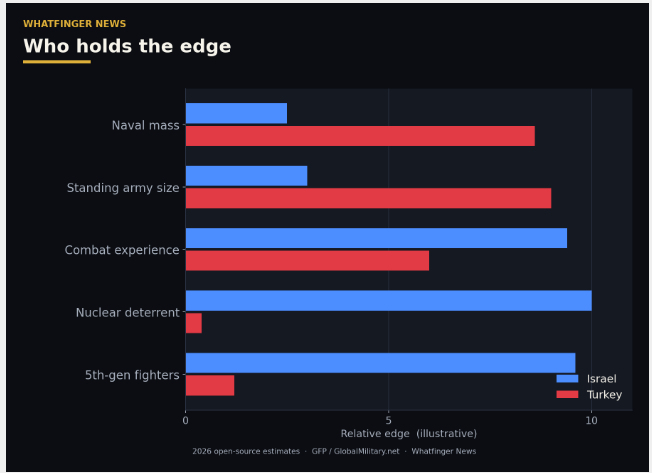
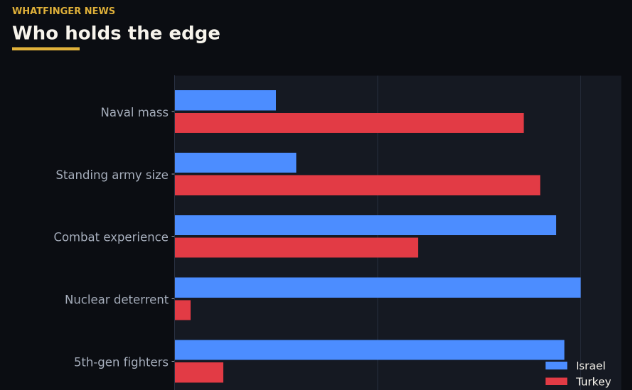
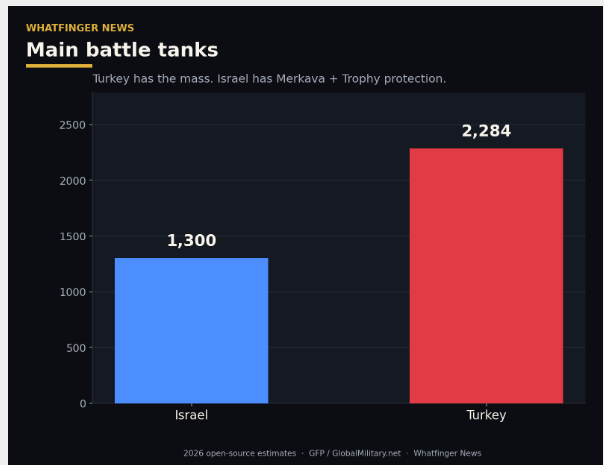
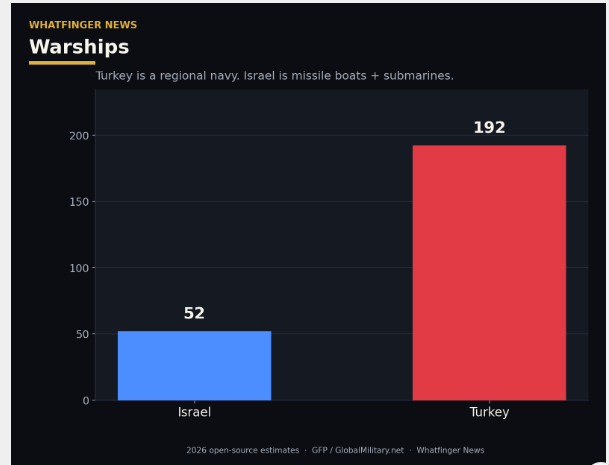
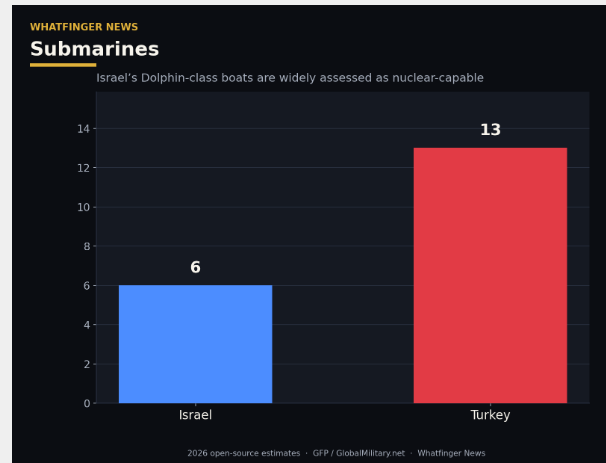
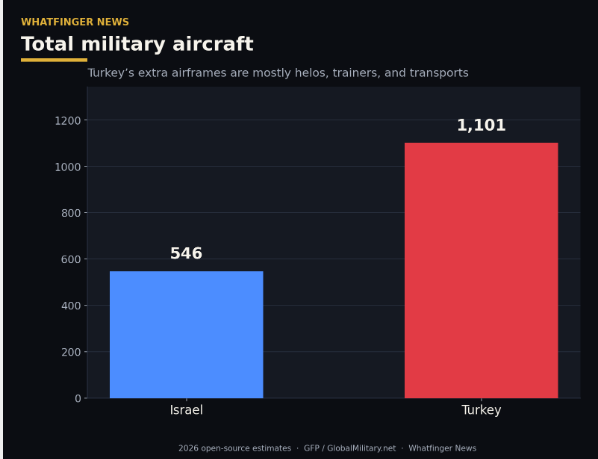
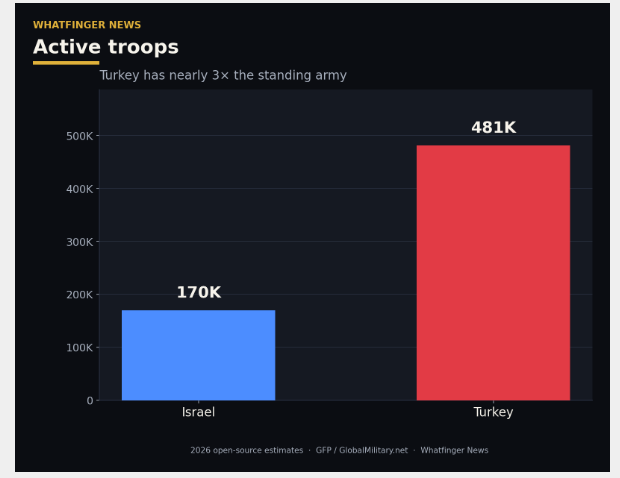
Turkey is bigger. Israel is sharper. That is the whole comparison — and it is why a Syria clash is dangerous without being a fair fight on paper.
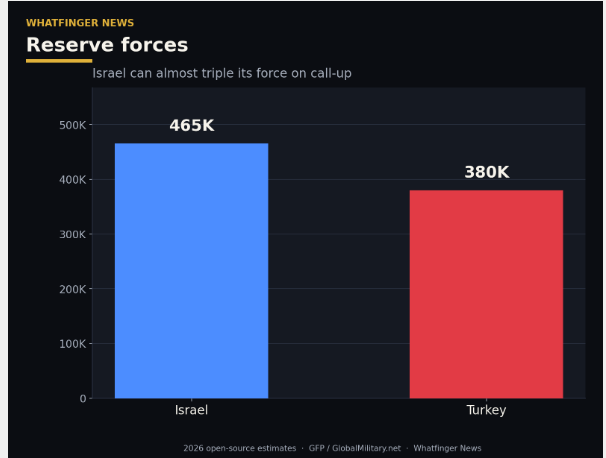
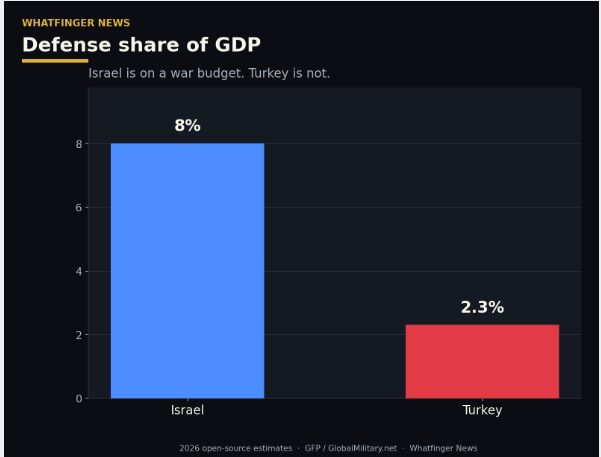
Blue is Israel. Red is Turkey. Figures are a 2026 open-source composite (Global Firepower + GlobalMilitary.net). Counts move by source; quality does not show up in a tank total.
The one-screen brief
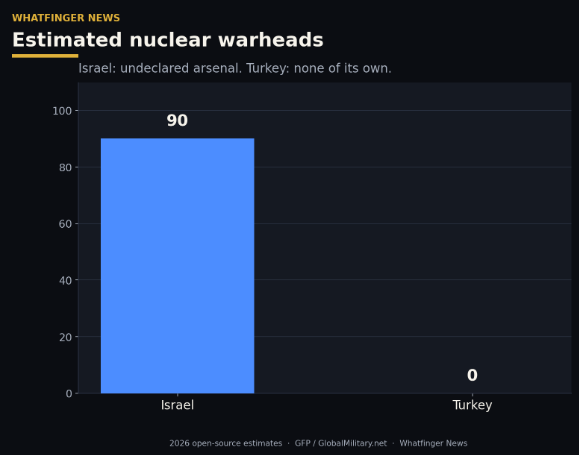
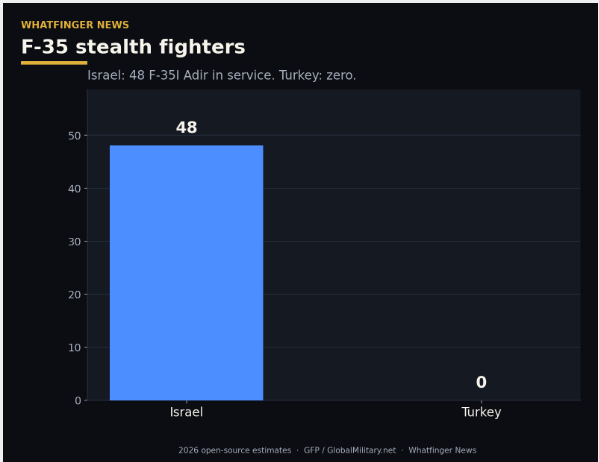
Israel spends more ($43B vs $31B) and a far larger share of GDP (8% vs 2.3%). Combat jets are nearly even (284 vs 299) — except Israel has ~48 F-35I Adirs and Turkey has zero fifth-gen fighters. Turkey has the standing army (481K vs 170K), the navy (192 hulls vs 52), the tanks (2,284 vs 1,300), and NATO’s Article 5 over its own soil. Israel has the reserve surge (465K), the undeclared nuclear stockpile (~90), and the air force that just cratered Abu al-Duhur.
What Turkey and Syria say
Ankara rejected the charges as “untenable allegations” meant to cover “unlawful” Israeli strikes and “expansionist” politics. Turkey’s presidency said it will keep cooperating with the Syrian government for stability and will not allow Syria to be destabilized. The Turkish Defense Ministry denied a military delegation was at the base before or during the raid and demanded Israel stop “reckless” attacks.
Syrian Foreign Minister Asaad al-Shaibani told Axios there was no plan for a Turkish base or a permanent Turkish force at Abu al-Duhur. He said Turkish officers had visited as part of training and military cooperation, and that the airfield was being rehabilitated for the Syrian Air Force. He said Israel had no legitimate justification for the bombing. Monitors and some Syrian officials, however, confirmed a recent Turkish military visit to the field.
A rare phone call days before the strike—Mossad chief Roman Gofman and Shaibani on August 14—centered on Turkish military activity in Syria, according to sources who spoke to Reuters. Israel says diplomacy failed. The bombs were the backup message.
Why Jerusalem treats a NATO army as a threat
This is not a sudden spat. Relations collapsed over Gaza. Erdoğan has praised Hamas, cut trade, and framed Turkey’s security as starting in Aleppo, Damascus, and Beirut. Israeli ministers have long said they will not accept Turkish entrenchment in Syria. After Assad’s fall, Israel’s old Iran-in-Syria problem was replaced by a new one: a large, hostile NATO army with air defenses, drones, and political cover, creeping south.
From Israel’s point of view, Turkish systems at Abu al-Duhur are not “reconstruction.” They are a lid on Israeli airpower and a forward base for a leader who talks about wiping Israel off the map. Katz and Netanyahu have made that the public line. On X and in interviews, Israeli officials keep repeating the same map: Turkey stays in the north; it does not march toward the Golan. IDF Chief of Staff Eyal Zamir visited forces in southern Syria after the raid and said Israel will not let a hostile force establish itself on the border.
U.S. envoy Tom Barrack—Washington’s man in Ankara and on Syria—called the strike an unnecessary escalation. He said Turkey was not warned in advance, Israeli aircraft approached Turkish airspace, and “calm heads” stopped a worse night. He later suggested the raid may have been “baiting” Turkey ahead of Israeli elections. Israel shot that down. Katz said the IDF recommended the strike on clear intelligence, Syria was warned, and Erdoğan was “caught with his hand in the cookie jar.”
Can NATO Turkey and Israel go to war?
Yes, a clash is possible. A full NATO war on Israel is another matter.
Article 5 covers an armed attack on a member. A strike on Turkish soil would give Ankara the strongest case to invoke collective defense. A fight between Israeli and Turkish units inside Syria is murkier. Turkish forces outside Turkey’s borders are not automatically “NATO territory.” Analysts and Israeli commentary have argued that a uniform does not export Article 5. That is why some reports say Israeli planners have studied how to hit Turkish-linked targets in Syria without handing Ankara a clean alliance trigger.
Even if Article 5 were invoked, NATO does not flip a switch and declare war. Each ally chooses how to help. The United States is bound to Turkey by treaty and to Israel by strategy, politics, and military partnership. A NATO-Israel war would require Washington to pick a side against its closest Middle East ally. That is why officials talk deconfliction, not doomsday. NATO Secretary General Mark Rutte has previously bet that Erdoğan is too experienced to let the situation “get out of hand.”
The danger is not a formal alliance war. It is a night like August 18 with less luck: Israeli jets near the Turkish border, Turkish radars lighting up, a commander who does not wait for “calm heads.” Barrack said Turkey could reasonably have scrambled. That is the path to a shooting incident neither capital claims to want.
Israel says it has no interest in escalation with Turkey or Syria—only in stopping a southward move. Turkey says it will keep working with Damascus. The U.S. is trying to build a deconfliction mechanism among Israel, Turkey, and Syria. None of that erases the new fact on the ground: Israel has already used force to veto a Turkish foothold, and it has said it will do it again.
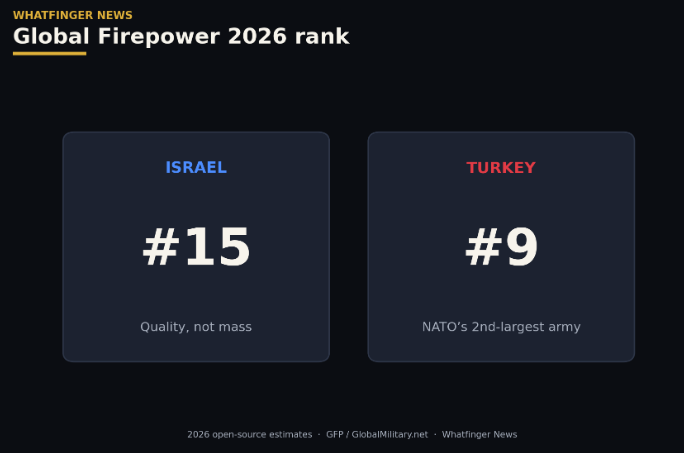
Erdogan still has NATO’s second-largest army, a long border with Syria, and a president in Washington who likes him. Netanyahu still has an air force that just cratered a runway and a political calendar that rewards looking tough. Red lines work until someone tests them twice.
On X, the argument is already binary: either Israel just blocked a Turkish march toward its border, or it picked a fight with a NATO member for votes. Both things can be true at once. The map does not care. If Turkish forces move south again, the next message may not be one word. It may be another crater—and a test of whether NATO treats Syria as a member’s battlefield or a place where two U.S. partners are on their own.
— The Whatfinger News Team: Sgt K and Sgt Pat
Resources
- Israel Warns Turkey: Stay Out of Syria or We’ll Strike Again – Dedicated Issues of Whatfinger News
- ‘Don’t’: Netanyahu says he warned Turkey before Israel struck Syrian base | The Times of Israel
- Israel strikes military airbase in Syria while warning Turkey | FDD’s Long War Journal
- Israeli warns Turkey against ‘dangerous adventures’ in Syria | Al-Monitor
- Israel struck Syria after Turkey ‘crossed a red line’, envoy to US says | The Jerusalem Post
- Israel claims strikes at Syrian military base deterred growing Turkish threat | The Jerusalem Post
- ‘We have no interest in escalation’: Israel says strike blocked Turkish military buildup | Ynet
- Israel’s Syria strike may have been bid to provoke Turkey conflict, US envoy says | Financial Times
- Could NATO go to war with Israel over Turkey? | Ynet Explainer
- Israel’s Syria strike was a warning shot to Turkey, and Erdoğan finally got it | Israel Hayom
- Israel Katz on X: warning to Erdoğan on “dangerous adventures” in Syria
Top Features and Vids across all Whatfinger sites right now
- Big Pharma Doctors Are Giving You the Exact Opposite Advice — Thanks to Their Rigid, Pharma-Protected “Standard of Care”
- This is pure insanity – group of blacks walking around the neighborhood in daylight, flashing guns, rifles…. WTF Chicago?
- TRAGIC: A young man lost his life at a shooting range when a gun accidentally discharged? Looks strange though? Suicide likely?
- Megyn Kelly on Kim Kardashian’s 13-Year-Old Daughter’s DISTURBING New Look in Magazine Photo Shoot
Get on over to Whatfinger.com – Whatfinger News does millions of pageviews a month for a reason…. Truth, Justice, the American way, plus news on the Left as well – all links from all sites gives you the true news. – CLICK HERE 🛑
Drudge Report Alternative


<span class="dsq-postid" data-dsqidentifier="149765 https://dedicatedissues.com/?p=149765">9 Comments
Pingback: Cities across America are ripping Flock Safety’s cameras off the poles – Dedicated Issues of Whatfinger News
Pingback: Young American men aren’t “soft.” A culture that treats their instincts as a problem, then wonders why they check out, is – Dedicated Issues of Whatfinger News
Pingback: New “No Rap” Policy at Milwaukee Bar Has BIacks Acting Like It’s a Civil Rights Emergency – Dedicated Issues of Whatfinger News
Pingback: ICE Ramps up Operations on Connecticut Streets, Arresting 50 in Danbury – Dedicated Issues of Whatfinger News
Pingback: ‘SCAM ON THE AMERICAN PEOPLE’: Lawmaker calls to get rid of H-1B visa program – Dedicated Issues of Whatfinger News
Pingback: ‘It’s official’: Trump signs order renaming Lake Ontario ‘Lake of America’ – Dedicated Issues of Whatfinger News
Pingback: Based dude SNEAKS camera inside mosque… Holy FREAKIN’ SH*T – Dedicated Issues of Whatfinger News
Pingback: It’s TRUE That Some Male Animals are Turning Into Female: “There’s SOMETHING in the Water” – Dedicated Issues of Whatfinger News
Pingback: Erdogan’s Ottoman Dream Meets Israel’s Reality: Turkey and Israel Are Headed for a Clash — and Nukes Are the Only Thing Holding Ankara Back – Dedicated Issues of Whatfinger News