


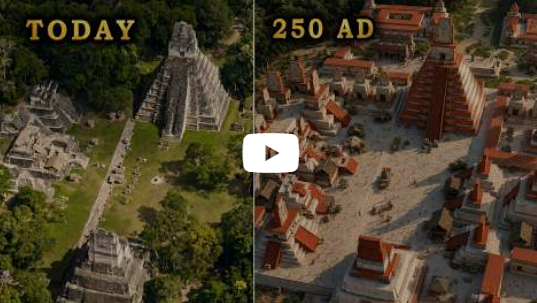

A fresh reconstruction video just dropped (above) that forces you to confront just how advanced the ancient Maya really were. “How Mayan Mega Cities Actually Looked: Maya Civilization” from Universe Inside You strips away the gray, overgrown ruins we see today and shows Tikal, Chichen Itza, and Palenque as they once stood: massive, brightly painted, cosmically aligned urban centers humming with tens of thousands of people.
These weren’t primitive jungle tribes waiting for European “civilization.” They were a sophisticated network of city-states that mastered astronomy, invented the mathematical concept of zero independently, engineered complex water systems, and raised pyramids that still dominate the landscape more than a thousand years later. And they did it without metal tools, without the wheel, and without draft animals. Pure human ingenuity, organization, and grit.
That’s the part the soft modern narrative often soft-pedals. The Maya prove what determined people can achieve when they focus on reality — stars, soil, seasons, and power — instead of endless grievance.
What the Maya Actually Built
At its height during the Classic period (roughly 250–900 AD), Maya civilization stretched across the Yucatán, Guatemala, Belize, and parts of Honduras and El Salvador. Tikal alone supported over 100,000 people across a sprawling complex of more than 3,000 structures. Its Great Plaza, temples, and acropolises were plastered in bright colors — red from hematite dominating — and aligned with solar and planetary cycles. Temple I (the Temple of the Great Jaguar) rose nearly 150 feet as a nine-tiered monument to the underworld and heavens.
Chichen Itza’s El Castillo is a stone calendar: 91 steps on each of four sides plus the top platform equal 365 days. On the equinox the shadow of a serpent descends the staircase. The Great Ball Court there remains one of the largest in Mesoamerica, tied to high-stakes ritual games that could end in sacrifice. Palenque’s Temple of the Inscriptions hid the tomb of Pakal the Great, complete with a jade mask and a sarcophagus lid that has fueled endless speculation (including fringe ancient-astronaut theories the video nods to without fully endorsing).
Think the Maya only built pyramids? They tracked Venus and eclipses, wrote history, farmed with skill, and faced drought, war, and strain. Complex history, not magic
Think the Maya only built pyramids? They tracked Venus and eclipses, wrote history, farmed with skill, and faced drought, war, and strain. Complex history, not magic. #Maya #Archaeology #History #Science pic.twitter.com/AQ8iuahcZ6
— Coffeetweet (@coffeetweet) August 16, 2026
They tracked Venus with precision, maintained interlocking calendars (the 260-day Tzolk’in, 365-day Haab, and the Long Count), and developed a hieroglyphic writing system capable of recording history, astronomy, and ritual. Only a handful of their bark-paper codices survived the Spanish burnings. Their engineers built reservoirs with multi-layer filtration using quartz, sand, and zeolite in places with no reliable rivers. Causeways (sacbeob) linked cities across the landscape.
All of this with stone tools — obsidian, jadeite, and chert harder or sharper than early metals in some applications — and human labor. Blocks were cut, moved with tumplines and levers, and set with lime mortars that sometimes incorporated natural rubber and tree saps for durability. No iron. No wheels for transport. No oxen. Just organization and will.
The Mysteries That Refuse to Die
For all we know, the biggest questions remain open.
The Classic Collapse. Between roughly 800 and 900 AD, the southern lowland cities emptied. Monument building stopped. Populations crashed. Droughts — some of the worst in 7,000 years according to lake-core data — hit hard. Warfare intensified. Elite legitimacy (kings claimed to mediate with the rain and maize gods) collapsed when the rains failed. Overpopulation and environmental strain from intensive agriculture played roles. No single smoking gun. It was a cascade of political failure, environmental stress, and violence. Northern centers continued longer, and the Maya people never vanished — millions of descendants still speak Mayan languages and live in the region today. The “disappeared civilization” myth is lazy. What happened was a sharp political and demographic contraction of the classic city-state system.
This is Tikal, one of the great cities of the ancient Maya. Around 2,000 years ago, its inhabitants were already filtering their drinking water. Researchers discovered that one reservoir used layers containing quartz and zeolite, a mineral that can remove contaminants from water. It is the oldest known use of zeolite for water purification anywhere in the world.
This is Tikal, one of the great cities of the ancient Maya.
Around 2,000 years ago, its inhabitants were already filtering their drinking water.
Researchers discovered that one reservoir used layers containing quartz and zeolite, a mineral that can remove contaminants from… pic.twitter.com/KAPch7M8zH
— Knowledge Czar (@knowledge_czar) August 16, 2026
Hidden scale. LiDAR has rewritten the map. A 2018 survey in Guatemala’s Petén revealed more than 60,000 previously unknown structures — houses, fortifications, causeways, and agricultural works — implying populations of 10–16 million across the lowlands at peak, far denser than earlier estimates. In 2024, analysis of older environmental LiDAR data in Campeche, Mexico, turned up the lost city of Valeriana and thousands more structures right next to a modern highway that locals and the government never formally recognized as a major site. Archaeologists keep saying the same thing: we have not found everything. Large areas remain unmapped.
How they built at that scale. Local limestone helped. Sophisticated knowledge of materials and labor organization did the rest. But the sheer volume of cut stone, the precision of alignments, and the hydraulic systems still impress modern engineers. The exact mix of techniques for the largest projects remains incompletely understood.
A MEXICAN tour guide explains that the ancient MAYAN civilization built in areas that utilize sound waves, centered deep, surrounded by higher structures and buildings. Surround sound. This is similar to inside Music Halls, Churches, etc. But outside like FOOTBALL stadiums.
A MEXICAN tour guide explains that the ancient MAYAN civilization built in areas that utilize sound waves, centered deep, surrounded by higher structures and buildings.
Surround sound. This is similar to inside Music Halls, Churches, etc. But outside like FOOTBALL stadiums. pic.twitter.com/wXVhB7S4z6
— Cornbread Mafioso 🖕🏾 (@Soulful1865) November 18, 2023
The Red Queen. In Palenque’s Temple XIII, archaeologists found a woman in her 50s or 60s covered in cinnabar, wearing a malachite mask and jade ornaments, with sacrificed attendants. DNA showed she was not related by blood to Pakal the Great. Most researchers now identify her as his wife, Tz’akbu Ajaw (Lady Tz’akbu Ajaw), who married him in 626 AD and died in 672. But without inscriptions in her tomb and without DNA from confirmed sons for final comparison, a residual uncertainty lingers.
Other open questions include the full extent of early monumental construction (sites like Aguada Fénix push organized building back toward 1000 BC), the precise function of certain towers and E-Groups, the complete recipe history of the famous Maya Blue pigment (lost for centuries and only reconstructed in modern labs), and how much ritual and astronomical knowledge died with the codices.
Lessons Written in Stone
The Maya were not noble savages or mystical aliens. They were ambitious, hierarchical, warlike, scientifically capable, and ultimately vulnerable to the same forces that break societies: prolonged environmental stress, elite failure to deliver results, escalating conflict, and loss of legitimacy. Their achievements stand as a rebuke to any ideology that treats technological progress or complex society as uniquely Western or modern. Their collapse is a warning against assuming stability is permanent.
Watch the reconstruction video. The cities look alive again — red-plastered, crowded, oriented to the sky. Then remember that most of what they built still lies under jungle or farmland, waiting for the next LiDAR pass or determined expedition. History is not a closed book. The Maya still have secrets, and the ground is still giving them up. Join us over at Whatfinger News, where we explore ancient civilizations as well as tackle current events, politics and news.
— The Whatfinger News Team: Sgt L and Alex
Resources
- How Mayan Mega Cities Actually Looked: Maya Civilization
- What really caused the collapse of the Maya civilization? | National Geographic
- Everything we thought we knew about the ancient Maya is being upended | National Geographic
- Laser Scans Reveal 60,000 Hidden Maya Structures in Guatemala | Smithsonian Magazine
- Laser scans locate previously unknown Maya city hidden in a Mexican rainforest | Science
- Lost Maya city discovered in Mexico | CNN
- Have we found all the major Maya cities? Not even close, new research suggests | Antiquity
- Maya Tomb of the Unknown Red Queen | National Geographic
- Solving the Mystery of the Maya Red Queen | Mexicolore
- How did the ancient Maya build their pyramids? | Mexico News Daily
- Rubber and tree sap: How ancient Maya cities have withstood the ravages of time | BBC Future
- Mayan Mysteries: Unsolved Riddles of the Ancient Maya | Mayan.org
Top Features and Vids across all Whatfinger sites right now
-
- Kayleigh Mcenany can’t believe what’s written on the teleprompter. – Liberal Hivemind Vid
- Florida man just casually walked away with a full Flock surveillance camera… still bolted to a 12-foot pole… while draped in the American flag
- Massive 660 Pound Tuna Causes Chaos as It Surges Toward Swimmers in Spain – Clip
- The Democratic Party Has Been Captured by Communists – And They’re Out to Torch the Constitution Right in Front of Our Faces
- Whatfinger: The Fire Returns – Sgt Pat and Beth

Get on over to Whatfinger.com – Whatfinger News does millions of pageviews a month for a reason…. Truth, Justice, the American way, plus news on the Left as well – all links from all sites gives you the true news. – CLICK HERE 🛑
Drudge Report Alternative