



That’s not speculation—it’s the latest proof that Beijing watches every American breakthrough and tries to reverse-engineer it. ZeroHedge reported this week that state-owned Chongqing Jianshe Industry filed a patent for a multi-barrel hemispherical array that looks suspiciously like the sub-second detect-to-fire system from Picket Defense Systems.
The American design is elegant and lethal: a fixed multi-barrel hemispherical array with no turret slewing delay. Sub-second sensor-to-shooter cycle. No dead zones. No blind spots. It fires the optimal barrel already pointed roughly at the threat. Perfect for the nightmare scenario of drone swarms hitting from multiple directions at once. China’s version uses multiple barrel assemblies sharing a propellant chamber, spherical projectiles, and spring-fed mechanisms so it can theoretically shoot several directions simultaneously. Same problem, same basic solution—except one is American innovation and the other is a copy.
This is the new arms race. Cheap, mass-produced drones have broken traditional air defense economics. A $500 FPV or a $20,000 Shahed can force a defender to spend $50,000–$100,000+ on a missile. Nations that solve the cost-exchange ratio win. Here’s where the top players actually stand in mid-2026. The Chinese need only to steal our tech, then they can mass produce and outproduce the U.S. in every way.
US Lockheed Martin Unveils MORFIUS — The Drone Killer Built to Take Down Swarms
🇺🇸 BREAKING: US Lockheed Martin Unveils MORFIUS — The Drone Killer Built to Take Down Swarms
Lockheed Martin says its MORFIUS™ high power microwave system can neutralize more than 50 enemy drones in a single flight.
Instead of firing an interceptor at every target, MORFIUS… pic.twitter.com/A8xvwUsRTl
— Defence Index (@Defence_Index) August 14, 2026
America: Layered, AI-Driven, and Finally Scaling
The United States is building the most sophisticated counter-UAS architecture on Earth—when the bureaucracy gets out of the way. At Whatfinger News we highlight them all so be sure to come back daily for more.
- Picket Defense Systems’ Inferno RTC / dome array: The system China is copying. Fixed multi-barrel hemispherical coverage delivers true sub-second engagements with zero slewing lag. Ideal for fixed-site or high-value asset defense against saturation attacks.
- Epirus Leonidas (and new HAVOC variant): High-power microwave that fries drone electronics. Demonstrated defeating 49 drones with a single pulse. Effective against fiber-optic controlled FPVs that laugh at jamming. Current effective range against small drones is roughly 2 km (GEN II aims to double it). Cost per engagement is electricity—single digits to low tens of dollars. Marine Corps just awarded an $11 million contract for the vehicle-mounted HAVOC evolution.
- Anduril Lattice + Anvil + Roadrunner: AI command-and-control backbone now under a massive Army enterprise contract (up to $20 billion ceiling). Anvil is the low-collateral kinetic interceptor for Group 1-2 threats; Roadrunner is the reusable/jet-powered higher-end option. Lattice fuses sensors and effectors across services and even law enforcement. This is the “Moneyball” approach Palmer Luckey promised.
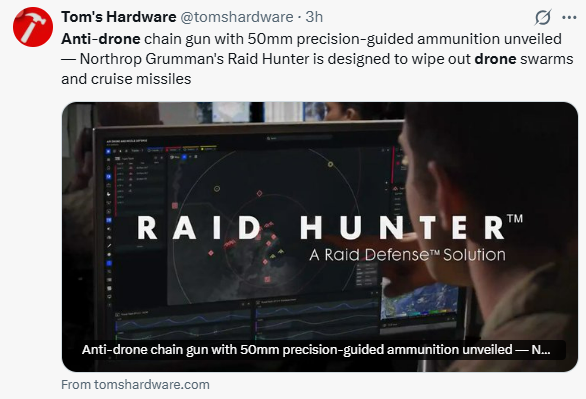
- Northrop Grumman Raid Hunter: New chain-gun system specifically marketed for critical infrastructure against swarms with precision-guided gunfire.
- Supporting cast: Coyote interceptors, various gun systems (including AI-aimed “Bullfrog”-style robotic guns), and a growing directed-energy portfolio.
American strength is the full kill chain—detection, AI decision-making, and mixed effectors (microwave for swarms, kinetic for precision, guns for magazine depth). The weak point has been procurement speed. That is changing under pressure from real-world threats.
Israel: Combat-Proven Lasers and Layered Reality
Israel remains the gold standard for operational experience. Iron Beam (Or Eitan) is a ~100 kW-class high-energy laser integrated with the Iron Dome network. Range against small drones and rockets is publicly cited around 7–10 km. Marginal cost per shot is a few dollars of electricity. First systems were delivered in late 2025; combat use against drones and rockets has occurred, though full battery density and maturity are still scaling.
Drone Dome provides the RF detection/jamming layer with optional laser hard-kill. Israel’s edge is not raw technology—it’s the daily feedback loop from actual threats. They treat every engagement as a data point and iterate faster than anyone else.
China: Volume, Directed Energy, and Theft
China is throwing everything at the wall: lasers (Silent Hunter, OW5-A50 50 kW, Guangjian-21A shoot-on-the-move, even backpack Lijian systems claiming 500 m range), high-power microwaves (Hurricane 3000 claimed >3 km), guns, and now the direct copy of the American dome concept. They parade systems and claim world-leading performance. Reality is harder to verify. Weather sensitivity of lasers, power generation logistics, and actual combat reliability against modern swarms remain open questions. Quantity has a quality of its own, and the PLA is fielding a lot of it.

United Kingdom: DragonFire Coming Online
The UK’s DragonFire 50 kW-class laser has demonstrated the ability to shoot down high-speed drones (including above-horizon engagements) and is scheduled for Type 45 destroyers by 2027. Cost per shot is roughly £10. Accuracy claims include hitting a coin-sized target at 1 km. It is Europe’s most serious directed-energy program and will give the Royal Navy a deep magazine against cheap threats without burning expensive Aster missiles.
Russia: Attrition and Adaptation Under Fire
Russia relies heavily on Pantsir (including the new SMD-E mini-missile variants optimized for drones) and Tor systems, plus massive electronic warfare. Lasers and microwaves exist in prototype or limited form (Perun claims, Chinese Silent Hunter reportedly present). The problem is attrition: Ukrainian drones keep killing expensive air-defense batteries. Moscow is responding with more automated close-in guns (Zubr) and EW, but the cost-exchange ratio still favors the attacker. Quantity of SAMs is high; efficiency against mass FPV and loitering munitions is not.
The Numbers That Matter
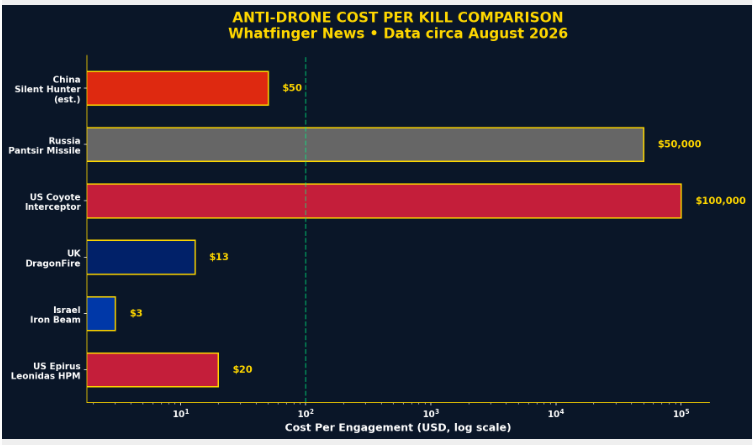
Cost per kill is the decisive metric. Directed-energy and microwave systems collapse the economics. Kinetic interceptors and traditional missiles do not.
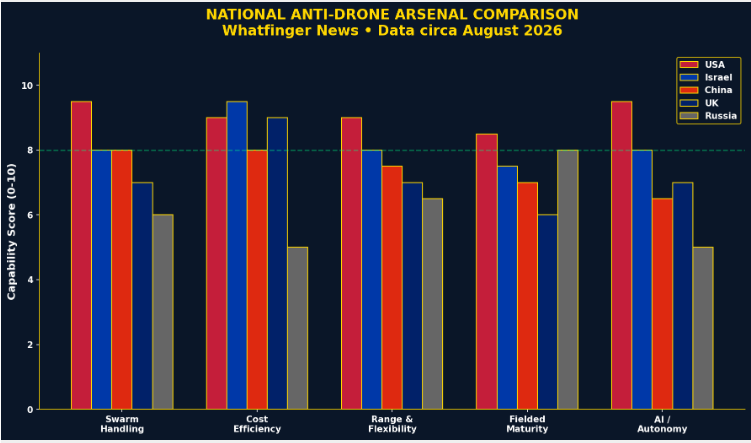
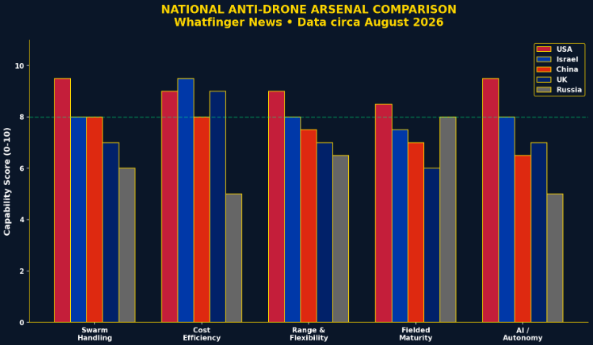
The United States leads on swarm handling and AI autonomy. Israel leads on proven cost efficiency and combat feedback. China competes on scale and directed-energy volume. The UK is rapidly closing the laser gap. Russia is fighting a defensive war of attrition.
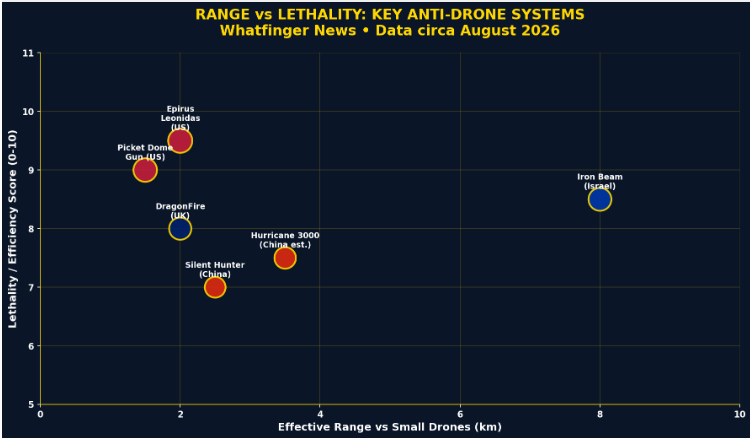
Range versus lethality/efficiency shows the trade-offs. High-power microwaves and the new American dome concepts score high on efficiency against saturation attacks even at shorter ranges. Lasers offer longer reach when weather and power allow.
Bottom Line
Drone swarms are the new artillery. The side that can defeat them cheaply and repeatedly owns the low-altitude sky. America has the best overall toolbox—AI command systems, microwave swarm killers, reusable interceptors, and now the sub-second dome gun that China felt compelled to copy. The limiting factor has never been American ingenuity. It has been will, speed of procurement, and domestic manufacturing capacity. As we have been saying for many years here at Whatfinger.com, hire ethnic Chinese at your company, and you will be ripped off, as these folks have no choice but to steal if they have family back in China. The CCP expects them to do their part, so all high tech is stolen from us. We built China and all of their tech.
Trump-era priorities on securing the industrial base, tariffs on Chinese drones and components, and rapid fielding of systems like Leonidas, Anduril’s suite, and the Picket concept are exactly the correct response. Allies (Israel and the UK) are serious partners. China is a determined copycat. Russia is learning the hard way that Soviet-style mass has limits against cheap, attritable threats.
The next two years will determine whether the United States locks in a decisive advantage or lets the window close. The technology is ready. The question is whether Washington treats this like the emergency it is.
— The Whatfinger News Team: Sgt Pat and Sgt K
Resources
- China Copies America’s Futuristic “Sub-Second Detect-To-Fire” Anti-Drone Swarm Dome Gun
- “Sub-Second Detect-To-Fire”: Futuristic Dome Turret Could Be US Military’s Answer To Drone Swarms
- Marine Corps awards Epirus $11M for high-powered microwave program
- Epirus Leonidas high-power microwave details and testing
- Israel’s Iron Beam laser status and cost claims
- UK DragonFire laser on track for 2027 Type 45 deployment
Top Features and Vids across all Whatfinger sites right now
-
- Well.. That ended quickly 😂
- Based dude SNEAKS INSIDE… Immediately finds VOTER FRAUD.
- Officer Screams Like ‘Little Girl’ Demonstrating ICE’s New Shock Gloves
- Fool Democrat Mayor Jacob Frey at the ‘Black Entrepreneur State Fair’ in Minneapolis. Brutal watch. Clips
- Always Ripping People Off Now? Walmart exposed AGAIN for shorting their product weights, this time with their Great Value bacon
Get on over to Whatfinger.com – Whatfinger News does millions of pageviews a month for a reason…. Truth, Justice, the American way, plus news on the Left as well – all links from all sites gives you the true news. – CLICK HERE 🛑
Drudge Report Alternative